
Entry
Reader's guide
Entries A-Z
Subject index
Legume Crops
Legumes are plants in the botanical family Fabaceae, which is also called Leguminosae, or the pea family. Legumes are the second-largest family of flowering plants, with between 14,000 and 17,000 species and as many as 18,000 species that belong to the pea family, with the Composite family being the largest. The Latin origin of the term legume (legumen) is the verb for “to gather,” reflecting the fact that the seed pods of the plants are gathered for food.
The “fruit” of legumes is a seed pod. The seeds (pulses), such as a pea, a bean, or the peanut, split into two valves. The seeds are attached to one edge of the valves. The pod or the seeds are used as food. They include a variety of common and broad beans, as well as acacia, alfalfa, carob, clover, cowpeas, lentils, lupines, mesquites, mimosa, peas, soybeans, tamarind, and peanuts.
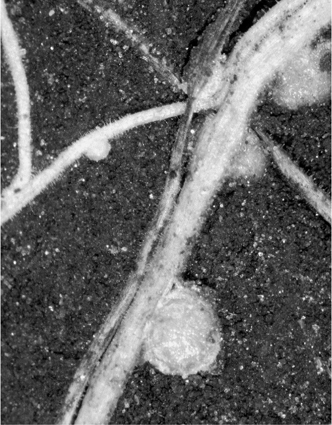
The photo shows the small (2 mm) nodules on the roots of a legume plant where the beneficial bacteria rhizobia establishes itself and helps the plant procure nitrogen from air.
Legumes can be found in much of the world and vary so widely that it is often only the trained botanist who recognizes them as legumes. There are three subfamilies of Fabaceae or legumes (Caesalpinioideae, Mimosoideae, and Papilionoideae), all of which produce root nodules. Some are trees, and others are shrubs, herbs, or climbing plants. Papilionoideae are legumes that have flowers that look like butterflies. The sweet pea is a member of this group. The flowers vary from small to large and from regular to irregular.
The ability of legumes to fix nitrogen in the soil makes them an important natural fertilizer. Nitrogen is a gas that makes up much of the Earth's atmosphere. However, it is relatively inert, which creates a problem for soil fertility. Without nitrogen, the fertility of soil is low. Violent lightning can create nitrogen compounds in the atmosphere that can wash into the soil to fertilize it. Much more effective are the legumes that can fertilize the soil by fixing atmospheric nitrogen. The roots of these legumes take in nitrogen from the air with the aid of a beneficial bacterium.
Legumes have a unique relationship with the bacteria rhizobia, which are soil bacteria. They fix nitrogen (diazotrophy) after the bacteria becomes established in the root nodules of legumes. It is a symbiotic relationship: The rhizobia cannot independently fix nitrogen; they can only do so through a host plant. The rhizobia are usually gram-negative, motile, and nonsporulating rods.
Humans have been growing and gathering legumes for around 8,000 years. Where meat is in short supply, legumes make an excellent source of protein. Legumes such as beans are usually eaten by cultures that depend on rice or corn as their main food; combined, legumes and grains provide a nearly complete diet.
Globally, legumes such as peas, beans, and peanuts are very important economically as foods. The legumes alfalfa, clover, and vetch are grown for animal feed in forage or pasture. Many other legumes are valuable in making edible oils, flavors, fibers, gums, fibers, oils, medicines, dyes, poisons, and timber. Some are used naturally, and others are chemically processed and synthesized into plastics or other products. Some are used as ornamentals.
...
- Food Challenges
- Animal Welfare
- Beyond Organic
- Cheap Food Policy
- Crop Genetic Diversity
- DDT
- Debt Crisis
- Disappearing Middle
- Export Dependency
- Famine
- Farm Crisis
- Fast Food
- Food Processing Industry
- Food Safety
- Food Security
- Genetically Modified Organisms
- Grain-Fed Beef
- High Fructose Corn Syrup
- Integrated Pest Management
- Irradiation
- Mad Cow Disease
- Malthusianism
- Mechanization
- Millennium Development Goals
- Modernization
- Nitrogen Fixation
- Organochlorines
- Origin Labeling
- Peasant
- Pesticide
- Productionism
- Proletarianization
- Recombinant Bovine Growth Hormone
- Roundup Ready Crops
- Salmonella
- Sewage Sludge
- Soil Erosion
- Sustainable Agriculture
- Swidden Agriculture
- Weed Management
- Food Economics and Trade
- Food Farm and Industry
- Agrarian Question
- Agrarianism
- Agribusiness
- Agricultural Commodity Programs
- Agricultural Extension
- Agrodiversity
- Agroecology
- Agrofood System (Agrifood)
- Aquaculture
- Biodynamic Agriculture
- Biological Control
- Bt
- Composting
- Confined Animal Feeding Operation
- Contract Farming
- Cooperative
- Corn
- Cover Cropping
- Crop Rotation
- Dairy
- Dioxins
- Factory Farm
- Family Farm
- Fertilizer
- Fruits
- Grazing
- Hunting
- Intercropping
- Irrigation
- Legume Crops
- Low-Input Agriculture
- Meats
- Nanotechnology and Food
- Organic Farming
- Plantation
- Rice
- Salmon
- Seed Industry
- Soil Nutrient Cycling
- Soybeans
- Substitutionism
- Sugarcane
- Urban Agriculture
- Vegetables
- Wheat
- Yeoman Farmer
- Food Laws, Agreements, and Organizations
- Archer Daniels Midland
- California Certified Organic Farmers
- Certified Humane
- Certified Organic
- Codex Alimentarius
- Commons ConAgra
- Department of Agriculture, U.S
- Diamond v. Chakrabarty
- Doha Round, World Trade Organization
- Fair Labor Association
- Fair Trade
- Farm Bill
- Federal Insecticide, Fungicide, and Rodenticide Act
- Food and Agriculture Organization
- Food and Drug Administration
- Food First
- Food Justice Movement
- Food Quality Protection Act
- Food Sovereignty
- Institute for Agriculture and Trade Policy
- International Coffee Agreement
- Land Grant University
- National Organic Program
- North American Free Trade Agreement
- Northeast Organic Farming Association
- Ogallala Aquifer
- Public Law 480, Food Aid
- Sustainable Fisheries Act
- United Farm Workers
- Wal-Mart
- Foods and Lifestyle
- Loading...
Get a 30 day FREE TRIAL
-
 Watch videos from a variety of sources bringing classroom topics to life
 -
Read modern, diverse business cases
-
Explore hundreds of books and reference titles

Read next

More like this
Sage Recommends
We found other relevant content for you on other Sage platforms.
Have you created a personal profile? Login or create a profile so that you can save clips, playlists and searches