
Entry
Reader's guide
Entries A-Z
Subject index
Irradiation
Food irradiation involves exposing food to shorter-wavelength ionizing radiation in the form of gamma rays, X-rays, or electron beams as an alternative means of preservation to more traditional methods such as canning. Small doses of irradiation can inhibit food properties such as sprouting or ripening, and larger doses can genetically alter or kill insects and microorganisms that lead to spoilage or human diseases. Irradiated food does not change in terms of appearance, smell, taste, or texture. Nutritional losses during the irradiation process are minimal and are either lower than or equal to nutritional losses from methods such as cooking or freezing. Food irradiation products or facilities can be found in over 30 nations worldwide, including the United States, Canada, Japan, China, Russia, the Netherlands, Belgium, France, and South Africa. Irradiated food does not play a significant role in the U.S. food industry, although research and development are expanding.
The discovery of radioactivity in the late 19th century led to scientific research into its effects and potential uses. French scientists determined in the 1920s that irradiation could be applied to food preservation. The United States did not pursue food irradiation studies until World War II, when the U.S. Army began experimenting with it to meet the challenges of feeding a large military force. Food irradiation is particularly useful in preservation, but it is also used to control sprouting, ripening, mold growth, insect damage, and microorganism control. Food irradiation at higher dosages is used for the sterilization of food for space travel or for hospital use in patients with compromised immune systems. Irradiated foods are still considered perishable, even though their shelf life is extended. Food irradiation at dosages used for consumer products does not sterilize food, so refrigeration and proper food handling and preparation guidelines must still be followed.
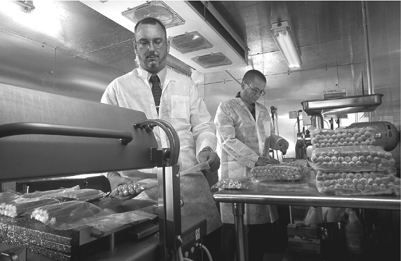
These biologists with the U.S. Department of Agriculture's Agricultural Research Service are preparing to irradiate hotdogs packaged in plastic as part of an experiment.
Food irradiation facilities are expensive to build but are generally considered safe. They house electron-accelerator machines that create beams of electrons. The most common source of radiation used in the process is cobalt-60, which is inside a steel casing in a lead-lined chamber. Conveyor belts carry the food through this chamber to complete the irradiation process. The amount of radiation absorbed by food during the irradiation process is known as a dose, which is measured either in the older form of rads or the newer form of grays. The U.S. Food and Drug Administration (FDA) measures doses in kilograys. Irradiation is a cold process, meaning that there is no significant temperature increase in the food during the irradiation process. U.S. food irradiation facilities must meet plant and worker safety guidelines established by the Nuclear Regulatory Commission and the Occupational Safety and Health Administration.
Within the United States, food irradiation is regulated by the FDA and monitored by the U.S. Department of Agriculture. Regulations specify the types of foods that may be irradiated, the radiation dosages that may be used, and labeling requirements for irradiated foods sold in the marketplace. The first FDA-approved use of food irradiation came in 1963 to control insect infestations of wheat and wheat flour. Since that time, approved uses have expanded to include inhibiting sprouting in white potatoes; controlling trichinosis in pork; controlling insects and microorganisms in certain herbs, spices, vegetable seasonings, dry enzyme preparations, packaged fresh or frozen uncooked poultry, and red meat; and inhibiting growth and ripening in a variety of fruits, vegetables, and grains.
...
- Food Challenges
- Animal Welfare
- Beyond Organic
- Cheap Food Policy
- Crop Genetic Diversity
- DDT
- Debt Crisis
- Disappearing Middle
- Export Dependency
- Famine
- Farm Crisis
- Fast Food
- Food Processing Industry
- Food Safety
- Food Security
- Genetically Modified Organisms
- Grain-Fed Beef
- High Fructose Corn Syrup
- Integrated Pest Management
- Irradiation
- Mad Cow Disease
- Malthusianism
- Mechanization
- Millennium Development Goals
- Modernization
- Nitrogen Fixation
- Organochlorines
- Origin Labeling
- Peasant
- Pesticide
- Productionism
- Proletarianization
- Recombinant Bovine Growth Hormone
- Roundup Ready Crops
- Salmonella
- Sewage Sludge
- Soil Erosion
- Sustainable Agriculture
- Swidden Agriculture
- Weed Management
- Food Economics and Trade
- Food Farm and Industry
- Agrarian Question
- Agrarianism
- Agribusiness
- Agricultural Commodity Programs
- Agricultural Extension
- Agrodiversity
- Agroecology
- Agrofood System (Agrifood)
- Aquaculture
- Biodynamic Agriculture
- Biological Control
- Bt
- Composting
- Confined Animal Feeding Operation
- Contract Farming
- Cooperative
- Corn
- Cover Cropping
- Crop Rotation
- Dairy
- Dioxins
- Factory Farm
- Family Farm
- Fertilizer
- Fruits
- Grazing
- Hunting
- Intercropping
- Irrigation
- Legume Crops
- Low-Input Agriculture
- Meats
- Nanotechnology and Food
- Organic Farming
- Plantation
- Rice
- Salmon
- Seed Industry
- Soil Nutrient Cycling
- Soybeans
- Substitutionism
- Sugarcane
- Urban Agriculture
- Vegetables
- Wheat
- Yeoman Farmer
- Food Laws, Agreements, and Organizations
- Archer Daniels Midland
- California Certified Organic Farmers
- Certified Humane
- Certified Organic
- Codex Alimentarius
- Commons ConAgra
- Department of Agriculture, U.S
- Diamond v. Chakrabarty
- Doha Round, World Trade Organization
- Fair Labor Association
- Fair Trade
- Farm Bill
- Federal Insecticide, Fungicide, and Rodenticide Act
- Food and Agriculture Organization
- Food and Drug Administration
- Food First
- Food Justice Movement
- Food Quality Protection Act
- Food Sovereignty
- Institute for Agriculture and Trade Policy
- International Coffee Agreement
- Land Grant University
- National Organic Program
- North American Free Trade Agreement
- Northeast Organic Farming Association
- Ogallala Aquifer
- Public Law 480, Food Aid
- Sustainable Fisheries Act
- United Farm Workers
- Wal-Mart
- Foods and Lifestyle
- Loading...
Get a 30 day FREE TRIAL
-
 Watch videos from a variety of sources bringing classroom topics to life
 -
Read modern, diverse business cases
-
Explore hundreds of books and reference titles

Read next

More like this
Sage Recommends
We found other relevant content for you on other Sage platforms.
Have you created a personal profile? Login or create a profile so that you can save clips, playlists and searches