
Entry
Reader's guide
Entries A-Z
Subject index
Intercropping
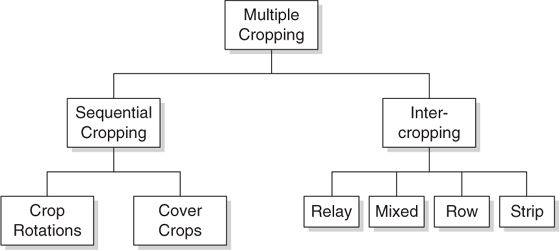
Intercropping is an agricultural practice in which two or more crops are planted in a spatial arrangement that facilitates direct interactions between them. In recent years, the study of intercropping has revealed the complex ecological relationships that often make intercropping superior to single-species (i.e., monoculture) cultivation in terms of productivity and environmental impact. A subset of multiple cropping, intercropping is distinct from sequential cropping practices such as crop rotations and cover cropping, in which crops are combined in time rather than in space (see Figure 1).
Intercropping takes four principal forms: relay, mixed, row, and strip intercropping, described here. All forms of multiple cropping systems increase on-farm diversity compared with crop monocultures and also facilitate agroecosystem functioning, which can reduce or remove the need for synthetic or chemical inputs into the farm and contribute to sustainability.
Figure 1 Multiple Cropping Systems Are Based on Temporal Combinations of Crops (Sequential Cropping) or Spatial Combinations (Intercropping)
In the Field
Intercropping is an agricultural management practice with roots in traditional farming worldwide. Examples of intercrops range from simple soybean-corn systems, in which the plants coexist in neatly planted rows, to tropical homegardens with tens of different crop species intermingled in no row pattern whatsoever. When planning an intercrop system, a farmer must consider the different agroecological roles of plants. For example, intercropping similar crops such as broccoli and kale, which are both in the Brassicaceae family, could result in nitrogen depletion from the soil because the brassicas are heavy nitrogen feeders. It might be more beneficial to intercrop the kale with a bush bean, which can fix nitrogen and return it to the soil.
Intercropping Ecology
Intercropping can benefit pest and weed management; alter soil, water, and light dynamics; and increase farm productivity. Describing and understanding the ecological mechanisms behind these benefits is a central focus of the field of agroecology. What follows is a brief review of ecological theory relevant to intercropping.
In an intercrop, pest damage may be reduced through a variety of means such as food source interruption, natural enemies, or trap crops, to name a few. Food source interruption occurs when a pest encounters a plant that is not food. For example, an insect that specializes in cucumber foliage will flourish in a monoculture of cucumbers but may leave the system if it encounters a tomato in a cucumber-tomato intercrop. Incorporating plants that attract the natural enemies of a particular pest into an intercrop may help control pests through predation and parasitism. Trap crops are usually noncrop plants that are attractive to crop pests and draw the pests out of the productive portion of the agroecosystem.
Intercropping can reduce weeds by having mixed crops occupying open ground or through allelopathic inhibition. In an intercrop, there is often less bare ground than in a monoculture, which means there is less space for weeds to colonize. For example, in a sugarcane monoculture, weeds could easily fill in bare space between cane plants. If a ground-covering vegetable such as squash were intercropped into the system, that space would be unavailable for colonization by weeds. Allelopathic control of weeds is also possible in an intercrop when a plant with known allelopathic attributes, such as wild mustard, is planted. The chemicals released by the mustard plant through its roots and leaves can inhibit the growth of weeds in the system.
...
- Food Challenges
- Animal Welfare
- Beyond Organic
- Cheap Food Policy
- Crop Genetic Diversity
- DDT
- Debt Crisis
- Disappearing Middle
- Export Dependency
- Famine
- Farm Crisis
- Fast Food
- Food Processing Industry
- Food Safety
- Food Security
- Genetically Modified Organisms
- Grain-Fed Beef
- High Fructose Corn Syrup
- Integrated Pest Management
- Irradiation
- Mad Cow Disease
- Malthusianism
- Mechanization
- Millennium Development Goals
- Modernization
- Nitrogen Fixation
- Organochlorines
- Origin Labeling
- Peasant
- Pesticide
- Productionism
- Proletarianization
- Recombinant Bovine Growth Hormone
- Roundup Ready Crops
- Salmonella
- Sewage Sludge
- Soil Erosion
- Sustainable Agriculture
- Swidden Agriculture
- Weed Management
- Food Economics and Trade
- Food Farm and Industry
- Agrarian Question
- Agrarianism
- Agribusiness
- Agricultural Commodity Programs
- Agricultural Extension
- Agrodiversity
- Agroecology
- Agrofood System (Agrifood)
- Aquaculture
- Biodynamic Agriculture
- Biological Control
- Bt
- Composting
- Confined Animal Feeding Operation
- Contract Farming
- Cooperative
- Corn
- Cover Cropping
- Crop Rotation
- Dairy
- Dioxins
- Factory Farm
- Family Farm
- Fertilizer
- Fruits
- Grazing
- Hunting
- Intercropping
- Irrigation
- Legume Crops
- Low-Input Agriculture
- Meats
- Nanotechnology and Food
- Organic Farming
- Plantation
- Rice
- Salmon
- Seed Industry
- Soil Nutrient Cycling
- Soybeans
- Substitutionism
- Sugarcane
- Urban Agriculture
- Vegetables
- Wheat
- Yeoman Farmer
- Food Laws, Agreements, and Organizations
- Archer Daniels Midland
- California Certified Organic Farmers
- Certified Humane
- Certified Organic
- Codex Alimentarius
- Commons ConAgra
- Department of Agriculture, U.S
- Diamond v. Chakrabarty
- Doha Round, World Trade Organization
- Fair Labor Association
- Fair Trade
- Farm Bill
- Federal Insecticide, Fungicide, and Rodenticide Act
- Food and Agriculture Organization
- Food and Drug Administration
- Food First
- Food Justice Movement
- Food Quality Protection Act
- Food Sovereignty
- Institute for Agriculture and Trade Policy
- International Coffee Agreement
- Land Grant University
- National Organic Program
- North American Free Trade Agreement
- Northeast Organic Farming Association
- Ogallala Aquifer
- Public Law 480, Food Aid
- Sustainable Fisheries Act
- United Farm Workers
- Wal-Mart
- Foods and Lifestyle
- Loading...
Get a 30 day FREE TRIAL
-
 Watch videos from a variety of sources bringing classroom topics to life
 -
Read modern, diverse business cases
-
Explore hundreds of books and reference titles

Read next

More like this
Sage Recommends
We found other relevant content for you on other Sage platforms.
Have you created a personal profile? Login or create a profile so that you can save clips, playlists and searches