
Entry
Reader's guide
Entries A-Z
Subject index
Grazing
Originating from the Old English for grass, grazing refers to the consumption of grasses and other plant materials by herbivores and some omnivores. Wild or domestic grazing animals (e.g., cattle, sheep, deer, horses) consume portions of low-lying plants, often only eating part of the plant and leaving the rest behind (most importantly, the root) to allow for new growth. Sometimes multiple species will graze on the same plants, with smaller animals eating the tender parts exposed after larger animals have consumed the tougher, woodier parts. When grazing focuses on higher vegetation, such as the twigs and leaves of shrubbery and trees, it is called “browsing.” For instance, the caprid subfamily (or “goat-antelope family”) includes grazers (e.g., sheep, musk-oxen), browsers (e.g., goats), and animals that both graze and browse (e.g., ibexes). Giraffes have evolved to browse on the higher-level foliage that other browsers cannot reach. In the agriculture, domestic grazing animals are traditionally food sources themselves and/or produce other food byproducts (e.g., milk).
Most domestic livestock are, and historically have been, grazers, and grazing has been an opportunity for people since the earliest days of man to make indirect food use of grasses and other vegetative resources that are of limited direct use. At the same time, because cattle and sheep were feeding on grasses, they were not competing for food with their human ranchers. Though we do not think much about the fact that we do not raise carnivorous species for food, one reason early man made that choice was because of the inefficiencies involved. (The principal exception is the pig, which is omnivorous; the pig can eat meat, but does not require it as long as it obtains protein from some source. Omnivorousness has an efficiency appeal all its own, as a pig can be fed unusable or undesirable scraps or leftovers, much as the family dog would be. The trade-off is that, unlike the grazing species, it does not provide milk for its owners.) Furthermore, through a lucky ecological quirk, most land that is suitable for grazing is not suitable for growing crops, and vice versa. It is easy in the 21st century to lose sight of how well-adapted farming and animal husbandry are to the natural dispositions of the environment.
These Colorado ranchers have brought a herd of cattle to graze on a healthy pasture (at right) while avoiding the overgrazed land on the other side of the fence.
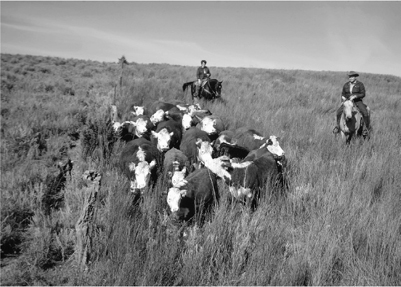
When livestock graze, the grazing can be controlled (with the farmer regulating what is available to the animals, through one means or another) or continuous (where the animals have free access to whatever is available to for age). The growth of the cattle ranching industry and its continuous grazing in the 19th century highlighted the problems of grazing large numbers of livestock without any method or system to prevent overgrazing, in which grasses are eaten too quickly to grow back (which could lead to root systems dying). Overgrazing can lead to soil erosion, as those root systems are no longer there to tether the soil in place, and it can affect local water quality—soil erosion, left unchecked, will reduce the amount of plant life that can be sustained by the land, which in turn will lead to further soil erosion, and so on. The intentional clearing of land to turn it into grazing land usually involves the destruction of woodland or wetland, both of which have their own consequences, both short and—especially—long term. Over the course of the 20th century, particularly as the frontier closed and public lands were no longer available for indiscriminate cowboys to let their cattle graze at will, various grazing systems were developed with an eye toward sustainability.
...
- Food Challenges
- Animal Welfare
- Beyond Organic
- Cheap Food Policy
- Crop Genetic Diversity
- DDT
- Debt Crisis
- Disappearing Middle
- Export Dependency
- Famine
- Farm Crisis
- Fast Food
- Food Processing Industry
- Food Safety
- Food Security
- Genetically Modified Organisms
- Grain-Fed Beef
- High Fructose Corn Syrup
- Integrated Pest Management
- Irradiation
- Mad Cow Disease
- Malthusianism
- Mechanization
- Millennium Development Goals
- Modernization
- Nitrogen Fixation
- Organochlorines
- Origin Labeling
- Peasant
- Pesticide
- Productionism
- Proletarianization
- Recombinant Bovine Growth Hormone
- Roundup Ready Crops
- Salmonella
- Sewage Sludge
- Soil Erosion
- Sustainable Agriculture
- Swidden Agriculture
- Weed Management
- Food Economics and Trade
- Food Farm and Industry
- Agrarian Question
- Agrarianism
- Agribusiness
- Agricultural Commodity Programs
- Agricultural Extension
- Agrodiversity
- Agroecology
- Agrofood System (Agrifood)
- Aquaculture
- Biodynamic Agriculture
- Biological Control
- Bt
- Composting
- Confined Animal Feeding Operation
- Contract Farming
- Cooperative
- Corn
- Cover Cropping
- Crop Rotation
- Dairy
- Dioxins
- Factory Farm
- Family Farm
- Fertilizer
- Fruits
- Grazing
- Hunting
- Intercropping
- Irrigation
- Legume Crops
- Low-Input Agriculture
- Meats
- Nanotechnology and Food
- Organic Farming
- Plantation
- Rice
- Salmon
- Seed Industry
- Soil Nutrient Cycling
- Soybeans
- Substitutionism
- Sugarcane
- Urban Agriculture
- Vegetables
- Wheat
- Yeoman Farmer
- Food Laws, Agreements, and Organizations
- Archer Daniels Midland
- California Certified Organic Farmers
- Certified Humane
- Certified Organic
- Codex Alimentarius
- Commons ConAgra
- Department of Agriculture, U.S
- Diamond v. Chakrabarty
- Doha Round, World Trade Organization
- Fair Labor Association
- Fair Trade
- Farm Bill
- Federal Insecticide, Fungicide, and Rodenticide Act
- Food and Agriculture Organization
- Food and Drug Administration
- Food First
- Food Justice Movement
- Food Quality Protection Act
- Food Sovereignty
- Institute for Agriculture and Trade Policy
- International Coffee Agreement
- Land Grant University
- National Organic Program
- North American Free Trade Agreement
- Northeast Organic Farming Association
- Ogallala Aquifer
- Public Law 480, Food Aid
- Sustainable Fisheries Act
- United Farm Workers
- Wal-Mart
- Foods and Lifestyle
- Loading...
Get a 30 day FREE TRIAL
-
 Watch videos from a variety of sources bringing classroom topics to life
 -
Read modern, diverse business cases
-
Explore hundreds of books and reference titles

Read next

More like this
Sage Recommends
We found other relevant content for you on other Sage platforms.
Have you created a personal profile? Login or create a profile so that you can save clips, playlists and searches