
Entry
Reader's guide
Entries A-Z
Subject index
Food Safety
Food safety is the management of food in ways that prevent food-borne illness and negative social and environmental consequences. Food can contain or grow bacteria that can cause food poisoning and transmit diseases. Food therefore requires scientific examination to ensure safety to its consumers. Food safety therefore emerges as a new scientific discipline that examines the production and processing of food to prevent negative health, environmental, and social implications. Green or organic food is often presented as an example of safe food because of the debate on the health and environmental consequences of genetically modified food. Previously, food safety was understood just as freshness and taste free from any hazardous bacteria; at this time, however, different social and environmental attributes are also part of it.
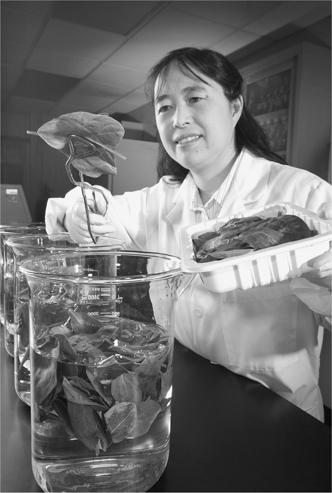
This food technology scientist is comparing the efficacy of several types of washes that may reduce microbes and contaminants on spinach and other greens.
Evolution of Food Safety System
The hazard analysis critical control point (HACCP) is one of the main tools and mechanisms for food safety. The HACCP system has a long history of development and evolution. The current global food safety system, under the auspices of the United Nations, began in 1945 with the organization of the Food and Agriculture Organization (FAO). The General Agreement on Tariffs and Trade, concluded in 1947, included provisions for countries to apply measures necessary to protect human, animal, or plant life or health. Several of its stipulations were that measures adopted by an individual country must not unjustifiably discriminate between countries in which similar conditions prevail and must not act as disguised restrictions on international trade. After that, the HACCP system took a long path of evolution until, in 1997, it reached the “Codex Document on HACCP Principles and Application.”
Although the early HACCP system (in place until 1972) was quite simple and consisted of only three principles (conducting hazard analysis, determining critical control points, and establishing monitoring procedures), modern HACCP is built on seven principles (conducting hazard analysis, determining critical control points, establishing critical limits, establishing monitoring procedures, establishing corrective actions, establishing verification procedures, and establishing recordkeeping procedures). The United States, Japan, and several European Union countries largely use modern HACCP systems to ensure food safety. They also require that their food exporters in the developing nations apply HACCP systems. The current food safety system, however, goes beyond the HACCP manuals.
Privatizing Food Safety Governance
Since time immemorial, “food” has been playing a pivotal role not only in human health and pleasure but also in economics, culture, and politics. Whereas early human societies—hunters and gatherers, for instance—were dependent on food sources within their tribal territories, nowadays most people in richer countries consume food from all over the globe. As a consequence, the physical distance between the places of production and places of consumption is growing fast, whereas the time gap between producing and consuming a food is closing rapidly. At this time, because of the globalization process, developing nations are orienting their food products to meet global market demands, and as a result, many local food production systems in developing countries are increasingly linked to global commodity chains or networks, generating a complex governing system between the local and the global.
...
- Food Challenges
- Animal Welfare
- Beyond Organic
- Cheap Food Policy
- Crop Genetic Diversity
- DDT
- Debt Crisis
- Disappearing Middle
- Export Dependency
- Famine
- Farm Crisis
- Fast Food
- Food Processing Industry
- Food Safety
- Food Security
- Genetically Modified Organisms
- Grain-Fed Beef
- High Fructose Corn Syrup
- Integrated Pest Management
- Irradiation
- Mad Cow Disease
- Malthusianism
- Mechanization
- Millennium Development Goals
- Modernization
- Nitrogen Fixation
- Organochlorines
- Origin Labeling
- Peasant
- Pesticide
- Productionism
- Proletarianization
- Recombinant Bovine Growth Hormone
- Roundup Ready Crops
- Salmonella
- Sewage Sludge
- Soil Erosion
- Sustainable Agriculture
- Swidden Agriculture
- Weed Management
- Food Economics and Trade
- Food Farm and Industry
- Agrarian Question
- Agrarianism
- Agribusiness
- Agricultural Commodity Programs
- Agricultural Extension
- Agrodiversity
- Agroecology
- Agrofood System (Agrifood)
- Aquaculture
- Biodynamic Agriculture
- Biological Control
- Bt
- Composting
- Confined Animal Feeding Operation
- Contract Farming
- Cooperative
- Corn
- Cover Cropping
- Crop Rotation
- Dairy
- Dioxins
- Factory Farm
- Family Farm
- Fertilizer
- Fruits
- Grazing
- Hunting
- Intercropping
- Irrigation
- Legume Crops
- Low-Input Agriculture
- Meats
- Nanotechnology and Food
- Organic Farming
- Plantation
- Rice
- Salmon
- Seed Industry
- Soil Nutrient Cycling
- Soybeans
- Substitutionism
- Sugarcane
- Urban Agriculture
- Vegetables
- Wheat
- Yeoman Farmer
- Food Laws, Agreements, and Organizations
- Archer Daniels Midland
- California Certified Organic Farmers
- Certified Humane
- Certified Organic
- Codex Alimentarius
- Commons ConAgra
- Department of Agriculture, U.S
- Diamond v. Chakrabarty
- Doha Round, World Trade Organization
- Fair Labor Association
- Fair Trade
- Farm Bill
- Federal Insecticide, Fungicide, and Rodenticide Act
- Food and Agriculture Organization
- Food and Drug Administration
- Food First
- Food Justice Movement
- Food Quality Protection Act
- Food Sovereignty
- Institute for Agriculture and Trade Policy
- International Coffee Agreement
- Land Grant University
- National Organic Program
- North American Free Trade Agreement
- Northeast Organic Farming Association
- Ogallala Aquifer
- Public Law 480, Food Aid
- Sustainable Fisheries Act
- United Farm Workers
- Wal-Mart
- Foods and Lifestyle
- Loading...
Get a 30 day FREE TRIAL
-
 Watch videos from a variety of sources bringing classroom topics to life
 -
Read modern, diverse business cases
-
Explore hundreds of books and reference titles

Read next

More like this
Sage Recommends
We found other relevant content for you on other Sage platforms.
Have you created a personal profile? Login or create a profile so that you can save clips, playlists and searches