
Entry
Reader's guide
Entries A-Z
Subject index
Fisheries
The term fisheries refers to the sum total of activities involved in the capture, harvesting, processing, trade, and consumption of freshwater and saltwater fish and fish products. These activities contribute to food security and poverty alleviation by providing animal protein, fatty acids, and other micronutrients for billions of humans and nonhumans; giving support and employment to 250 million people, including many small-scale fishing communities; and acting as a source of export earnings for many countries, particularly in the developing world. The greatest dependence on fish for dietary purposes is found in the least developed countries, and in 40 such countries, fish is the third-largest export industry. Fish are also consumed for subsistence purposes and traded locally. Over three billion people, mainly in developing countries, obtain 20 percent or more of their animal protein intake from fish and fish products, and over 400 million people in parts of Africa and South Asia derived more than 50 percent of their protein intake from fish. Despite the increase in global production of the past 50 years, many developing countries have experienced a decline in per capita availability and consumption as a result of population growth, reduction in access to common pool resources, growing domestic income inequality, and the increased cost of fish, making it less affordable for the poor. Efforts are being made to prevent further stock declines, promote more sustainable fisheries policies, and improve the access of poor people to fish.
Fishing activity takes many forms, and fishing communities are highly varied. Conventional classifications recognize three main fisher categories: recreational, large-scale/industrial, and small-scale/artisanal fishers. Recreational fishers are noncommercial fishers who do not fish for a livelihood and who account for 12 percent of total world catches. They are found throughout the world, with the largest numbers found in developed countries. Large-scale and small-scale fishers generally fish for economic gain, to meet household dietary needs, or some combination of the two. The distinction between large-scale and small-scale fishers is best seen as a continuum ranging from single-line individual fishers operating in limited ranges along coasts and riverbanks and fishing largely for local consumption to highly capital-intensive commercial factory ships, which sweep large areas of the ocean using advanced sonar technology and industrial nets and process and freeze catch onboard. Over 90 percent of the estimated 29 million capture fish workers worldwide are officially classified as small-scale fishers, of which more than 80 percent are in Asia, accounting for 45 percent of total open capture marine and inland fish catch. Both large-scale and small-scale fishers include boat and net owners and investors, owner-operators, seasonal workers, share-catch workers, and wage workers. Although large-scale fisheries directly employ fewer people and are concentrated in fewer countries, their catches per unit of effort and their aquatic environmental impacts are larger than those of small-scale fishers, although the latter do cause environmental damage.
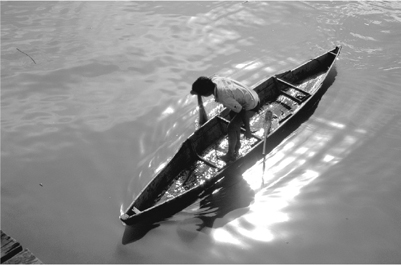
Small-scale fishers in Asia like this man fishing alone in a small boat in Indonesia land close to half of the world's total open-capture marine and inland fish catch.
...
- Food Challenges
- Animal Welfare
- Beyond Organic
- Cheap Food Policy
- Crop Genetic Diversity
- DDT
- Debt Crisis
- Disappearing Middle
- Export Dependency
- Famine
- Farm Crisis
- Fast Food
- Food Processing Industry
- Food Safety
- Food Security
- Genetically Modified Organisms
- Grain-Fed Beef
- High Fructose Corn Syrup
- Integrated Pest Management
- Irradiation
- Mad Cow Disease
- Malthusianism
- Mechanization
- Millennium Development Goals
- Modernization
- Nitrogen Fixation
- Organochlorines
- Origin Labeling
- Peasant
- Pesticide
- Productionism
- Proletarianization
- Recombinant Bovine Growth Hormone
- Roundup Ready Crops
- Salmonella
- Sewage Sludge
- Soil Erosion
- Sustainable Agriculture
- Swidden Agriculture
- Weed Management
- Food Economics and Trade
- Food Farm and Industry
- Agrarian Question
- Agrarianism
- Agribusiness
- Agricultural Commodity Programs
- Agricultural Extension
- Agrodiversity
- Agroecology
- Agrofood System (Agrifood)
- Aquaculture
- Biodynamic Agriculture
- Biological Control
- Bt
- Composting
- Confined Animal Feeding Operation
- Contract Farming
- Cooperative
- Corn
- Cover Cropping
- Crop Rotation
- Dairy
- Dioxins
- Factory Farm
- Family Farm
- Fertilizer
- Fruits
- Grazing
- Hunting
- Intercropping
- Irrigation
- Legume Crops
- Low-Input Agriculture
- Meats
- Nanotechnology and Food
- Organic Farming
- Plantation
- Rice
- Salmon
- Seed Industry
- Soil Nutrient Cycling
- Soybeans
- Substitutionism
- Sugarcane
- Urban Agriculture
- Vegetables
- Wheat
- Yeoman Farmer
- Food Laws, Agreements, and Organizations
- Archer Daniels Midland
- California Certified Organic Farmers
- Certified Humane
- Certified Organic
- Codex Alimentarius
- Commons ConAgra
- Department of Agriculture, U.S
- Diamond v. Chakrabarty
- Doha Round, World Trade Organization
- Fair Labor Association
- Fair Trade
- Farm Bill
- Federal Insecticide, Fungicide, and Rodenticide Act
- Food and Agriculture Organization
- Food and Drug Administration
- Food First
- Food Justice Movement
- Food Quality Protection Act
- Food Sovereignty
- Institute for Agriculture and Trade Policy
- International Coffee Agreement
- Land Grant University
- National Organic Program
- North American Free Trade Agreement
- Northeast Organic Farming Association
- Ogallala Aquifer
- Public Law 480, Food Aid
- Sustainable Fisheries Act
- United Farm Workers
- Wal-Mart
- Foods and Lifestyle
- Loading...
Get a 30 day FREE TRIAL
-
 Watch videos from a variety of sources bringing classroom topics to life
 -
Read modern, diverse business cases
-
Explore hundreds of books and reference titles

Read next

More like this
Sage Recommends
We found other relevant content for you on other Sage platforms.
Have you created a personal profile? Login or create a profile so that you can save clips, playlists and searches