
Entry
Reader's guide
Entries A-Z
Subject index
Fertilizer
Since medieval times, fertilizers have been used to help increase crop production. The earlier fertilizers were organic and consisted of decayed plant or animal matter, as well as various other items, whereas inorganic fertilizers consist largely of chemicals. Essentially, when crops are produced through the use of organic fertilizers, they are deemed to be “green,” whereas when inorganic fertilizers are used, there are certainly queries about whether the crops grown through their use can be regarded as “green.”
In ancient and early medieval times, the system of crop rotation was found to be very good in helping with crop yields. Part of this involved leaving the fields to lie fallow for a year in the process, and often being used for grazing animals. The resulting animal dung contributed to helping fields recover from intensive cultivation, and the Koreans introduced similar systems that involved fields being fallow for many years after the growing of ginseng.
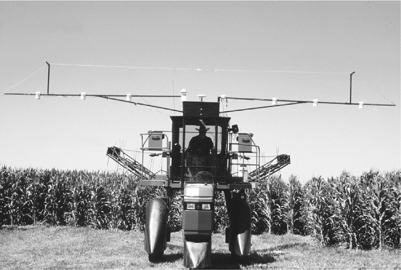
Modern methods of fertilizing sometimes make use of computer technology and other instruments. This sprayer features crop canopy sensors on either side to monitor the greenness of plants and an onboard computer that adjusts the application of fertilizer accordingly.
Technically, the use of “slash and burn” (or swidden) agricultural techniques, still practiced by some people such as jungle tribes, used carbon to fertilize the soil, but as they found out, the nutrients thus provided were often rapidly used up, causing them to move to a new location. Gradually, during the late medieval and early modern period in Europe, it was determined that some forms of natural fertilizers could be used. The Englishman Gabriel Potts, in the 17th century, worked out that “colored water” from flooded land, and soil from streams, as well as malt dust, blood offal, and the entrails of animals helped plant nutrition. This was followed up by Walter Blith in the 1640s, who started using farmyard manure, human urine, bones, horn, fish, seaweed, and later even coarse wool clippings and soot—the latter essentially replicating some aspects of “slash and burn” agriculture. Blith also experimented with the use of chalk and lime, depending on the soil where the crops were being grown. By experimentation, agriculturalists learned that particular natural fertilizers were more suitable to specific crops and, indeed, specific species of vegetables.
During the 1730s, Viscount Charles Townshend (1674—1738) studied methods of improving crop production by having a four-year rotation system instead of the three-year system that had been used in Britain for hundreds of years. More than 100 years later, the German chemist Justus von Liebig (1803—83) recognized the importance of ammonia in helping plants grow, and he started promoting the manufacture and use of inorganic minerals involving ammonium salts to help plant nutrition and increase crop yields. He also came up with a method of using bone meal after it was treated with sulfuric acid, but it was not successful. Von Liebig's work went on to inspire the French scientist Jean Baptiste Boussingault (1802—87), who, when he returned to France from Latin America in 1832, worked on the introduction of nitrogen fixation to help in the production of legumes.
...
- Food Challenges
- Animal Welfare
- Beyond Organic
- Cheap Food Policy
- Crop Genetic Diversity
- DDT
- Debt Crisis
- Disappearing Middle
- Export Dependency
- Famine
- Farm Crisis
- Fast Food
- Food Processing Industry
- Food Safety
- Food Security
- Genetically Modified Organisms
- Grain-Fed Beef
- High Fructose Corn Syrup
- Integrated Pest Management
- Irradiation
- Mad Cow Disease
- Malthusianism
- Mechanization
- Millennium Development Goals
- Modernization
- Nitrogen Fixation
- Organochlorines
- Origin Labeling
- Peasant
- Pesticide
- Productionism
- Proletarianization
- Recombinant Bovine Growth Hormone
- Roundup Ready Crops
- Salmonella
- Sewage Sludge
- Soil Erosion
- Sustainable Agriculture
- Swidden Agriculture
- Weed Management
- Food Economics and Trade
- Food Farm and Industry
- Agrarian Question
- Agrarianism
- Agribusiness
- Agricultural Commodity Programs
- Agricultural Extension
- Agrodiversity
- Agroecology
- Agrofood System (Agrifood)
- Aquaculture
- Biodynamic Agriculture
- Biological Control
- Bt
- Composting
- Confined Animal Feeding Operation
- Contract Farming
- Cooperative
- Corn
- Cover Cropping
- Crop Rotation
- Dairy
- Dioxins
- Factory Farm
- Family Farm
- Fertilizer
- Fruits
- Grazing
- Hunting
- Intercropping
- Irrigation
- Legume Crops
- Low-Input Agriculture
- Meats
- Nanotechnology and Food
- Organic Farming
- Plantation
- Rice
- Salmon
- Seed Industry
- Soil Nutrient Cycling
- Soybeans
- Substitutionism
- Sugarcane
- Urban Agriculture
- Vegetables
- Wheat
- Yeoman Farmer
- Food Laws, Agreements, and Organizations
- Archer Daniels Midland
- California Certified Organic Farmers
- Certified Humane
- Certified Organic
- Codex Alimentarius
- Commons ConAgra
- Department of Agriculture, U.S
- Diamond v. Chakrabarty
- Doha Round, World Trade Organization
- Fair Labor Association
- Fair Trade
- Farm Bill
- Federal Insecticide, Fungicide, and Rodenticide Act
- Food and Agriculture Organization
- Food and Drug Administration
- Food First
- Food Justice Movement
- Food Quality Protection Act
- Food Sovereignty
- Institute for Agriculture and Trade Policy
- International Coffee Agreement
- Land Grant University
- National Organic Program
- North American Free Trade Agreement
- Northeast Organic Farming Association
- Ogallala Aquifer
- Public Law 480, Food Aid
- Sustainable Fisheries Act
- United Farm Workers
- Wal-Mart
- Foods and Lifestyle
- Loading...
Get a 30 day FREE TRIAL
-
 Watch videos from a variety of sources bringing classroom topics to life
 -
Read modern, diverse business cases
-
Explore hundreds of books and reference titles

Read next

More like this
Sage Recommends
We found other relevant content for you on other Sage platforms.
Have you created a personal profile? Login or create a profile so that you can save clips, playlists and searches