
Entry
Reader's guide
Entries A-Z
Subject index
Factory Farm
Depending on the economies of scale, the term factory farm refers to industrialized livestock rearing in which animals are confined at high densities and brought to production or slaughter as rapidly as possible. Also called intensive, industrialized, or confinement agriculture, factory farming is dominated by agribusinesses, which have invested a great deal of capital into standardizing and mechanizing the “growing” and processing of animals to produce meat, eggs, and milk at the lowest possible costs. Chickens, turkeys, cattle, and swine/pigs are the most common factory farm animals, an estimated 10 billion of which are slaughtered each year in the United States alone. Given predictions that the global demand for livestock foods will more than double over the next 20 years, factory farming will likely continue to expand around the world. Critics argue that the environmental, social, health, and animal welfare costs of expanding factory farming practices are too high.
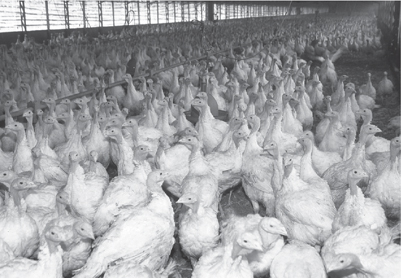
Large turkey farms like this one in Benton, Arkansas, have multiple buildings that can house as many as 10,000 turkeys each.
History of Factory Farming
For at least 10,000 years, humans have intentionally and unintentionally reconfigured their environments as they have devised ways to raise, store, harvest, and selectively breed their domesticated plants and animals. This article highlights significant reconfigurations in livestock rearing that have taken place since the 19th century.
In North America, the development of mechanical refrigeration enabled the dramatic expansion of the meatpacking industry and thus led to further intensification in livestock production. By the late 19th century, stockyards in Chicago, Illinois, served as a striking example of the mass-production trend. Meat had become yet another of the wide variety of factory-produced consumer items epitomizing American capitalism and its growing dependence on economies of scale. Although the working conditions in the U.S. meatpacking industry led Congress to enact the Pure Food and Drug Act and the Federal Meat Inspection Act shortly after the publication of Upton Sinclair's The Jungle (1906), legislation on behalf of farm animals would not exist for several more decades.
In the 1960s, the U.S. company Iowa Beef Packers triggered a major revolution in meatpacking by redesigning the slaughter and packing process to fragment tasks and deskill work. This allowed for the reduction of wages while making it easier to replace laborers; sped up the chain of production; and relocated plants to rural areas, which were less expensive operation locales and usually did not have organized labor. The Iowa Beef Packers model dominated beef processing from that point onward and was adopted in poultry and swine operations, all of which depended increasingly on factory farming.
The post-World War II boom in U.S. and European industries and populations contributed to this expansion of factory farms, as urban and suburban regions overflowed into surrounding farmland. Attendant shifts in production occurred as large-scale commercial agribusiness replaced subsistence and small-scale farming, so that by the 1990s, less than 2 percent of Americans were even involved in production agriculture. Just before World War II, one-fourth of the U.S. population worked in agriculture.
...
- Food Challenges
- Animal Welfare
- Beyond Organic
- Cheap Food Policy
- Crop Genetic Diversity
- DDT
- Debt Crisis
- Disappearing Middle
- Export Dependency
- Famine
- Farm Crisis
- Fast Food
- Food Processing Industry
- Food Safety
- Food Security
- Genetically Modified Organisms
- Grain-Fed Beef
- High Fructose Corn Syrup
- Integrated Pest Management
- Irradiation
- Mad Cow Disease
- Malthusianism
- Mechanization
- Millennium Development Goals
- Modernization
- Nitrogen Fixation
- Organochlorines
- Origin Labeling
- Peasant
- Pesticide
- Productionism
- Proletarianization
- Recombinant Bovine Growth Hormone
- Roundup Ready Crops
- Salmonella
- Sewage Sludge
- Soil Erosion
- Sustainable Agriculture
- Swidden Agriculture
- Weed Management
- Food Economics and Trade
- Food Farm and Industry
- Agrarian Question
- Agrarianism
- Agribusiness
- Agricultural Commodity Programs
- Agricultural Extension
- Agrodiversity
- Agroecology
- Agrofood System (Agrifood)
- Aquaculture
- Biodynamic Agriculture
- Biological Control
- Bt
- Composting
- Confined Animal Feeding Operation
- Contract Farming
- Cooperative
- Corn
- Cover Cropping
- Crop Rotation
- Dairy
- Dioxins
- Factory Farm
- Family Farm
- Fertilizer
- Fruits
- Grazing
- Hunting
- Intercropping
- Irrigation
- Legume Crops
- Low-Input Agriculture
- Meats
- Nanotechnology and Food
- Organic Farming
- Plantation
- Rice
- Salmon
- Seed Industry
- Soil Nutrient Cycling
- Soybeans
- Substitutionism
- Sugarcane
- Urban Agriculture
- Vegetables
- Wheat
- Yeoman Farmer
- Food Laws, Agreements, and Organizations
- Archer Daniels Midland
- California Certified Organic Farmers
- Certified Humane
- Certified Organic
- Codex Alimentarius
- Commons ConAgra
- Department of Agriculture, U.S
- Diamond v. Chakrabarty
- Doha Round, World Trade Organization
- Fair Labor Association
- Fair Trade
- Farm Bill
- Federal Insecticide, Fungicide, and Rodenticide Act
- Food and Agriculture Organization
- Food and Drug Administration
- Food First
- Food Justice Movement
- Food Quality Protection Act
- Food Sovereignty
- Institute for Agriculture and Trade Policy
- International Coffee Agreement
- Land Grant University
- National Organic Program
- North American Free Trade Agreement
- Northeast Organic Farming Association
- Ogallala Aquifer
- Public Law 480, Food Aid
- Sustainable Fisheries Act
- United Farm Workers
- Wal-Mart
- Foods and Lifestyle
- Loading...
Get a 30 day FREE TRIAL
-
 Watch videos from a variety of sources bringing classroom topics to life
 -
Read modern, diverse business cases
-
Explore hundreds of books and reference titles

Read next

More like this
Sage Recommends
We found other relevant content for you on other Sage platforms.
Have you created a personal profile? Login or create a profile so that you can save clips, playlists and searches