
Entry
Reader's guide
Entries A-Z
Subject index
Crop Genetic Diversity
Genetic diversity in crops provides the raw material that allows breeders to improve yield, increase protein and vitamin content, and augment drought and pest resistance in food plants. The increasing food needs of a growing human population, combined with global climate change, regional water shortages, and altered environments, make it imperative to preserve crop genetic diversity. Loss of diversity has been severe in recent decades, as the number of crops grown has declined, and large-scale planting of genetically uniform, high-yield varieties has replaced traditional, locally grown crops.
Crops originated from wild plants. Through selective breeding, farmers have produced higher-yielding, more-nutritious forms of these plants. As people migrated around the globe, they brought their crop plants with them and selected forms best adapted to the new environmental conditions. Regionally adapted variants of crop plants, known as landraces, are the result of hundreds of years of local breeding and selection. The size, shape, color, and taste of different landraces result from genetic differences that have been selected in response to local tastes, customs, and markets. Selection in response to local soil characteristics, water availability, and cultivation practices has resulted in different varieties in different areas. Often, traditional farmers maintain many varieties that can be planted under different conditions and for different tastes.
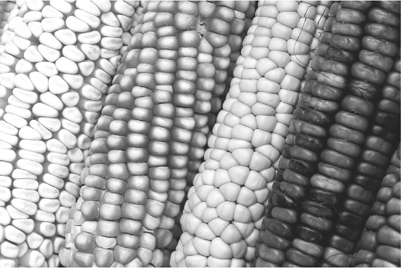
The National Plant Germplasm System from the U.S. Department of Agriculture's Agricultural Research Service stores unusual varieties of Latin American maize like these, which may be used to enhance the genetic diversity of the U.S. corn crop.
The green revolution in the mid-1900s dramatically increased crop yields for a rapidly growing human population. Scientific principles were applied to crop breeding: Better irrigation systems, mechanized cultivation, and the expanded use of pesticides, herbicides, and fertilizers quickly changed the nature of agriculture. Although landraces persisted in subsistence agriculture, modern agriculture no longer focused on local markets but provided large quantities of fewer crops to international markets. Now, of 7,000 crop plants that are grown globally, only 150 are widely cultivated, and only three—rice, wheat, and corn—provide the bulk of the world's calories. Genetically homogeneous, high-yield crops, cultivated in standardized ways, are planted over large expanses of land. However, such homogeneous crops are genetically vulnerable in that a disease, pest epidemic, or environmental change can decimate a crop. If high-yield varieties succumb to pest resistance, yields are significantly reduced within about 5 years. It takes 8 to 11 years to breed new varieties, using genes from wild relatives, landraces, and stock exposed to mutagens to induce variation. However, the loss of wild relatives through habitat destruction and the decline in cultivation of landraces have resulted in gene erosion, limiting options for change.
A few examples from the United Nations Food and Agriculture Organization (FAO) illustrate the extent of gene erosion:
- 96 percent of the 7,098 U.S. apple varieties cultivated before 1904 are extinct
- 95 percent of U.S. cabbage and 81 percent of tomato varieties are gone
- Only 10 percent of the 10,000 wheat varieties grown in China before 1940 remain
- 80 percent of Mexican maize varieties grown in the 1930s are lost
In addition to these types of gene erosion, researchers from Bioversity predict that global climate change will result in the extinction of 16–22 percent of the wild relatives of food plants.
...
- Food Challenges
- Animal Welfare
- Beyond Organic
- Cheap Food Policy
- Crop Genetic Diversity
- DDT
- Debt Crisis
- Disappearing Middle
- Export Dependency
- Famine
- Farm Crisis
- Fast Food
- Food Processing Industry
- Food Safety
- Food Security
- Genetically Modified Organisms
- Grain-Fed Beef
- High Fructose Corn Syrup
- Integrated Pest Management
- Irradiation
- Mad Cow Disease
- Malthusianism
- Mechanization
- Millennium Development Goals
- Modernization
- Nitrogen Fixation
- Organochlorines
- Origin Labeling
- Peasant
- Pesticide
- Productionism
- Proletarianization
- Recombinant Bovine Growth Hormone
- Roundup Ready Crops
- Salmonella
- Sewage Sludge
- Soil Erosion
- Sustainable Agriculture
- Swidden Agriculture
- Weed Management
- Food Economics and Trade
- Food Farm and Industry
- Agrarian Question
- Agrarianism
- Agribusiness
- Agricultural Commodity Programs
- Agricultural Extension
- Agrodiversity
- Agroecology
- Agrofood System (Agrifood)
- Aquaculture
- Biodynamic Agriculture
- Biological Control
- Bt
- Composting
- Confined Animal Feeding Operation
- Contract Farming
- Cooperative
- Corn
- Cover Cropping
- Crop Rotation
- Dairy
- Dioxins
- Factory Farm
- Family Farm
- Fertilizer
- Fruits
- Grazing
- Hunting
- Intercropping
- Irrigation
- Legume Crops
- Low-Input Agriculture
- Meats
- Nanotechnology and Food
- Organic Farming
- Plantation
- Rice
- Salmon
- Seed Industry
- Soil Nutrient Cycling
- Soybeans
- Substitutionism
- Sugarcane
- Urban Agriculture
- Vegetables
- Wheat
- Yeoman Farmer
- Food Laws, Agreements, and Organizations
- Archer Daniels Midland
- California Certified Organic Farmers
- Certified Humane
- Certified Organic
- Codex Alimentarius
- Commons ConAgra
- Department of Agriculture, U.S
- Diamond v. Chakrabarty
- Doha Round, World Trade Organization
- Fair Labor Association
- Fair Trade
- Farm Bill
- Federal Insecticide, Fungicide, and Rodenticide Act
- Food and Agriculture Organization
- Food and Drug Administration
- Food First
- Food Justice Movement
- Food Quality Protection Act
- Food Sovereignty
- Institute for Agriculture and Trade Policy
- International Coffee Agreement
- Land Grant University
- National Organic Program
- North American Free Trade Agreement
- Northeast Organic Farming Association
- Ogallala Aquifer
- Public Law 480, Food Aid
- Sustainable Fisheries Act
- United Farm Workers
- Wal-Mart
- Foods and Lifestyle
- Loading...
Get a 30 day FREE TRIAL
-
 Watch videos from a variety of sources bringing classroom topics to life
 -
Read modern, diverse business cases
-
Explore hundreds of books and reference titles

Read next

More like this
Sage Recommends
We found other relevant content for you on other Sage platforms.
Have you created a personal profile? Login or create a profile so that you can save clips, playlists and searches