
Entry
Reader's guide
Entries A-Z
Subject index
Corn
Corn is one of the most widely grown crops in the world. In recent decades, modern chemistry and other industrial processes have changed corn from something people ate at the dinner table to something in almost everything people eat. In fact, it is in much of what they use as well: Corn is now a part of an industrial food chain, as well as the source in part or in whole of a myriad of products.
The Taínos were pre-Columbian inhabitants of the Bahamas and other Caribbean islands. When the Spanish first encountered them, they adopted corn and used the word maize as the Spanish form of the Taínos word maiz. Maize is used fairly globally today; however, corn, the English general name for a cereal grain, is still used in English-speaking North America. In the United States and Canada, the term Indian corn is used to describe a variety of multicolored field cultivars. They range in color from red to blue to black and may be sold as an autumn decoration or as a popcorn specialty item.
Today, corn is a globally important food crop. It originated in the Americas, specifically in central Mexico, from a plant the Aztecs called teosinte in their Nahuatl language, meaning “the mother of corn.” It is believed to have originated on a single mountain in southern Mexico. Teosinte still grows wild in southern Mexico and northern Central America; however, it is not corn. It took thousands of years for the plant to be developed into modern corn. As it became corn, it was able to support the Mayan and later Aztec civilizations, becoming a god (and some times a goddess) that they worshipped as their corn culture became central to their survival.
The development of corn as a food is one of the greatest of human achievements. From this miraculous agricultural achievement has come a major food source for millions of descendants of the Indians who first produced corn, as well as hundreds of millions of people and countless animals around the world.
Corn is a hybrid that seems to have originated from genetic mutations of some teosinte plants about 9,000 years ago. Since then, corn has been a hybrid plant dependent on humans for its continued existence. It is an existence that, since Christopher Columbus, has spread from the Americas around the world to most of the places humans farm. The only cereal to outrank corn in production as a cereal grain is wheat. Rice is in third place.
Organically grown corn like this is surrounded by more weeds than conventional corn because only nonchemical weed management techniques are used, but the amount of corn yielded is similar.
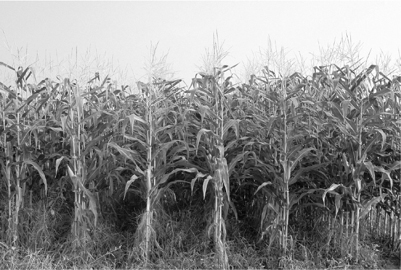
As a food commodity, more than half of the world's corn production is in the Corn Belt of the midwestern United States, with Iowa as the center of production. Corn is really a tropical or semitropical plant. To grow well, corn needs hot rainy summers that turn dry when the corn is nearly ready for harvesting. Large quantities of corn are also grown in the southern United States, where cornbread in a variety of forms—including as hush puppies—is a favorite food.
...
- Food Challenges
- Animal Welfare
- Beyond Organic
- Cheap Food Policy
- Crop Genetic Diversity
- DDT
- Debt Crisis
- Disappearing Middle
- Export Dependency
- Famine
- Farm Crisis
- Fast Food
- Food Processing Industry
- Food Safety
- Food Security
- Genetically Modified Organisms
- Grain-Fed Beef
- High Fructose Corn Syrup
- Integrated Pest Management
- Irradiation
- Mad Cow Disease
- Malthusianism
- Mechanization
- Millennium Development Goals
- Modernization
- Nitrogen Fixation
- Organochlorines
- Origin Labeling
- Peasant
- Pesticide
- Productionism
- Proletarianization
- Recombinant Bovine Growth Hormone
- Roundup Ready Crops
- Salmonella
- Sewage Sludge
- Soil Erosion
- Sustainable Agriculture
- Swidden Agriculture
- Weed Management
- Food Economics and Trade
- Food Farm and Industry
- Agrarian Question
- Agrarianism
- Agribusiness
- Agricultural Commodity Programs
- Agricultural Extension
- Agrodiversity
- Agroecology
- Agrofood System (Agrifood)
- Aquaculture
- Biodynamic Agriculture
- Biological Control
- Bt
- Composting
- Confined Animal Feeding Operation
- Contract Farming
- Cooperative
- Corn
- Cover Cropping
- Crop Rotation
- Dairy
- Dioxins
- Factory Farm
- Family Farm
- Fertilizer
- Fruits
- Grazing
- Hunting
- Intercropping
- Irrigation
- Legume Crops
- Low-Input Agriculture
- Meats
- Nanotechnology and Food
- Organic Farming
- Plantation
- Rice
- Salmon
- Seed Industry
- Soil Nutrient Cycling
- Soybeans
- Substitutionism
- Sugarcane
- Urban Agriculture
- Vegetables
- Wheat
- Yeoman Farmer
- Food Laws, Agreements, and Organizations
- Archer Daniels Midland
- California Certified Organic Farmers
- Certified Humane
- Certified Organic
- Codex Alimentarius
- Commons ConAgra
- Department of Agriculture, U.S
- Diamond v. Chakrabarty
- Doha Round, World Trade Organization
- Fair Labor Association
- Fair Trade
- Farm Bill
- Federal Insecticide, Fungicide, and Rodenticide Act
- Food and Agriculture Organization
- Food and Drug Administration
- Food First
- Food Justice Movement
- Food Quality Protection Act
- Food Sovereignty
- Institute for Agriculture and Trade Policy
- International Coffee Agreement
- Land Grant University
- National Organic Program
- North American Free Trade Agreement
- Northeast Organic Farming Association
- Ogallala Aquifer
- Public Law 480, Food Aid
- Sustainable Fisheries Act
- United Farm Workers
- Wal-Mart
- Foods and Lifestyle
- Loading...
Get a 30 day FREE TRIAL
-
 Watch videos from a variety of sources bringing classroom topics to life
 -
Read modern, diverse business cases
-
Explore hundreds of books and reference titles

Read next

More like this
Sage Recommends
We found other relevant content for you on other Sage platforms.
Have you created a personal profile? Login or create a profile so that you can save clips, playlists and searches