
Entry
Reader's guide
Entries A-Z
Subject index
Composting
Cured or finished compost is organic plant or animal matter that has decomposed into a stable soil, usually dark brown or black, called humus. All organic matter eventually decays, but composting is defined as using techniques that create an ideal environment that speeds the process up to reduce waste and provide easily accessible nutrients for growing plants. Composting is a key component of organic gardening and farming.
Composting is essentially the recycling of soil nutrients by decomposers. Decomposers are organisms that break down dead animals and plants; they include fungi, bacteria, worms, enzymes, and aerobic soil microbes and are cultivated to break down organic matter. The rate of decomposition depends on the ratio of carbon to nitrogen. Carbon-rich material is called “brown” matter and includes leaves, wood chips, straw, and manure. “Green” matter is nitrogen heavy and includes food scraps, coffee grounds, and grass clippings. The ideal brown-to-green ratio—when the material will decompose the fastest and produce the richest humus—is 25:1. Too much carbon will slow the decomposition process, and too much nitrogen will cause odor. The rate of decomposition slows as outside temperatures drop and accelerates in the heat of summer. Because they are slow to decompose and thus create odor and attract rodents, animal products (meat, eggs, dairy, fat), cooking oil, and other grease should not be put in a home compost heap or bin.
There are many methods of composting; the two broadest categories are passive and active. Passive composting takes much longer and relies heavily on natural forces. Throwing food scraps and lawn waste into a large pile or bin is considered passive composting. This form of composting reduces waste but is not ideal for creating compost that can be used on farms or gardens as a source of nutrients.
Sheet composting is another example of passive composting whereby organic materials, which can include manure, are spread over the soil, dug in, and allowed to decompose slowly. The soil should not be planted until the materials are fully broken down, which can take three months or more. U.S. Department of Agriculture organic standards regulate the use of manure, which must be allowed to reach a sterilizing temperature. If raw animal manure is used, 120 days must pass before the crop is harvested.
The ideal mixture for composting is 25 parts of carbon-rich material for every one part of nitrogen-rich material. Compost that is made correctly can have over 6 billion microbes per teaspoon, which is very beneficial for crops.
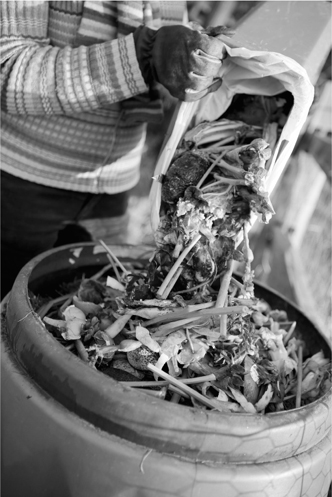
Active compost involves more planning and labor but “finishes” more quickly and creates a more reliable and nutritious product. There is not one right way to actively compost. Early organic pioneer Sir Albert Howard, for instance, developed the Indore method, a type of aerated windrow composting that involves the introduction of animal residues to the compost process to activate decomposition.
Composting can be done commercially or by individual households. Most home composters build a bin or buy a composting tub, of which many shapes and varieties are available. The ideal size for a backyard or garden compost bin is approximately three cubic yards. Temperature should be monitored frequently and can reach above 150 degrees Fahrenheit. Compost should be moist, but not wet—the consistency of a damp sponge. Contrary to common belief, compost piles should not smell. If they do, carbon sources should be added and the compost turned or aerated.
...
- Food Challenges
- Animal Welfare
- Beyond Organic
- Cheap Food Policy
- Crop Genetic Diversity
- DDT
- Debt Crisis
- Disappearing Middle
- Export Dependency
- Famine
- Farm Crisis
- Fast Food
- Food Processing Industry
- Food Safety
- Food Security
- Genetically Modified Organisms
- Grain-Fed Beef
- High Fructose Corn Syrup
- Integrated Pest Management
- Irradiation
- Mad Cow Disease
- Malthusianism
- Mechanization
- Millennium Development Goals
- Modernization
- Nitrogen Fixation
- Organochlorines
- Origin Labeling
- Peasant
- Pesticide
- Productionism
- Proletarianization
- Recombinant Bovine Growth Hormone
- Roundup Ready Crops
- Salmonella
- Sewage Sludge
- Soil Erosion
- Sustainable Agriculture
- Swidden Agriculture
- Weed Management
- Food Economics and Trade
- Food Farm and Industry
- Agrarian Question
- Agrarianism
- Agribusiness
- Agricultural Commodity Programs
- Agricultural Extension
- Agrodiversity
- Agroecology
- Agrofood System (Agrifood)
- Aquaculture
- Biodynamic Agriculture
- Biological Control
- Bt
- Composting
- Confined Animal Feeding Operation
- Contract Farming
- Cooperative
- Corn
- Cover Cropping
- Crop Rotation
- Dairy
- Dioxins
- Factory Farm
- Family Farm
- Fertilizer
- Fruits
- Grazing
- Hunting
- Intercropping
- Irrigation
- Legume Crops
- Low-Input Agriculture
- Meats
- Nanotechnology and Food
- Organic Farming
- Plantation
- Rice
- Salmon
- Seed Industry
- Soil Nutrient Cycling
- Soybeans
- Substitutionism
- Sugarcane
- Urban Agriculture
- Vegetables
- Wheat
- Yeoman Farmer
- Food Laws, Agreements, and Organizations
- Archer Daniels Midland
- California Certified Organic Farmers
- Certified Humane
- Certified Organic
- Codex Alimentarius
- Commons ConAgra
- Department of Agriculture, U.S
- Diamond v. Chakrabarty
- Doha Round, World Trade Organization
- Fair Labor Association
- Fair Trade
- Farm Bill
- Federal Insecticide, Fungicide, and Rodenticide Act
- Food and Agriculture Organization
- Food and Drug Administration
- Food First
- Food Justice Movement
- Food Quality Protection Act
- Food Sovereignty
- Institute for Agriculture and Trade Policy
- International Coffee Agreement
- Land Grant University
- National Organic Program
- North American Free Trade Agreement
- Northeast Organic Farming Association
- Ogallala Aquifer
- Public Law 480, Food Aid
- Sustainable Fisheries Act
- United Farm Workers
- Wal-Mart
- Foods and Lifestyle
- Loading...
Get a 30 day FREE TRIAL
-
 Watch videos from a variety of sources bringing classroom topics to life
 -
Read modern, diverse business cases
-
Explore hundreds of books and reference titles

Read next

More like this
Sage Recommends
We found other relevant content for you on other Sage platforms.
Have you created a personal profile? Login or create a profile so that you can save clips, playlists and searches