
Entry
Reader's guide
Entries A-Z
Subject index
Cash Crop
Cash crops are grown for direct sale in the market, rather than for family consumption or to feed livestock. Coffee, cocoa, tea, sugarcane, cotton, and spices are some examples of cash crops. Food crops such as rice, wheat, and corn are also grown as cash crops to meet the global food demand. Production of many of these crops is a form of export-oriented production, a development associated with European colonization in the topics and subtropics. Europeans developed cash crops in large-scale, capital-intensive, and export-oriented plantation agricultural systems. Today, smallholder farmers in developing countries grow most of the cash crops, such as coffee.
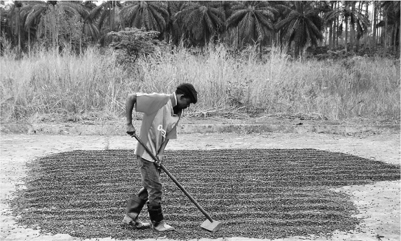
A man spreads coffee beans out to dry in May 2008 in Kwanza Sul Province, Angola, where the coffee industry has only recently recovered after decades of war. For some countries, coffee brings in 75 percent or more of all export earnings.
Cultivation of cash crops was not always associated with colonization. Precolonial societies also engaged in growing crops for sale to balance their dual foci of risk and subsistence security. Colonization brought another dimension to cash crop production by introducing new crops, technology, and scale of production.
Colonization in the countries of Africa, Asia, and South America has transformed peasant households into commodity producers. Cultivation of cash crops has brought structural changes in the peasant livelihoods in developing countries as a result of the rising cost of production, increased in- and out-migration, and dependency on the global market. Largeholder farmers in developing countries often devote a larger share of their land to cash crops compared with that of smallholder farmers. During most of the 20th century, many countries intervened in primary cash crop markets. In the late 1980s and early 1990s, commodity agreements, such as the International Coffee Agreement, failed, and commodity parastatals became financially strained.
Cultivation of export-oriented cash crops has increased the peasant farmers’ vulnerability to fluctuating global market prices. With rising costs of land and labor—the increased cost of inputs without guarantees of higher output for cash crops—farmers in developing countries are forced to intensify their cash crop production, to reduce their level of consumption, or both. Despite this disadvantage, cultivation of cash crops affords a means for smallholder farmers to improve their economic conditions.
Coffee is an important cash crop, grown mostly in developing countries of Asia, Africa, and the Americas. Coffee grows as a red cherry on a bush that grows to about 1.5 meters in diameter. Coffee cultivation was expanded to Africa, Asia, and Latin America by the European colonial powers. Coffee, produced in more than 60 countries, is one of the world's most heavily traded commodities. For many countries, coffee exports account for more than 75 percent of their total export earnings. The coffee market was highly regulated until 1989, when the international coffee agreement between producing countries and consuming countries collapsed. The 1990s and 2000s experienced coffee crises as global coffee prices plummeted and livelihood conditions of millions of smallholder farmers throughout the coffee-growing countries deteriorated.
Tea remains an important cash crop worldwide. The tea plant is a large evergreen shrub. Ideally, the tip of the new shoot, including two leaves and a bud, is used in making tea. Most of the tea consumed in the world is produced on large plantations. There are also many small tea gardens. The world tea production is about 3.15 million tons annually. The largest producers are India and China, followed by Kenya and Sri Lanka.
...
- Food Challenges
- Animal Welfare
- Beyond Organic
- Cheap Food Policy
- Crop Genetic Diversity
- DDT
- Debt Crisis
- Disappearing Middle
- Export Dependency
- Famine
- Farm Crisis
- Fast Food
- Food Processing Industry
- Food Safety
- Food Security
- Genetically Modified Organisms
- Grain-Fed Beef
- High Fructose Corn Syrup
- Integrated Pest Management
- Irradiation
- Mad Cow Disease
- Malthusianism
- Mechanization
- Millennium Development Goals
- Modernization
- Nitrogen Fixation
- Organochlorines
- Origin Labeling
- Peasant
- Pesticide
- Productionism
- Proletarianization
- Recombinant Bovine Growth Hormone
- Roundup Ready Crops
- Salmonella
- Sewage Sludge
- Soil Erosion
- Sustainable Agriculture
- Swidden Agriculture
- Weed Management
- Food Economics and Trade
- Food Farm and Industry
- Agrarian Question
- Agrarianism
- Agribusiness
- Agricultural Commodity Programs
- Agricultural Extension
- Agrodiversity
- Agroecology
- Agrofood System (Agrifood)
- Aquaculture
- Biodynamic Agriculture
- Biological Control
- Bt
- Composting
- Confined Animal Feeding Operation
- Contract Farming
- Cooperative
- Corn
- Cover Cropping
- Crop Rotation
- Dairy
- Dioxins
- Factory Farm
- Family Farm
- Fertilizer
- Fruits
- Grazing
- Hunting
- Intercropping
- Irrigation
- Legume Crops
- Low-Input Agriculture
- Meats
- Nanotechnology and Food
- Organic Farming
- Plantation
- Rice
- Salmon
- Seed Industry
- Soil Nutrient Cycling
- Soybeans
- Substitutionism
- Sugarcane
- Urban Agriculture
- Vegetables
- Wheat
- Yeoman Farmer
- Food Laws, Agreements, and Organizations
- Archer Daniels Midland
- California Certified Organic Farmers
- Certified Humane
- Certified Organic
- Codex Alimentarius
- Commons ConAgra
- Department of Agriculture, U.S
- Diamond v. Chakrabarty
- Doha Round, World Trade Organization
- Fair Labor Association
- Fair Trade
- Farm Bill
- Federal Insecticide, Fungicide, and Rodenticide Act
- Food and Agriculture Organization
- Food and Drug Administration
- Food First
- Food Justice Movement
- Food Quality Protection Act
- Food Sovereignty
- Institute for Agriculture and Trade Policy
- International Coffee Agreement
- Land Grant University
- National Organic Program
- North American Free Trade Agreement
- Northeast Organic Farming Association
- Ogallala Aquifer
- Public Law 480, Food Aid
- Sustainable Fisheries Act
- United Farm Workers
- Wal-Mart
- Foods and Lifestyle
- Loading...
Get a 30 day FREE TRIAL
-
 Watch videos from a variety of sources bringing classroom topics to life
 -
Read modern, diverse business cases
-
Explore hundreds of books and reference titles

Read next

More like this
Sage Recommends
We found other relevant content for you on other Sage platforms.
Have you created a personal profile? Login or create a profile so that you can save clips, playlists and searches