
Entry
Reader's guide
Entries A-Z
Subject index
Biological Control
Biological control is the use of an organism to control the growth rate of a pest population through predation, parasitism, herbivory, or competition. Optimally, biological control reduces a pest population to a level that is below economic injury to the crop, but high enough to sustain the population of the beneficial organism. Because biological control relies on ecological processes, it is considered an essential tactic in integrated pest management programs.
Most animal populations experience fluctuations in numbers as a result of abiotic disturbances, such as drought, floods, and hurricanes, and biological factors, such as natural enemies, disease, and food quantity and quality. When resources are abundant, favorable environmental conditions exist, and natural enemies are scarce, population growth rates can be high. Conversely, when resources are limiting, environmental conditions are unfavorable, and activity from an antagonist organism increases, the animal population can decline.
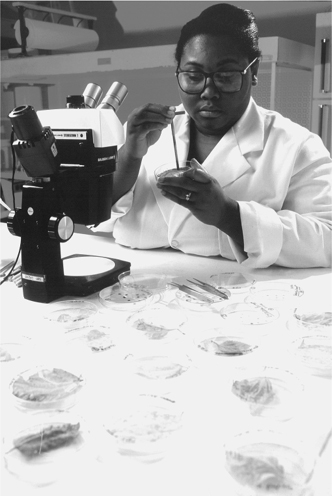
This U.S. Department of Agriculture Agricultural Research Service staffer is working with an insect called Encarsia formosa, which may be beneficial in controlling the whitefly pest.
Most plants possess physical (e.g., spines, waxy coatings, tough cell walls) or chemical (e.g., plant secondary metabolites) defenses against plant-feeding organisms. In agricultural crops, breeding has mainly focused on characteristics such as uniform growth, durability during shipping, and palatability. In the process, the plant's natural defenses against herbivores may be reduced or lost, increasing their susceptibility to damage from pests. When susceptible crops are planted in large “monocultures,” they can be more apparent to and therefore more easily located by herbivores than in natural systems, which tend to be more diverse. Hence, in agroecosystems, food resources are generally not limiting for herbivores, and their populations may increase to levels that reduce crop yield or marketability, thereby becoming a “pest.” Furthermore, intensively managed monocultures may lack the diversity and stability of resources to support a diverse natural enemy community. Thus, the idea behind biological control is to increase the population numbers of natural enemies of pests by either introducing or attracting them to fields or conserving those that may already be present.
Biocontrol agents can be herbivores, predators, parasitoids, or pathogens. Within those functional groups, biocontrol agents may be generalists (use a broad number of species) or specialists (use a limited number of species). When their numbers are sufficiently high, specialist natural enemies can be particularly effective at quickly and efficiently reducing the population of a single host species or genus. On contrast, the collective activity of generalists, which may be common in the farm landscape, can prevent a host population from reaching pest status.
Weed populations are controlled by herbivores and plant pathogens, which use above-ground (stems, leaves, flowers, and seeds) or below-ground (roots and tubers) plant parts. Ground beetles (Coleoptera: Carabidae) have been widely documented for their ability to consistently consume weed seeds present in the soil (the seed bank), thereby reducing the following generation of weed seedlings. The combined granivory (seed-feeding) of crickets, earthworms, slugs, rodents, and birds can also reduce the seed bank of several economically important weed species, such as jimsonweed, pigweed, and common lamb's-quarters, by as much as 90 percent.
...
- Food Challenges
- Animal Welfare
- Beyond Organic
- Cheap Food Policy
- Crop Genetic Diversity
- DDT
- Debt Crisis
- Disappearing Middle
- Export Dependency
- Famine
- Farm Crisis
- Fast Food
- Food Processing Industry
- Food Safety
- Food Security
- Genetically Modified Organisms
- Grain-Fed Beef
- High Fructose Corn Syrup
- Integrated Pest Management
- Irradiation
- Mad Cow Disease
- Malthusianism
- Mechanization
- Millennium Development Goals
- Modernization
- Nitrogen Fixation
- Organochlorines
- Origin Labeling
- Peasant
- Pesticide
- Productionism
- Proletarianization
- Recombinant Bovine Growth Hormone
- Roundup Ready Crops
- Salmonella
- Sewage Sludge
- Soil Erosion
- Sustainable Agriculture
- Swidden Agriculture
- Weed Management
- Food Economics and Trade
- Food Farm and Industry
- Agrarian Question
- Agrarianism
- Agribusiness
- Agricultural Commodity Programs
- Agricultural Extension
- Agrodiversity
- Agroecology
- Agrofood System (Agrifood)
- Aquaculture
- Biodynamic Agriculture
- Biological Control
- Bt
- Composting
- Confined Animal Feeding Operation
- Contract Farming
- Cooperative
- Corn
- Cover Cropping
- Crop Rotation
- Dairy
- Dioxins
- Factory Farm
- Family Farm
- Fertilizer
- Fruits
- Grazing
- Hunting
- Intercropping
- Irrigation
- Legume Crops
- Low-Input Agriculture
- Meats
- Nanotechnology and Food
- Organic Farming
- Plantation
- Rice
- Salmon
- Seed Industry
- Soil Nutrient Cycling
- Soybeans
- Substitutionism
- Sugarcane
- Urban Agriculture
- Vegetables
- Wheat
- Yeoman Farmer
- Food Laws, Agreements, and Organizations
- Archer Daniels Midland
- California Certified Organic Farmers
- Certified Humane
- Certified Organic
- Codex Alimentarius
- Commons ConAgra
- Department of Agriculture, U.S
- Diamond v. Chakrabarty
- Doha Round, World Trade Organization
- Fair Labor Association
- Fair Trade
- Farm Bill
- Federal Insecticide, Fungicide, and Rodenticide Act
- Food and Agriculture Organization
- Food and Drug Administration
- Food First
- Food Justice Movement
- Food Quality Protection Act
- Food Sovereignty
- Institute for Agriculture and Trade Policy
- International Coffee Agreement
- Land Grant University
- National Organic Program
- North American Free Trade Agreement
- Northeast Organic Farming Association
- Ogallala Aquifer
- Public Law 480, Food Aid
- Sustainable Fisheries Act
- United Farm Workers
- Wal-Mart
- Foods and Lifestyle
- Loading...
Get a 30 day FREE TRIAL
-
 Watch videos from a variety of sources bringing classroom topics to life
 -
Read modern, diverse business cases
-
Explore hundreds of books and reference titles

Read next

More like this
Sage Recommends
We found other relevant content for you on other Sage platforms.
Have you created a personal profile? Login or create a profile so that you can save clips, playlists and searches