
Entry
Reader's guide
Entries A-Z
Subject index
Aquaculture
Aquaculture refers to the growing of aquatic floral and faunal organisms under controlled conditions. These range from preindustrial forms of stock enhancement to systematic intervention in the entire life cycle of the organisms most commonly found in today's semi-intensive and intensive forms of commercial aquaculture. Attention here is confined to faunal aquaculture; that is, finfish, mollusks, crustaceans, and other organisms. In the face of declining or static global stocks of open capture fisheries, aquaculture has been promoted by government, business groups such as the Global Aquaculture Alliance, and global governance agencies such as the World Bank as an efficient and environmentally sustainable way of providing animal protein for humans, particularly for fish-eating populations in developing countries. It has also been criticized by academics, national and international nongovernmental organizations (NGOs), local communities, and some policymakers as ecologically damaging, socially and economically regressive, and unsustainable in the long term. Particular criticism has been directed at tropical-water shrimp producers who supply elite consumer markets in the developed world and at salmon farmers in developed and developing countries. In response to such criticism and to the growing global demand for seafood, efforts are being made to move toward more sustainable and socially equitable forms of aquaculture production.
Aquaculture has expanded greatly in the past three decades and accounts for some 43 percent of global fish supply. It is dominated by freshwater finfish such as carp and other cyprinids (carp and minnows), mollusks (oysters, clams, cockles, ark shells), and crustaceans (shrimp). Freshwater aquaculture contributes the highest volume and value of the sector, but marine and diadromous (salt- to freshwater migratory) species add higher monetary value relative to production volume. Aquaculture is an important export industry in many developing countries, providing direct employment for over 12 million people and earning valuable foreign exchange. Asia—and China in particular—accounts for over 90 percent of the volume and over 80 percent of the value of global aquaculture production and has seven of the top 10 export countries. It is a good example of the globalization of production, exchange, and consumption in which hatcheries, farmers, processors, exporters, transporters, retailers, and consumers are linked through vertical and lateral networks of trade. These trading networks are increasingly dominated by corporate retailers in the developed world who exert control over the supply chains linking consumers to producers and processors located in developing countries. It is such “industrial aquaculture” that has attracted most attention and criticism. However, many developing countries also farm aquatic products under a variety of economic, social, and environmental conditions serving large, ethnically diverse, and economically differentiated local and domestic markets.
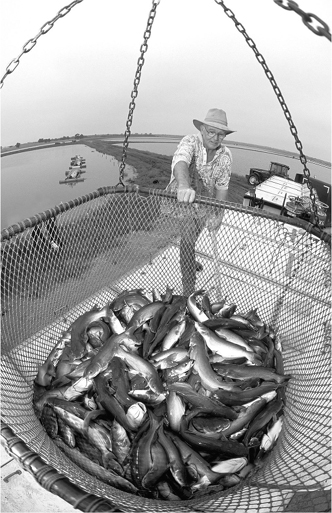
A manager at a catfish farm in Columbus, Mississippi, loads 2,000 pounds of fish onto a truck. Aquaculture facilities employ over 12 million people worldwide and now provide as much as 43 percent of the world's supply of fish.
Types of Aquaculture
There are several types of aquaculture including freshwater and brackish water aquaculture, mariculture, open capture aquaculture, pond and tank culture, pen and cage aquaculture, and sea ranching. Farming systems vary from traditional extensive through modified extensive and semi-intensive to intensive and hyperintensive. Traditional extensive, modified extensive, and semi-intensive farming systems are found mainly in developing countries, whereas highly intensive production systems are more common in developed countries such as Canada and Norway. These systems are distinguished by levels and types of capital investment, use of commercial feeds, stocking densities, use of water exchange, aeration systems and pumps, and antibiotic and chemical usage. The more intensive the system, the greater the degree of technical and organizational control of the production process, the higher the capital costs, and the more disembedded the system from surrounding environments and communities.
...
- Food Challenges
- Animal Welfare
- Beyond Organic
- Cheap Food Policy
- Crop Genetic Diversity
- DDT
- Debt Crisis
- Disappearing Middle
- Export Dependency
- Famine
- Farm Crisis
- Fast Food
- Food Processing Industry
- Food Safety
- Food Security
- Genetically Modified Organisms
- Grain-Fed Beef
- High Fructose Corn Syrup
- Integrated Pest Management
- Irradiation
- Mad Cow Disease
- Malthusianism
- Mechanization
- Millennium Development Goals
- Modernization
- Nitrogen Fixation
- Organochlorines
- Origin Labeling
- Peasant
- Pesticide
- Productionism
- Proletarianization
- Recombinant Bovine Growth Hormone
- Roundup Ready Crops
- Salmonella
- Sewage Sludge
- Soil Erosion
- Sustainable Agriculture
- Swidden Agriculture
- Weed Management
- Food Economics and Trade
- Food Farm and Industry
- Agrarian Question
- Agrarianism
- Agribusiness
- Agricultural Commodity Programs
- Agricultural Extension
- Agrodiversity
- Agroecology
- Agrofood System (Agrifood)
- Aquaculture
- Biodynamic Agriculture
- Biological Control
- Bt
- Composting
- Confined Animal Feeding Operation
- Contract Farming
- Cooperative
- Corn
- Cover Cropping
- Crop Rotation
- Dairy
- Dioxins
- Factory Farm
- Family Farm
- Fertilizer
- Fruits
- Grazing
- Hunting
- Intercropping
- Irrigation
- Legume Crops
- Low-Input Agriculture
- Meats
- Nanotechnology and Food
- Organic Farming
- Plantation
- Rice
- Salmon
- Seed Industry
- Soil Nutrient Cycling
- Soybeans
- Substitutionism
- Sugarcane
- Urban Agriculture
- Vegetables
- Wheat
- Yeoman Farmer
- Food Laws, Agreements, and Organizations
- Archer Daniels Midland
- California Certified Organic Farmers
- Certified Humane
- Certified Organic
- Codex Alimentarius
- Commons ConAgra
- Department of Agriculture, U.S
- Diamond v. Chakrabarty
- Doha Round, World Trade Organization
- Fair Labor Association
- Fair Trade
- Farm Bill
- Federal Insecticide, Fungicide, and Rodenticide Act
- Food and Agriculture Organization
- Food and Drug Administration
- Food First
- Food Justice Movement
- Food Quality Protection Act
- Food Sovereignty
- Institute for Agriculture and Trade Policy
- International Coffee Agreement
- Land Grant University
- National Organic Program
- North American Free Trade Agreement
- Northeast Organic Farming Association
- Ogallala Aquifer
- Public Law 480, Food Aid
- Sustainable Fisheries Act
- United Farm Workers
- Wal-Mart
- Foods and Lifestyle
- Loading...
Get a 30 day FREE TRIAL
-
 Watch videos from a variety of sources bringing classroom topics to life
 -
Read modern, diverse business cases
-
Explore hundreds of books and reference titles

Read next

More like this
Sage Recommends
We found other relevant content for you on other Sage platforms.
Have you created a personal profile? Login or create a profile so that you can save clips, playlists and searches