
Entry
Reader's guide
Entries A-Z
Subject index
Animal Welfare
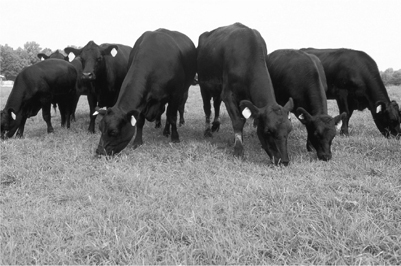
Among other issues, animal welfare reformers focus on reducing confined animal feeding operations while promoting free-range farms that allow animals like these Angus cattle to feed by traditional grazing.
Concerns about the welfare of animals has grown since animal farming emerged with sedentary civilization. Many argue that animals should be treated humanely because they are sentient beings, meaning that they experience pleasure and pain. In the last quarter century, the arguments have become more vocal, particularly in industrialized countries, where the vast majority of land animals and certain sea creatures are raised in confined animal feeding operations (CAFOs), which are considered by many to be an inhumane system of animal productions. CAFOs are highly industrialized systems that strive for maximum efficiency, where animals are produced as objects according to principles of mass production, warranting the label “factory farming.” The problem of factory farming and CAFOs motivate some consumers to purchase animal products that are produced by smaller farms, where animals may be unconfined or “free range,” or by avoiding meat products altogether by becoming vegetarian or vegan.
Development of Farmed Animal Welfare Attitudes
Ethical and spiritual concerns for animals have motivated vegetarianism for several millennia. Ancient vegetarian proponents include Eastern religious leaders Buddha, Mahavira, and Lao Tzu, as well as prominent ancient Greeks such as Pythagoras, Plato, Porphyry, and Plutarch, who proposed the sentience, rationality, and kinship of other animals. Plutarch critiqued cruel farming methods practiced to improve taste, which suggests that even traditional farming involved suffering.
Vegetarianism waned in Western culture during the reign of Christianity, which relies on the human/animal dichotomy. Animal welfare writings resurfaced in the 18th century, largely in resistance to “Cartesianism”—Descartes's scientific viewpoint suggesting that nonhuman animals were automata with little consciousness or feeling—an instrumental attitude serving to justify animal use amid growing concerns over animal suffering in science and agriculture. In contrast, utilitarian philosophers Jeremy Bentham and John Stuart Mill acknowledged animal sentience and promoted restricting animal use to only necessary food and research. Popular sentiment dictated that causing wanton animal suffering led to inhumanity toward other humans. This anthropocentric concern for creating a peaceful civilization was common in 19th-century vegetarian writers, such as Leo Tolstoy, Mahatma Gandhi, and Albert Schweitzer. Henry Salt and J. Howard Moore even promoted an early idea of extending human rights to other animals, often referring to animal cruelty as criminal.
These ideas anticipated philosophies that ushered in the late-20th-century animal rights movement, largely credited to Tom Regan and Peter Singer. Regan considered it morally inconsistent to take away the life of a nonhuman animal—a fellow subject of a life—when one would not take a human life, such as for food. Singer argued that animal agribusiness, whether free range or intensive, is a speciesist practice, meaning it discriminates based on one's species, sacrificing their major interests (life) to satisfy our minor interests (taste).
Agricultural Practices
Historically, a largely rural society supported animal farming because they witnessed animals leading wholesome, natural lives. However, over the previous quarter-century, most family farmers were forced out of business by larger corporate farms. Today's agricultural status quo severely deviates from the bucolic ideal of the pastoral “Old McDonald's Farms,” as industry has largely confined the animals behind closed doors. Pigs and birds are the most intensively confined, cows raised for dairy are semiconfined, and cattle are the least confined until sent to a feedlot.
...
- Food Challenges
- Animal Welfare
- Beyond Organic
- Cheap Food Policy
- Crop Genetic Diversity
- DDT
- Debt Crisis
- Disappearing Middle
- Export Dependency
- Famine
- Farm Crisis
- Fast Food
- Food Processing Industry
- Food Safety
- Food Security
- Genetically Modified Organisms
- Grain-Fed Beef
- High Fructose Corn Syrup
- Integrated Pest Management
- Irradiation
- Mad Cow Disease
- Malthusianism
- Mechanization
- Millennium Development Goals
- Modernization
- Nitrogen Fixation
- Organochlorines
- Origin Labeling
- Peasant
- Pesticide
- Productionism
- Proletarianization
- Recombinant Bovine Growth Hormone
- Roundup Ready Crops
- Salmonella
- Sewage Sludge
- Soil Erosion
- Sustainable Agriculture
- Swidden Agriculture
- Weed Management
- Food Economics and Trade
- Food Farm and Industry
- Agrarian Question
- Agrarianism
- Agribusiness
- Agricultural Commodity Programs
- Agricultural Extension
- Agrodiversity
- Agroecology
- Agrofood System (Agrifood)
- Aquaculture
- Biodynamic Agriculture
- Biological Control
- Bt
- Composting
- Confined Animal Feeding Operation
- Contract Farming
- Cooperative
- Corn
- Cover Cropping
- Crop Rotation
- Dairy
- Dioxins
- Factory Farm
- Family Farm
- Fertilizer
- Fruits
- Grazing
- Hunting
- Intercropping
- Irrigation
- Legume Crops
- Low-Input Agriculture
- Meats
- Nanotechnology and Food
- Organic Farming
- Plantation
- Rice
- Salmon
- Seed Industry
- Soil Nutrient Cycling
- Soybeans
- Substitutionism
- Sugarcane
- Urban Agriculture
- Vegetables
- Wheat
- Yeoman Farmer
- Food Laws, Agreements, and Organizations
- Archer Daniels Midland
- California Certified Organic Farmers
- Certified Humane
- Certified Organic
- Codex Alimentarius
- Commons ConAgra
- Department of Agriculture, U.S
- Diamond v. Chakrabarty
- Doha Round, World Trade Organization
- Fair Labor Association
- Fair Trade
- Farm Bill
- Federal Insecticide, Fungicide, and Rodenticide Act
- Food and Agriculture Organization
- Food and Drug Administration
- Food First
- Food Justice Movement
- Food Quality Protection Act
- Food Sovereignty
- Institute for Agriculture and Trade Policy
- International Coffee Agreement
- Land Grant University
- National Organic Program
- North American Free Trade Agreement
- Northeast Organic Farming Association
- Ogallala Aquifer
- Public Law 480, Food Aid
- Sustainable Fisheries Act
- United Farm Workers
- Wal-Mart
- Foods and Lifestyle
- Loading...
Get a 30 day FREE TRIAL
-
 Watch videos from a variety of sources bringing classroom topics to life
 -
Read modern, diverse business cases
-
Explore hundreds of books and reference titles

Read next

More like this
Sage Recommends
We found other relevant content for you on other Sage platforms.
Have you created a personal profile? Login or create a profile so that you can save clips, playlists and searches