
Entry
Reader's guide
Entries A-Z
Subject index
Agricultural Extension
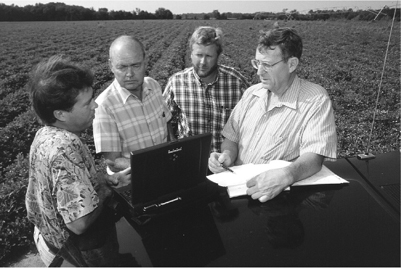
Agricultural extension has grown more collaborative, as suggested by this photograph of a farmer (second from left) consulting with an extension agent, a systems analyst, and a mechanical engineer about conditions in his peanut field in Terrell County, Georgia.
Drawing its name from the act of “extending” scientific knowledge to the general public, agricultural extension serves as the bridge between scientific research and farmers. Beginning in the late 19th century, government-funded agricultural schools and research stations developed practices and technologies that were then transferred to farmers by extensionists. This top-down model was used to disseminate new agricultural technologies and was vital to the scale-up of agriculture in the United States. A similar model of extension was used in the global South by colonial administrations and independent governments alike to increase export crop production. Cuts in government spending under structural adjustment led to the decline of government-funded extension and a growing role for nongovernmental organizations (NGOs) in many such countries. The failures of extension and new technologies to better the lives of small farmers led to calls for greater farmer participation and an overhaul of the top-down extension model. Its scope was expanded to include other aspects of rural development. Although top-down transfer of research and technology—and biotechnology, in particular—persists, agricultural extension has become a more collaborative and participatory practice, where farmer knowledge and experience play a significantly larger role.
The dissemination of agricultural information to farmers is as old as civilization itself. Bountiful harvests fed growing urban populations, provided tax revenue to governments, and fueled armies and the expansion of empires; rulers thus had a vested interest in ensuring good production. Examples of cropping calendars and recommendations for improved farming practices were widespread in ancient Mesopotamia, Egypt, Greece, Phoenicia, and Rome. Agricultural research and extension began in China as early as the late Han Dynasty. In Europe, the development of printing technology led to the widespread distribution of treatises on crop and livestock husbandry during the Renaissance. During the Age of Enlightenment, agricultural clubs were founded by gentlemen farmers interested in applying scientific methods to production on their estates. By the early 19th century, itinerant agricultural teachers throughout Europe and North America were hired by landowners to educate their tenants on improved production techniques.
Birth of Modern Agricultural Extension
The financial support of the state was central to the development of modern agricultural extension. By the middle of the 19th century, most European countries had agricultural schools conducting training and research and disseminating ideas through publications and fairs. The first wholly state-funded agricultural extension service was established in France in 1879 to keep farmers up to date on the latest discoveries in agricultural science. Britain soon followed suit. In the United States, formal state-sponsored extension began with a series of federal laws establishing an infrastructure for agricultural research, education, and extension. The land grant university system, a network of state colleges teaching agriculture and mechanical science, was created with the signing of the Morrill Acts of 1862 and 1890; state agricultural research stations were established under the Hatch Act of 1887. The Smith-Lever Act of 1914 formalized cooperative extension—an organizational hierarchy linking the federal and state Departments of Agriculture and land grant universities. Under this system, a network of extension agents working from county offices disseminated agricultural research conducted at the universities and state research stations.
...
- Food Challenges
- Animal Welfare
- Beyond Organic
- Cheap Food Policy
- Crop Genetic Diversity
- DDT
- Debt Crisis
- Disappearing Middle
- Export Dependency
- Famine
- Farm Crisis
- Fast Food
- Food Processing Industry
- Food Safety
- Food Security
- Genetically Modified Organisms
- Grain-Fed Beef
- High Fructose Corn Syrup
- Integrated Pest Management
- Irradiation
- Mad Cow Disease
- Malthusianism
- Mechanization
- Millennium Development Goals
- Modernization
- Nitrogen Fixation
- Organochlorines
- Origin Labeling
- Peasant
- Pesticide
- Productionism
- Proletarianization
- Recombinant Bovine Growth Hormone
- Roundup Ready Crops
- Salmonella
- Sewage Sludge
- Soil Erosion
- Sustainable Agriculture
- Swidden Agriculture
- Weed Management
- Food Economics and Trade
- Food Farm and Industry
- Agrarian Question
- Agrarianism
- Agribusiness
- Agricultural Commodity Programs
- Agricultural Extension
- Agrodiversity
- Agroecology
- Agrofood System (Agrifood)
- Aquaculture
- Biodynamic Agriculture
- Biological Control
- Bt
- Composting
- Confined Animal Feeding Operation
- Contract Farming
- Cooperative
- Corn
- Cover Cropping
- Crop Rotation
- Dairy
- Dioxins
- Factory Farm
- Family Farm
- Fertilizer
- Fruits
- Grazing
- Hunting
- Intercropping
- Irrigation
- Legume Crops
- Low-Input Agriculture
- Meats
- Nanotechnology and Food
- Organic Farming
- Plantation
- Rice
- Salmon
- Seed Industry
- Soil Nutrient Cycling
- Soybeans
- Substitutionism
- Sugarcane
- Urban Agriculture
- Vegetables
- Wheat
- Yeoman Farmer
- Food Laws, Agreements, and Organizations
- Archer Daniels Midland
- California Certified Organic Farmers
- Certified Humane
- Certified Organic
- Codex Alimentarius
- Commons ConAgra
- Department of Agriculture, U.S
- Diamond v. Chakrabarty
- Doha Round, World Trade Organization
- Fair Labor Association
- Fair Trade
- Farm Bill
- Federal Insecticide, Fungicide, and Rodenticide Act
- Food and Agriculture Organization
- Food and Drug Administration
- Food First
- Food Justice Movement
- Food Quality Protection Act
- Food Sovereignty
- Institute for Agriculture and Trade Policy
- International Coffee Agreement
- Land Grant University
- National Organic Program
- North American Free Trade Agreement
- Northeast Organic Farming Association
- Ogallala Aquifer
- Public Law 480, Food Aid
- Sustainable Fisheries Act
- United Farm Workers
- Wal-Mart
- Foods and Lifestyle
- Loading...
Get a 30 day FREE TRIAL
-
 Watch videos from a variety of sources bringing classroom topics to life
 -
Read modern, diverse business cases
-
Explore hundreds of books and reference titles

Read next

More like this
Sage Recommends
We found other relevant content for you on other Sage platforms.
Have you created a personal profile? Login or create a profile so that you can save clips, playlists and searches