
Entry
Reader's guide
Entries A-Z
Subject index
Agrarian Question
Historically, agriculture was based on family units and small-scale merchants. In the process of the modernization of European societies, the question came up about the future role of traditional agricultural production in the face of modernization. The question still remains relevant in multicultural societies with large tracts of land in the hands of small landholders.
Central to the agrarian question is the coexistence of three economic segments that articulate the flow of natural resources from remote rural areas and from the subsistence economies occupied by indigenous peoples and peasants, through the rural towns and medium cities that trade in natural resources in the mercantilist economy—where capital is based on social relationships, to when the goods arrive to the modern free market economy linked to the world economy through these exports.
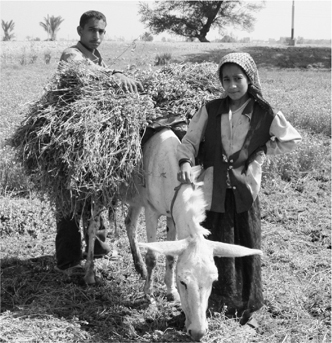
Although the majority of the world's agricultural systems have transitioned to mechanized production, small-scale subsistence farming persists alongside it. These children were photographed near Cairo, Egypt, in June 2006, helping to harvest crops using traditional means.
The agrarian question can be summarized as asking what role there is for small-scale agriculture in the modernization process. Small-scale agriculture does not disappear but is relocated and reduced to the fringes of the modern valley, the rocky slopes, and the wild open nature, where modernization can reach if necessary in the form of a mine or an oil well. The free market, however, prefers to deal with the more trade-oriented actors from the mercantilist economy that operate in the subsistence economy and organize the production that is extracted from the areas occupied by societies in subsistence economies. Thus the extraction of resources is mediated by the mercantilist economic agents from rural areas and towns that gather, transport, and accumulate this small-scale production to be sold by free market actors that are linked to the world market, or to the regional and national markets.
With the increase in globalization in the 21st century, modern crops have expanded through areas of long-term occupation with populations that have progressively been incorporated into the free market and that are usually self-identified as mixed and no longer appeal to an indigenous origin. However, peasants and small farmers survive in remote areas where the market lacks the infrastructure or institutions to expand, although it can arrive if need be. Noncontacted indigenous peoples survive in more remote areas, particularly in tropical areas.
The Amazon is currently confronting the agrarian question in the face of globalization. The Accelerated Plan for Growth promoted by Brazil's National Development Bank is a $220,000 million investment in communication, transport, and energy infrastructure opening access to its neighbors into both oceans. In this case, migrants to the Amazon from recent decades will be faced with the arrival of fresh capital in search of land and resources. Most will sell and move to recently opened areas to repeat the cycle of opening a frontier.
In the face of globalization, probusiness governments aiming to attract investment usually leave no space for small land holders in their governments' development strategy. In such cases, the drive for modernization occurs at the expense of the traditional producers, who leave the land, turn to the cities, survive with their traditional production in the margins of the modern agricultural areas, or move to another region when possible.
...
- Food Challenges
- Animal Welfare
- Beyond Organic
- Cheap Food Policy
- Crop Genetic Diversity
- DDT
- Debt Crisis
- Disappearing Middle
- Export Dependency
- Famine
- Farm Crisis
- Fast Food
- Food Processing Industry
- Food Safety
- Food Security
- Genetically Modified Organisms
- Grain-Fed Beef
- High Fructose Corn Syrup
- Integrated Pest Management
- Irradiation
- Mad Cow Disease
- Malthusianism
- Mechanization
- Millennium Development Goals
- Modernization
- Nitrogen Fixation
- Organochlorines
- Origin Labeling
- Peasant
- Pesticide
- Productionism
- Proletarianization
- Recombinant Bovine Growth Hormone
- Roundup Ready Crops
- Salmonella
- Sewage Sludge
- Soil Erosion
- Sustainable Agriculture
- Swidden Agriculture
- Weed Management
- Food Economics and Trade
- Food Farm and Industry
- Agrarian Question
- Agrarianism
- Agribusiness
- Agricultural Commodity Programs
- Agricultural Extension
- Agrodiversity
- Agroecology
- Agrofood System (Agrifood)
- Aquaculture
- Biodynamic Agriculture
- Biological Control
- Bt
- Composting
- Confined Animal Feeding Operation
- Contract Farming
- Cooperative
- Corn
- Cover Cropping
- Crop Rotation
- Dairy
- Dioxins
- Factory Farm
- Family Farm
- Fertilizer
- Fruits
- Grazing
- Hunting
- Intercropping
- Irrigation
- Legume Crops
- Low-Input Agriculture
- Meats
- Nanotechnology and Food
- Organic Farming
- Plantation
- Rice
- Salmon
- Seed Industry
- Soil Nutrient Cycling
- Soybeans
- Substitutionism
- Sugarcane
- Urban Agriculture
- Vegetables
- Wheat
- Yeoman Farmer
- Food Laws, Agreements, and Organizations
- Archer Daniels Midland
- California Certified Organic Farmers
- Certified Humane
- Certified Organic
- Codex Alimentarius
- Commons ConAgra
- Department of Agriculture, U.S
- Diamond v. Chakrabarty
- Doha Round, World Trade Organization
- Fair Labor Association
- Fair Trade
- Farm Bill
- Federal Insecticide, Fungicide, and Rodenticide Act
- Food and Agriculture Organization
- Food and Drug Administration
- Food First
- Food Justice Movement
- Food Quality Protection Act
- Food Sovereignty
- Institute for Agriculture and Trade Policy
- International Coffee Agreement
- Land Grant University
- National Organic Program
- North American Free Trade Agreement
- Northeast Organic Farming Association
- Ogallala Aquifer
- Public Law 480, Food Aid
- Sustainable Fisheries Act
- United Farm Workers
- Wal-Mart
- Foods and Lifestyle
- Loading...
Get a 30 day FREE TRIAL
-
 Watch videos from a variety of sources bringing classroom topics to life
 -
Read modern, diverse business cases
-
Explore hundreds of books and reference titles

Read next

More like this
Sage Recommends
We found other relevant content for you on other Sage platforms.
Have you created a personal profile? Login or create a profile so that you can save clips, playlists and searches