
Entry
Reader's guide
Entries A-Z
Subject index
Websites and Blogs
Triggered by the seminal contributions by Vance Packard (1957) and John Kenneth Galbraith (1958), the shift of sovereignty from consumers to producers has been attributed to the producers' domination of mass communication channels. However, modern digital media are not dominated by a few key communicators, and thus enable a voice for the people again. With increasing attention devoted to these media, consumers recover part of their sovereignty by gaining both “share of voice” and “share of attention.” Websites and blogs are the main instruments for consumers to strengthen their communication abilities.
According to Ralf Wagner (2009), Websites are defined as representations of individuals, groups, or organizations within the World Wide Web that are accessible by a uniform resource locator (or URL), using a browser. The Websites can be
- static—presenting text and audiovisual content according to a predefined navigation system—or
- dynamic—customizing the presented content according to both visitors' profiles and visitors' actions while browsing the site.
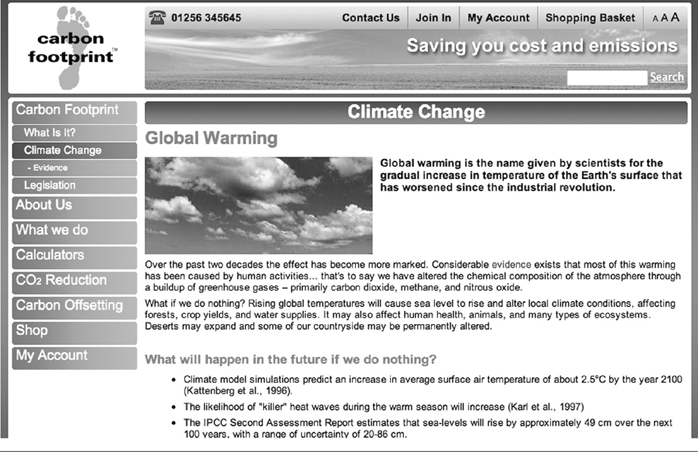
One example of an informative blog from an NGO is the Britain-based http://carbonfootprint.com, which allows consumers to calculate their own carbon footprint and learn tips on how to reduce it
Website vendors point to other Websites by incorporating hyperlinks to these Websites. This makes up a network of information. The links can be followed by human visitors and Web bots, which feed the search engines with information about Websites. Because most Web search engines use the number of in-links and the quality of the in-linking Websites for the ranking of Websites, the net citizens control the visibility of Websites and reinforce one another's visibility.
Blogs, or weblogs, are digital diaries on the Web. Consumers can share not only their experiences when using products and services but also their opinions and concerns about issues such as energy production and consumption, for example. Unlike Websites, blogs have typically been associated with individuals—nowadays, however, more and more organizations and companies are setting up blogs to communicate with their stakeholders or to promote their brands and labels—who make up a network by adding other blogs to their blog roll. Although blog rolls and links between Websites rely on the same hypertext technology, they have a different quality. As links can spread throughout the Website, they are typically embedded in a specific context. In contrast, the relations consolidated in blog rolls are highlighted by the fact that they are assigned to the blog roll. The blogger is also free to add links to other blogs or Websites when assembling the content. Moreover, bloggers usually provide one another with a ping as notification that they refer to other blogs, thus supporting community building within the blogosphere.
Blogging is becoming more popular than setting up Websites because some providers offer bloggers maintenance of personal blogs free of charge. Moreover, sophisticated tools disburden bloggers from any programming tasks: blogging allows the participant to focus on the content, whereas maintaining Websites requires technical knowledge of navigation design, file hosting, and so on.
In addition to conventional blogs, special blog types like videoblogs and microblogs are also gaining in popularity. The latter are made up of short messages and can be fed in and read not only by using computers with Internet access but also via mobile devices like cellular phones or personal digital assistants.
...
- Green Consumer Challenges
- Affluenza
- Air Travel
- Carbon Emissions
- Commuting
- Conspicuous Consumption
- Disparities in Consumption
- Dumpster Diving
- Durability
- E-Waste
- Electricity Usage
- Energy Efficiency of Products and Appliances
- Food Additives
- Food Miles
- Genetically Modified Products
- Greenwashing
- Healthcare
- Insulation
- Lawns and Landscaping
- Materialism
- Needs and Wants
- Overconsumption
- Pesticides and Fertilizers
- Pets
- Pharmaceuticals
- Positional Goods
- Poverty
- Pricing
- Quality of Life
- Resource Consumption and Usage
- Solid and Human Waste
- Super-Rich
- Symbolic Consumption
- Waste Disposal
- Windows
- Beverages
- Bottled Beverages (Water)
- Coffee
- Confections
- Dairy Products
- Fish
- Meat
- Poultry and Eggs
- Slow Food
- Tea
- Vegetables and Fruits
- Water
- Green Consumer Products and Services
- Adhesives
- Apparel
- Audio Equipment
- Automobiles
- Baby Products
- Books
- Car Washing
- Certified Products (Fair Trade or Organic)
- Cleaning Products
- Computers and Printers
- Cosmetics
- Disposable Plates and Plastic Implements
- Floor and Wall Coverings
- Fuel
- Funerals
- Furniture
- Garden Tools and Appliances
- Grains
- Home Appliances
- Home Shopping and Catalogs
- Homewares
- Internet Purchasing
- Lighting
- Linen and Bedding
- Magazines
- Malls
- Mobile Phones
- Packaging and Product Containers
- Paper Products
- Personal Products
- Recyclable Products
- Seasonal Products
- Services
- Shopping
- Shopping Bags
- Sports
- Supermarkets
- Swimming Pools and Spas
- Television and DVD Equipment
- Tools
- Toys
- Green Consumer Solutions
- Biodegradable
- Carbon Credits
- Carbon Offsets
- Certification Process
- Composting
- Consumer Activism
- Downshifting
- Ecolabeling
- Ecological Footprint
- Ecotourism
- Environmentally Friendly
- Ethically Produced Products
- Fair Trade
- Gardening/Growing
- Gifting (Green Gifts)
- Green Communities
- Green Consumer
- Green Consumerism Organizations
- Green Design
- Green Discourse
- Green Food
- Green Gross Domestic Product
- Green Homes
- Green Marketing
- Green Politics
- Local Exchange Trading Schemes
- Locally Made
- Markets (Organic/Farmers)
- Morality (Consumer Ethics)
- Organic
- Plants
- Product Sharing
- Public Transportation
- Recycling
- Regulation
- Secondhand Consumption
- Simple Living
- Sustainable Consumption
- Vege-Box Schemes
- Green Consumerism Organizations, Movements, and Planning
- Advertising
- Commodity Fetishism
- Consumer Behavior
- Consumer Boycotts
- Consumer Culture
- Consumer Ethics
- Consumer Society
- Consumerism
- Demographics
- Diderot Effect
- Environmentalism
- Fashion
- Final Consumption
- Finance and Economics
- Frugality
- Government Policy and Practice (Local and National)
- Heating and Cooling
- International Regulatory Frameworks
- Kyoto Protocol
- Leisure and Recreation
- Lifestyle, Rural
- Lifestyle, Suburban
- Lifestyle, Sustainable
- Lifestyle, Urban
- Organisation for Economic Co-operation and Development (OECD)
- Production and Commodity Chains
- Psychographics
- Social Identity
- Taxation
- United Nations Human Development Report 1998
- Websites and Blogs
- Loading...
Get a 30 day FREE TRIAL
-
 Watch videos from a variety of sources bringing classroom topics to life
 -
Read modern, diverse business cases
-
Explore hundreds of books and reference titles

Read next

More like this
Sage Recommends
We found other relevant content for you on other Sage platforms.
Have you created a personal profile? Login or create a profile so that you can save clips, playlists and searches