
Entry
Reader's guide
Entries A-Z
Subject index
Poultry and Eggs
Poultry farms, in which chickens (or turkeys, ducks, or other birds raised for food) are raised for meat, eggs, and breeding, can be significant sources of pollution, and numerous concerns have been raised about the safety and ethics of meat produced in the “factory farms” (also known as “confined animal feeding operations” in the language of some legislation) that developed in the second half of the 20th century. Despite the promise of “a chicken in every pot” when Herbert Hoover was elected president in 1928, whole chickens were not a common supermarket item in the United States until the 1950s; roast chicken, like turkey or duck now, was previously a luxurious special-occasion food, perhaps served as Sunday dinner for some middle-class families, instead of a baked ham, and the cook often had to eviscerate the chicken herself.
Whole chickens were not a common supermarket item until the 1950s. Roast chicken was previously a luxurious, special-occasion food, until factory farms supplanted family farms and made chicken affordable
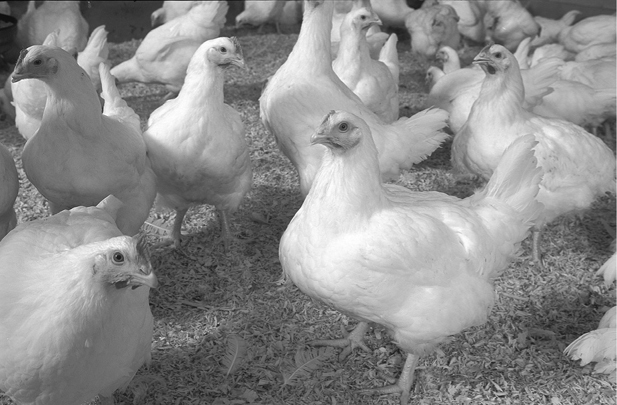
The factory farms that supplanted family farms—for which egg sales were the main revenue stream—made cheap chicken possible, while at the same time making the tough old chickens that had been the basis for many classic meals (the French coq au vin, or many a great-grandmother's chicken noodle soup) a thing of the past. With a seemingly limitless supply of chickens, they no longer had to be kept until their egg-laying days were over—they could be slaughtered while young, when the meat was still tender, and sold cheaply enough to be an everyday food, while leaving plenty of chickens alive for egg production. At the same time, egg production was enhanced by breeding chickens for larger yields—bigger eggs, and more of them. (From 1900 to 2000, the average number of eggs produced by a hen in a year increased from 83 to 300, and average egg size increased as well.) From the Great Depression to the end of World War II, the price of eggs dropped so low that many family farmers had little choice but to get out of the business, converting to some other farm product or selling their lands to a factory farm or one of the housing developments that spread across postwar America.
Industrial agriculture is resource-intensive, consuming vast amounts of water and energy, while increasing pollution of soil and water through animal waste products, dead animals, and other substances that are disposed of. Vitamin supplements, antimicrobial injections, and other substances are used to promote and accelerate the development of the chickens, and dominant behaviors are bred out as much as possible. Often chickens are physically restrained to keep them from attacking each other in their close quarters. They may also have their beaks removed to make it harder for them to hurt each other if they do attack. Animal waste at factory farms is required to be stored in “lagoons,” which, when they leak or are damaged, have caused significant pollution problems in the past. Concentrating such waste in such large amounts also leads to larger concentrations of trace elements of arsenic and copper, which may contaminate nearby bodies of water. The environment of a factory farm also becomes unhealthy for the workers there; the U.S. Centers for Disease Control and Prevention has determined that workers on such farms may be susceptible to chronic lung disease, injuries, and infections as a result of the heavy concentration of chemicals, bacteria, and viral compounds.
...
- Green Consumer Challenges
- Affluenza
- Air Travel
- Carbon Emissions
- Commuting
- Conspicuous Consumption
- Disparities in Consumption
- Dumpster Diving
- Durability
- E-Waste
- Electricity Usage
- Energy Efficiency of Products and Appliances
- Food Additives
- Food Miles
- Genetically Modified Products
- Greenwashing
- Healthcare
- Insulation
- Lawns and Landscaping
- Materialism
- Needs and Wants
- Overconsumption
- Pesticides and Fertilizers
- Pets
- Pharmaceuticals
- Positional Goods
- Poverty
- Pricing
- Quality of Life
- Resource Consumption and Usage
- Solid and Human Waste
- Super-Rich
- Symbolic Consumption
- Waste Disposal
- Windows
- Beverages
- Bottled Beverages (Water)
- Coffee
- Confections
- Dairy Products
- Fish
- Meat
- Poultry and Eggs
- Slow Food
- Tea
- Vegetables and Fruits
- Water
- Green Consumer Products and Services
- Adhesives
- Apparel
- Audio Equipment
- Automobiles
- Baby Products
- Books
- Car Washing
- Certified Products (Fair Trade or Organic)
- Cleaning Products
- Computers and Printers
- Cosmetics
- Disposable Plates and Plastic Implements
- Floor and Wall Coverings
- Fuel
- Funerals
- Furniture
- Garden Tools and Appliances
- Grains
- Home Appliances
- Home Shopping and Catalogs
- Homewares
- Internet Purchasing
- Lighting
- Linen and Bedding
- Magazines
- Malls
- Mobile Phones
- Packaging and Product Containers
- Paper Products
- Personal Products
- Recyclable Products
- Seasonal Products
- Services
- Shopping
- Shopping Bags
- Sports
- Supermarkets
- Swimming Pools and Spas
- Television and DVD Equipment
- Tools
- Toys
- Green Consumer Solutions
- Biodegradable
- Carbon Credits
- Carbon Offsets
- Certification Process
- Composting
- Consumer Activism
- Downshifting
- Ecolabeling
- Ecological Footprint
- Ecotourism
- Environmentally Friendly
- Ethically Produced Products
- Fair Trade
- Gardening/Growing
- Gifting (Green Gifts)
- Green Communities
- Green Consumer
- Green Consumerism Organizations
- Green Design
- Green Discourse
- Green Food
- Green Gross Domestic Product
- Green Homes
- Green Marketing
- Green Politics
- Local Exchange Trading Schemes
- Locally Made
- Markets (Organic/Farmers)
- Morality (Consumer Ethics)
- Organic
- Plants
- Product Sharing
- Public Transportation
- Recycling
- Regulation
- Secondhand Consumption
- Simple Living
- Sustainable Consumption
- Vege-Box Schemes
- Green Consumerism Organizations, Movements, and Planning
- Advertising
- Commodity Fetishism
- Consumer Behavior
- Consumer Boycotts
- Consumer Culture
- Consumer Ethics
- Consumer Society
- Consumerism
- Demographics
- Diderot Effect
- Environmentalism
- Fashion
- Final Consumption
- Finance and Economics
- Frugality
- Government Policy and Practice (Local and National)
- Heating and Cooling
- International Regulatory Frameworks
- Kyoto Protocol
- Leisure and Recreation
- Lifestyle, Rural
- Lifestyle, Suburban
- Lifestyle, Sustainable
- Lifestyle, Urban
- Organisation for Economic Co-operation and Development (OECD)
- Production and Commodity Chains
- Psychographics
- Social Identity
- Taxation
- United Nations Human Development Report 1998
- Websites and Blogs
- Loading...
Get a 30 day FREE TRIAL
-
 Watch videos from a variety of sources bringing classroom topics to life
 -
Read modern, diverse business cases
-
Explore hundreds of books and reference titles

Read next

More like this
Sage Recommends
We found other relevant content for you on other Sage platforms.
Have you created a personal profile? Login or create a profile so that you can save clips, playlists and searches