
Entry
Reader's guide
Entries A-Z
Subject index
Plants
The planet Earth is dominated by plants, and the green plant is fundamental to all other life. Charles Lewis explored human ties to the green world and concluded that people and plants are entwined by threads that reach back to our very beginnings as a species. Plants have a wide spectrum of uses, supplying our food requirements either directly or indirectly as feed for animals. Crop production—the management of useful plants—is the very basis of our civilization. Plants are used as a source of construction materials and as the raw materials in the manufacture of fabrics and paper. Plants are the basis of many of the complex substances used such as dyes, tannins, waxes, resins, flavorings, medicines, and drugs. Plants, in addition to having a direct effect on our ecological position, are used to control erosion by water and wind, provide a setting for recreation and sports, and as landscape materials that satisfy our desire for beauty. This article focuses on the use of plants in contemporary American gardens and the current awareness of using plants that provide a more sustainable approach to the environment.
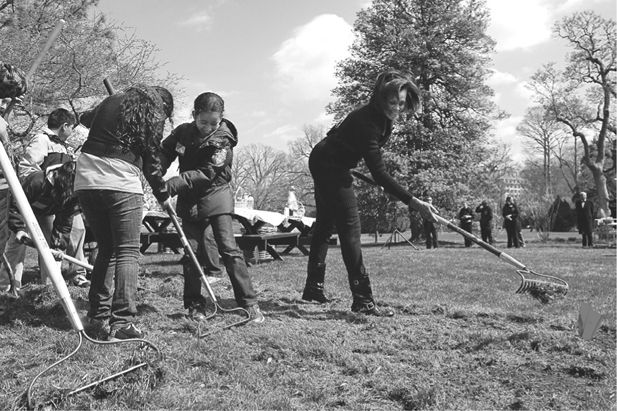
An estimated 36 million U.S. households, including the White House, now participate in food gardening. Here, First Lady Michelle Obama works with children from a local elementary school to break ground for a White House kitchen garden
According to Bruce Butterfield of the National Gardening Association, 81.2 million households in the United States in 2008 were involved in some form of gardening. These activities all require the growing or maintaining of plants and are a form of green consumerism. His research further broke this down to more specific trends. For example, homeowners spent a record $44.7 billion in 2008 to hire lawn care and landscape maintenance services, landscape installation and construction services, tree care services, and landscape design services. Thirty percent of all households nationwide, or an estimated 34.5 million households, currently hire at least one type of lawn and landscape service. As a consequence, the most popular plant-related activities in the United States are lawn care, landscaping with ornamental plants, and vegetable and fruit production. In 2008, interest in household participation in food gardening increased. Thirty-one percent of all U.S. households, or an estimated 36 million households, participated in food gardening. This includes growing vegetables, fruit, berries, and herbs.
Those 81.2 million households in the United States pose a considerable threat to natural functioning ecosystems through the overuse of pesticides and fertilizers that can affect the water quality in nearby groundwater and surface water areas. This has been documented by a number of studies showing high levels of pesticides and nutrients, primarily nitrates, leaching into drinking-water wells and flowing into rivers that eventually reach the oceans.
Any discussion of plants ought to include a brief discussion of gardening and the garden. The garden is a product of the domestication of plants, a utilitarian place, and a place of ritual. Gardening is a practice through which the division between humans and the rest of the world can be bridged. This practice is highly personal, providing real physical places to contemplate the world through the cultivation of plants. Gardening requires active engagement with the natural world: Planting a seed, running one's fingers through the soil, or watching a plant grow are living embodiments of this personal exploration. Through cultivating a particular parcel over a series of years, a gardener develops a personal connection to that place.
...
- Green Consumer Challenges
- Affluenza
- Air Travel
- Carbon Emissions
- Commuting
- Conspicuous Consumption
- Disparities in Consumption
- Dumpster Diving
- Durability
- E-Waste
- Electricity Usage
- Energy Efficiency of Products and Appliances
- Food Additives
- Food Miles
- Genetically Modified Products
- Greenwashing
- Healthcare
- Insulation
- Lawns and Landscaping
- Materialism
- Needs and Wants
- Overconsumption
- Pesticides and Fertilizers
- Pets
- Pharmaceuticals
- Positional Goods
- Poverty
- Pricing
- Quality of Life
- Resource Consumption and Usage
- Solid and Human Waste
- Super-Rich
- Symbolic Consumption
- Waste Disposal
- Windows
- Beverages
- Bottled Beverages (Water)
- Coffee
- Confections
- Dairy Products
- Fish
- Meat
- Poultry and Eggs
- Slow Food
- Tea
- Vegetables and Fruits
- Water
- Green Consumer Products and Services
- Adhesives
- Apparel
- Audio Equipment
- Automobiles
- Baby Products
- Books
- Car Washing
- Certified Products (Fair Trade or Organic)
- Cleaning Products
- Computers and Printers
- Cosmetics
- Disposable Plates and Plastic Implements
- Floor and Wall Coverings
- Fuel
- Funerals
- Furniture
- Garden Tools and Appliances
- Grains
- Home Appliances
- Home Shopping and Catalogs
- Homewares
- Internet Purchasing
- Lighting
- Linen and Bedding
- Magazines
- Malls
- Mobile Phones
- Packaging and Product Containers
- Paper Products
- Personal Products
- Recyclable Products
- Seasonal Products
- Services
- Shopping
- Shopping Bags
- Sports
- Supermarkets
- Swimming Pools and Spas
- Television and DVD Equipment
- Tools
- Toys
- Green Consumer Solutions
- Biodegradable
- Carbon Credits
- Carbon Offsets
- Certification Process
- Composting
- Consumer Activism
- Downshifting
- Ecolabeling
- Ecological Footprint
- Ecotourism
- Environmentally Friendly
- Ethically Produced Products
- Fair Trade
- Gardening/Growing
- Gifting (Green Gifts)
- Green Communities
- Green Consumer
- Green Consumerism Organizations
- Green Design
- Green Discourse
- Green Food
- Green Gross Domestic Product
- Green Homes
- Green Marketing
- Green Politics
- Local Exchange Trading Schemes
- Locally Made
- Markets (Organic/Farmers)
- Morality (Consumer Ethics)
- Organic
- Plants
- Product Sharing
- Public Transportation
- Recycling
- Regulation
- Secondhand Consumption
- Simple Living
- Sustainable Consumption
- Vege-Box Schemes
- Green Consumerism Organizations, Movements, and Planning
- Advertising
- Commodity Fetishism
- Consumer Behavior
- Consumer Boycotts
- Consumer Culture
- Consumer Ethics
- Consumer Society
- Consumerism
- Demographics
- Diderot Effect
- Environmentalism
- Fashion
- Final Consumption
- Finance and Economics
- Frugality
- Government Policy and Practice (Local and National)
- Heating and Cooling
- International Regulatory Frameworks
- Kyoto Protocol
- Leisure and Recreation
- Lifestyle, Rural
- Lifestyle, Suburban
- Lifestyle, Sustainable
- Lifestyle, Urban
- Organisation for Economic Co-operation and Development (OECD)
- Production and Commodity Chains
- Psychographics
- Social Identity
- Taxation
- United Nations Human Development Report 1998
- Websites and Blogs
- Loading...
Get a 30 day FREE TRIAL
-
 Watch videos from a variety of sources bringing classroom topics to life
 -
Read modern, diverse business cases
-
Explore hundreds of books and reference titles

Read next

More like this
Sage Recommends
We found other relevant content for you on other Sage platforms.
Have you created a personal profile? Login or create a profile so that you can save clips, playlists and searches