
Entry
Reader's guide
Entries A-Z
Subject index
Lifestyle, Suburban
While the term lifestyle has become synonymous in popular culture with terms such as way of life, in academic circles the term finds its strongest elaboration in debates on consumption and consumerism. Returning the focus to consumption enables us to assess more clearly both the ways in which lifestyles contribute to environmental harm as well as how they might be redirected toward lessening environmental impact. Moreover, orienting lifestyle consumption within a larger vision of green ways of life may strengthen the ways in which more sustainable living practices can be developed. The suburban environment can be seen as both the location for many environmentally harmful consumption practices as well as a fertile one for the development of more environmentally beneficial alternatives. Indeed, there are specific elements of traditional suburban patterns of life and culture that lend themselves to such developments.
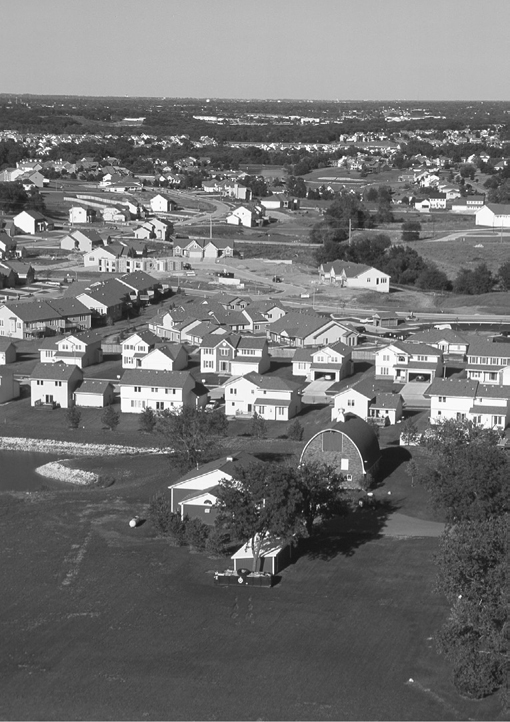
Suburbs often form from the transformation of farmland into tract housing, like these new homes replacing farmland outside Des Moines, Iowa
Lifestyle and Consumption Practices
As a term most fully developed in relation to consumption practices, lifestyle is not simply reducible to personal consumption by individuals. Various promotional industries may present consumption in that manner, constantly orienting it around images of personal consumption, but this is somewhat misleading. First, individuals are usually part of households, and household consumption decisions are significant in terms of their environmental impact and the prospects for lessening that impact. Consumption results from both the addition of personal consumption habits, practices, and plans, and also from household consumer practices which may not be specifically oriented to any one individual in a household.
Moreover, individual consumption is not all oriented toward lifestyle. Much individual, and most household, consumption can be best defined as ordinary consumption, and is concerned with matters including convenience, habit, and individual responses to changing social contexts. Much ordinary consumption is either necessary or obligatory; food, fuel, travel, insurance, and, increasingly, services that were often formally wholly provided by the state and funded through taxation, for example, paid elements of health and social care. Lifestyle consumption, on the other hand, is generally defined as consumption in excess of, or in addition to, that ordinary consumption oriented toward satisfying basic needs.
Lifestyle consumption is also usually represented as being oriented to certain kinds of goods, including clothing, cosmetics, and the products of the culture industries. As such, lifestyles are regarded very much as self-oriented sets of consumer practices forming part of a reflexive, biographical project of identity-formation and self-presentation and based particularly upon the consumption of the symbolic dimensions of commodities. Lifestyle is seen as a sensibility—something that helps make sense of consumer choice, reduces the anxiety that flows from having to make such choices, and provides a consistent framework within which consumption decisions are made so that there is a consonance between the objects, services or experiences chosen and consumed. This kind of consumption is seen by some environmentalists as particularly wasteful and harmful, not simply because of the resources it uses, but because it is seen as frivolous and superfluous.
...
- Green Consumer Challenges
- Affluenza
- Air Travel
- Carbon Emissions
- Commuting
- Conspicuous Consumption
- Disparities in Consumption
- Dumpster Diving
- Durability
- E-Waste
- Electricity Usage
- Energy Efficiency of Products and Appliances
- Food Additives
- Food Miles
- Genetically Modified Products
- Greenwashing
- Healthcare
- Insulation
- Lawns and Landscaping
- Materialism
- Needs and Wants
- Overconsumption
- Pesticides and Fertilizers
- Pets
- Pharmaceuticals
- Positional Goods
- Poverty
- Pricing
- Quality of Life
- Resource Consumption and Usage
- Solid and Human Waste
- Super-Rich
- Symbolic Consumption
- Waste Disposal
- Windows
- Beverages
- Bottled Beverages (Water)
- Coffee
- Confections
- Dairy Products
- Fish
- Meat
- Poultry and Eggs
- Slow Food
- Tea
- Vegetables and Fruits
- Water
- Green Consumer Products and Services
- Adhesives
- Apparel
- Audio Equipment
- Automobiles
- Baby Products
- Books
- Car Washing
- Certified Products (Fair Trade or Organic)
- Cleaning Products
- Computers and Printers
- Cosmetics
- Disposable Plates and Plastic Implements
- Floor and Wall Coverings
- Fuel
- Funerals
- Furniture
- Garden Tools and Appliances
- Grains
- Home Appliances
- Home Shopping and Catalogs
- Homewares
- Internet Purchasing
- Lighting
- Linen and Bedding
- Magazines
- Malls
- Mobile Phones
- Packaging and Product Containers
- Paper Products
- Personal Products
- Recyclable Products
- Seasonal Products
- Services
- Shopping
- Shopping Bags
- Sports
- Supermarkets
- Swimming Pools and Spas
- Television and DVD Equipment
- Tools
- Toys
- Green Consumer Solutions
- Biodegradable
- Carbon Credits
- Carbon Offsets
- Certification Process
- Composting
- Consumer Activism
- Downshifting
- Ecolabeling
- Ecological Footprint
- Ecotourism
- Environmentally Friendly
- Ethically Produced Products
- Fair Trade
- Gardening/Growing
- Gifting (Green Gifts)
- Green Communities
- Green Consumer
- Green Consumerism Organizations
- Green Design
- Green Discourse
- Green Food
- Green Gross Domestic Product
- Green Homes
- Green Marketing
- Green Politics
- Local Exchange Trading Schemes
- Locally Made
- Markets (Organic/Farmers)
- Morality (Consumer Ethics)
- Organic
- Plants
- Product Sharing
- Public Transportation
- Recycling
- Regulation
- Secondhand Consumption
- Simple Living
- Sustainable Consumption
- Vege-Box Schemes
- Green Consumerism Organizations, Movements, and Planning
- Advertising
- Commodity Fetishism
- Consumer Behavior
- Consumer Boycotts
- Consumer Culture
- Consumer Ethics
- Consumer Society
- Consumerism
- Demographics
- Diderot Effect
- Environmentalism
- Fashion
- Final Consumption
- Finance and Economics
- Frugality
- Government Policy and Practice (Local and National)
- Heating and Cooling
- International Regulatory Frameworks
- Kyoto Protocol
- Leisure and Recreation
- Lifestyle, Rural
- Lifestyle, Suburban
- Lifestyle, Sustainable
- Lifestyle, Urban
- Organisation for Economic Co-operation and Development (OECD)
- Production and Commodity Chains
- Psychographics
- Social Identity
- Taxation
- United Nations Human Development Report 1998
- Websites and Blogs
- Loading...
Get a 30 day FREE TRIAL
-
 Watch videos from a variety of sources bringing classroom topics to life
 -
Read modern, diverse business cases
-
Explore hundreds of books and reference titles

Read next

More like this
Sage Recommends
We found other relevant content for you on other Sage platforms.
Have you created a personal profile? Login or create a profile so that you can save clips, playlists and searches