
Entry
Reader's guide
Entries A-Z
Subject index
Grains
The term grains refers to grasses (members of the botanical family Gramineae Juss) that have been domesticated and selected by man to be used for food. The main characteristics of grains are having a low percentage of water in their fruit; an abundance of starch; and a relative scarcity of indigestible substances such as cellulose and lignin. After grinding, flour, when mixed with water and fermented, is used for bread making and other similar products, all of which are very important for nourishment.
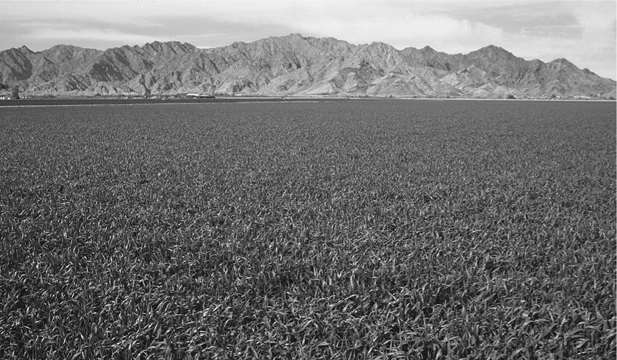
Wheat, corn, and rice account for about 85 percent of global grain production. Here, an irrigated wheat field in Arizona
Grain cultivation began in the Neolithic period, between 9000 and 8000 B.C.E. Since then, grains have played a crucial role in human nutrition. From a broad point of view, it is fair to say that the replacement of some grains that provide low nutritional value and that are difficult to digest (e.g., sorghum and millet) with others that are decidedly superior is a constant phenomenon in the progress of various civilizations. In fact, the evolution of civilizations has always been linked with the evolution and expansion of cereal cultivation. Among the oldest cultivated species are barley and wheat in the Mediterranean basin, rice in eastern Asia, millet and sorghum in southern Asia and Africa, and maize in the Americas.
The traditional cereal cultivation system underwent a revolution after the discovery of America; European colonists did, in fact, contribute to the diffusion throughout the Americas of Euro-Asiatic cereals (wheat, barley, oats, rye, rice) and, at the same time, introduced corn into European agricultural cycles. During the colonial era, European expansion contributed to the global diffusion of monoculture practices for the three principal grains: wheat, corn, and rice.
In the course of the 19th century, in Europe, the first true revolution in grains cultivation techniques occurred: an increase in yields resulting from the use of natural fertilizers, such as guano, imported from South America.
Between the early 1930s and 1940s, a second revolution in the cultivation of grains occurred, thanks to the creation of the first artificial grain (triticale) and to the development of high-yielding varieties. The triticale is a hybrid derived from the cross-fertilization of wheat and rye, that, thanks to its high protein content, has proven very valuable both for human and for animal consumption. “High-yielding varieties” refers to new seeds that are created through genetic hybridization to obtain varieties of grains that have a higher resistance to disease and are capable of higher yields. Experiments began in Mexico around the mid-1940s by U.S. scientist Norman Ernest Borlaugh. After the first experiments, beginning in the 1960s, the Food and Agriculture Organization of the United Nations promoted the use of high-yielding varieties with the intention of promoting the Indicative World Plan for Agricultural Development, known as the Green Revolution.
The new high-yielding varieties have, in effect, been able to make available higher quantities of food (between 1950 and 2000, world production of grains has increased from 631 to 1,863 million tons), but the environmental cost has also been high. High-yielding varieties have, in fact, demanded intensive irrigation and the employment of phytopharmaceuticals; this has caused radical territorial transformations caused by the construction of elaborate hydraulic infrastructures indispensable to providing the necessary volume of irrigation water, and also the increase in soil and water pollution. Furthermore, the nutritional elements contained in plant protection products (between 1950 and 2000, the consumption of soil fertilizers has increased from 14 to 141 million tons, and per person from 5.5 to 27 kg) bear the highest responsibility for the eutrophication that has affected the internal seas such as the Mediterranean, Baltic, and North seas. The use of high-yielding varieties has also meant a considerable loss in biodiversity (wheat varieties alone have shrunk from some thousands to a few dozen) and has contributed to the salinization of agricultural soils and increased erosion phenomena.
...
- Green Consumer Challenges
- Affluenza
- Air Travel
- Carbon Emissions
- Commuting
- Conspicuous Consumption
- Disparities in Consumption
- Dumpster Diving
- Durability
- E-Waste
- Electricity Usage
- Energy Efficiency of Products and Appliances
- Food Additives
- Food Miles
- Genetically Modified Products
- Greenwashing
- Healthcare
- Insulation
- Lawns and Landscaping
- Materialism
- Needs and Wants
- Overconsumption
- Pesticides and Fertilizers
- Pets
- Pharmaceuticals
- Positional Goods
- Poverty
- Pricing
- Quality of Life
- Resource Consumption and Usage
- Solid and Human Waste
- Super-Rich
- Symbolic Consumption
- Waste Disposal
- Windows
- Beverages
- Bottled Beverages (Water)
- Coffee
- Confections
- Dairy Products
- Fish
- Meat
- Poultry and Eggs
- Slow Food
- Tea
- Vegetables and Fruits
- Water
- Green Consumer Products and Services
- Adhesives
- Apparel
- Audio Equipment
- Automobiles
- Baby Products
- Books
- Car Washing
- Certified Products (Fair Trade or Organic)
- Cleaning Products
- Computers and Printers
- Cosmetics
- Disposable Plates and Plastic Implements
- Floor and Wall Coverings
- Fuel
- Funerals
- Furniture
- Garden Tools and Appliances
- Grains
- Home Appliances
- Home Shopping and Catalogs
- Homewares
- Internet Purchasing
- Lighting
- Linen and Bedding
- Magazines
- Malls
- Mobile Phones
- Packaging and Product Containers
- Paper Products
- Personal Products
- Recyclable Products
- Seasonal Products
- Services
- Shopping
- Shopping Bags
- Sports
- Supermarkets
- Swimming Pools and Spas
- Television and DVD Equipment
- Tools
- Toys
- Green Consumer Solutions
- Biodegradable
- Carbon Credits
- Carbon Offsets
- Certification Process
- Composting
- Consumer Activism
- Downshifting
- Ecolabeling
- Ecological Footprint
- Ecotourism
- Environmentally Friendly
- Ethically Produced Products
- Fair Trade
- Gardening/Growing
- Gifting (Green Gifts)
- Green Communities
- Green Consumer
- Green Consumerism Organizations
- Green Design
- Green Discourse
- Green Food
- Green Gross Domestic Product
- Green Homes
- Green Marketing
- Green Politics
- Local Exchange Trading Schemes
- Locally Made
- Markets (Organic/Farmers)
- Morality (Consumer Ethics)
- Organic
- Plants
- Product Sharing
- Public Transportation
- Recycling
- Regulation
- Secondhand Consumption
- Simple Living
- Sustainable Consumption
- Vege-Box Schemes
- Green Consumerism Organizations, Movements, and Planning
- Advertising
- Commodity Fetishism
- Consumer Behavior
- Consumer Boycotts
- Consumer Culture
- Consumer Ethics
- Consumer Society
- Consumerism
- Demographics
- Diderot Effect
- Environmentalism
- Fashion
- Final Consumption
- Finance and Economics
- Frugality
- Government Policy and Practice (Local and National)
- Heating and Cooling
- International Regulatory Frameworks
- Kyoto Protocol
- Leisure and Recreation
- Lifestyle, Rural
- Lifestyle, Suburban
- Lifestyle, Sustainable
- Lifestyle, Urban
- Organisation for Economic Co-operation and Development (OECD)
- Production and Commodity Chains
- Psychographics
- Social Identity
- Taxation
- United Nations Human Development Report 1998
- Websites and Blogs
- Loading...
Get a 30 day FREE TRIAL
-
 Watch videos from a variety of sources bringing classroom topics to life
 -
Read modern, diverse business cases
-
Explore hundreds of books and reference titles

Read next

More like this
Sage Recommends
We found other relevant content for you on other Sage platforms.
Have you created a personal profile? Login or create a profile so that you can save clips, playlists and searches