
Entry
Reader's guide
Entries A-Z
Subject index
Fish
The harvesting of and the use of fish as a consumer product have several environmental effects that are increasingly playing a role in consumer choices regarding the consumption of fish. The environmental effects of fishing can be divided into issues that involve the availability of fish to be caught, such as overfishing, sustainable fisheries, and fisheries management, and issues that involve the effect of fishing on the environment, such as by-catch. As world populations grow, the gap between how many fish are available to be caught and humanity's desire to catch them continually increases, raising questions about the sustainability of modern fishing practices. Governments and consumer groups have responded to these questions with the implementation of increasingly rigorous fisheries management and by demanding sustainably produced seafood.
One of the longest-standing environmental concerns of fishing is overfishing. Overfishing occurs when fishing activities reduce fish stocks below an acceptable level. This can occur in any body of water of any size and is a concern in both freshwater and saltwater fishing. Ultimately, overfishing may lead to resource depletion, low biological growth rates, and critically low biomass levels. In particular, overfishing of sharks has disrupted food chains and led to the upset of entire marine ecosystems.
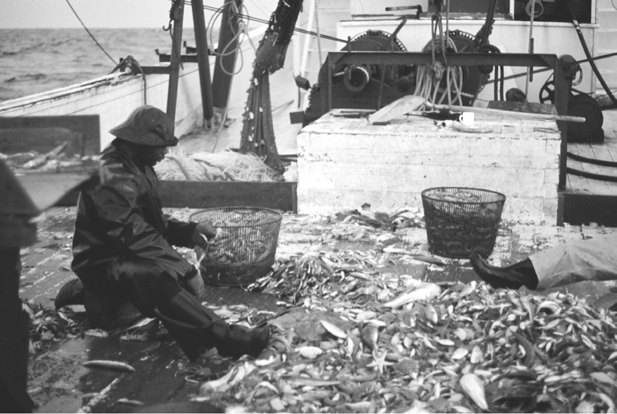
The shrimp-trawl fisheries produce over one-third of the world's total by-catch (the portion of the catch that is not the target species). Here, shrimpers in North Carolina separate shrimp from by-catch
Similarly, fishing may disrupt food webs by targeting specific, in-demand species. There might be too much fishing of prey species such as sardines and anchovies, thus reducing the food supply for the predators. It may also cause the increase of prey species when the target fishes are predator species, such as salmon and tuna. Fisheries can reduce fish stocks that cetaceans rely on for food.
Direct impacts on the environment are another significant aspect of fishing practices. Of particular significance is by-catch, or the portion of the catch that is not the target species. Often, this catch is all discarded, leading to higher levels of decomposition-related pollution. The highest incidence of by-catch occurs with shrimp trawling. Shrimp trawl fisheries catch 2 percent of the world's total catch of all fish by weight but produce over one-third of the world's total by-catch. Sea turtles, already critically endangered, have been killed in large numbers in shrimp trawl nets. Estimates indicate that thousands of Kemp's Ridley, loggerhead, green, and leatherback sea turtles are caught in shrimp trawl fisheries in the Gulf of Mexico and the U.S. Atlantic annually.
Consumer concern over by-catch has led fishermen and scientists to develop devices they can attach to their nets to reduce unwanted catch. The by-catch reduction device, for example, is a net modification that helps fish escape from shrimp nets. By-catch reduction devices allow many commercial finfish species to escape trawling nets. To be federally approved in the United States, by-catch reduction devices must reduce the by-catch of finfish by a minimum of 30 percent. In addition to efforts to reduce the amount of by-catch caught in nets, some fisheries are starting to implement programs to effectively use by-catch species, rather than throwing the fish back into the ocean. One such use of by-catch is the formulation of fish hydrolysate that can be used as a soil amendment in organic agriculture.
...
- Green Consumer Challenges
- Affluenza
- Air Travel
- Carbon Emissions
- Commuting
- Conspicuous Consumption
- Disparities in Consumption
- Dumpster Diving
- Durability
- E-Waste
- Electricity Usage
- Energy Efficiency of Products and Appliances
- Food Additives
- Food Miles
- Genetically Modified Products
- Greenwashing
- Healthcare
- Insulation
- Lawns and Landscaping
- Materialism
- Needs and Wants
- Overconsumption
- Pesticides and Fertilizers
- Pets
- Pharmaceuticals
- Positional Goods
- Poverty
- Pricing
- Quality of Life
- Resource Consumption and Usage
- Solid and Human Waste
- Super-Rich
- Symbolic Consumption
- Waste Disposal
- Windows
- Beverages
- Bottled Beverages (Water)
- Coffee
- Confections
- Dairy Products
- Fish
- Meat
- Poultry and Eggs
- Slow Food
- Tea
- Vegetables and Fruits
- Water
- Green Consumer Products and Services
- Adhesives
- Apparel
- Audio Equipment
- Automobiles
- Baby Products
- Books
- Car Washing
- Certified Products (Fair Trade or Organic)
- Cleaning Products
- Computers and Printers
- Cosmetics
- Disposable Plates and Plastic Implements
- Floor and Wall Coverings
- Fuel
- Funerals
- Furniture
- Garden Tools and Appliances
- Grains
- Home Appliances
- Home Shopping and Catalogs
- Homewares
- Internet Purchasing
- Lighting
- Linen and Bedding
- Magazines
- Malls
- Mobile Phones
- Packaging and Product Containers
- Paper Products
- Personal Products
- Recyclable Products
- Seasonal Products
- Services
- Shopping
- Shopping Bags
- Sports
- Supermarkets
- Swimming Pools and Spas
- Television and DVD Equipment
- Tools
- Toys
- Green Consumer Solutions
- Biodegradable
- Carbon Credits
- Carbon Offsets
- Certification Process
- Composting
- Consumer Activism
- Downshifting
- Ecolabeling
- Ecological Footprint
- Ecotourism
- Environmentally Friendly
- Ethically Produced Products
- Fair Trade
- Gardening/Growing
- Gifting (Green Gifts)
- Green Communities
- Green Consumer
- Green Consumerism Organizations
- Green Design
- Green Discourse
- Green Food
- Green Gross Domestic Product
- Green Homes
- Green Marketing
- Green Politics
- Local Exchange Trading Schemes
- Locally Made
- Markets (Organic/Farmers)
- Morality (Consumer Ethics)
- Organic
- Plants
- Product Sharing
- Public Transportation
- Recycling
- Regulation
- Secondhand Consumption
- Simple Living
- Sustainable Consumption
- Vege-Box Schemes
- Green Consumerism Organizations, Movements, and Planning
- Advertising
- Commodity Fetishism
- Consumer Behavior
- Consumer Boycotts
- Consumer Culture
- Consumer Ethics
- Consumer Society
- Consumerism
- Demographics
- Diderot Effect
- Environmentalism
- Fashion
- Final Consumption
- Finance and Economics
- Frugality
- Government Policy and Practice (Local and National)
- Heating and Cooling
- International Regulatory Frameworks
- Kyoto Protocol
- Leisure and Recreation
- Lifestyle, Rural
- Lifestyle, Suburban
- Lifestyle, Sustainable
- Lifestyle, Urban
- Organisation for Economic Co-operation and Development (OECD)
- Production and Commodity Chains
- Psychographics
- Social Identity
- Taxation
- United Nations Human Development Report 1998
- Websites and Blogs
- Loading...
Get a 30 day FREE TRIAL
-
 Watch videos from a variety of sources bringing classroom topics to life
 -
Read modern, diverse business cases
-
Explore hundreds of books and reference titles

Read next

More like this
Sage Recommends
We found other relevant content for you on other Sage platforms.
Have you created a personal profile? Login or create a profile so that you can save clips, playlists and searches