
Entry
Reader's guide
Entries A-Z
Subject index
Automobiles
The gasoline-powered automobile was introduced in the 1880s, but by the time it reached its first century, it had already become implicated in a range of environmental problems. As the largest, most complex consumer good, the consumption of automobility is also often one of the areas of greatest impact of personal consumption patterns in industrialized nations. Initially, industry saw the environmental debate as yet another temporary fad that could be addressed by technology and then quietly forgotten about. However, increasingly people realized that the environment was not some external entity deserving of our benevolent protection. Instead, at issue was our own living environment—mankind's ability to live on a planet that could survive perfectly well without us. As this realization spread, and with it social and legislative pressure on the car, the debate became incorporated into motor industry strategy such that the car and its use became increasingly shaped by environmental requirements. At first the debate focused on toxic emissions from car exhausts, which was reflected in the legislation that followed. Over the years, the scope of the debate widened to include other issues such as energy use, raw materials use, traffic congestion, and greenhouse gas emissions, as well as end-of-life issues such as recycling, reuse, and vehicle durability. As a result, a more global assessment of the car's impact became possible, leading to a so-called life cycle approach to the problem.
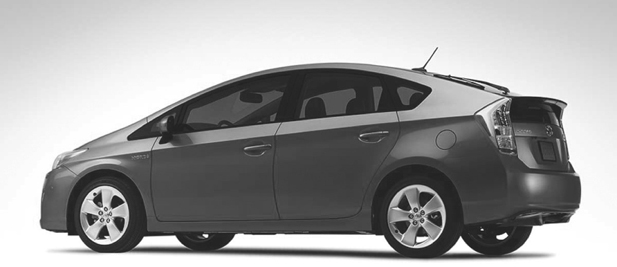
In the car market the success of the Toyota Prius hybrid has shown the power of green consumption; one of the car's strengths is in its distinctive styling
History
Perhaps surprisingly, environmental arguments have surrounded the car from the very beginning. Many welcomed the opportunity of reducing or even eliminating the growing urban problem of horse manure, and dead horses in the street were not uncommon either. It is estimated that at the turn of the century around 15,000 horse carcasses were removed from New York streets annually. Horses also deposited over 1,000 tons of manure and 225,000 liters of urine every day. By 1908, the cost of cleaning up this waste was put at $100 million a year. In London, some 5,000 tons of horse manure had to be removed from the city every day. Although the agricultural sector formed a ready market, it was still regarded as a major problem.
Contemporary environmental arguments centered around the then-fashionable concepts of hygiene and fresh air. The cities, with their deteriorating air and water quality, as well as the side effects of the horse economy, did not have much to offer in this respect and were considered major sources of bad “miasma.” Similar to the train and bicycle before it, the car provided a means of escaping the “bad” air of the city in favor of clean country air, with all its perceived health benefits. In fact, some medical authorities at the time argued that the greater speed enjoyed by those traveling in a car allowed the ingestion of larger quantities of clean air. Clearly, the new ability for city dwellers to become aware of the countryside and nature in general did much to promote a love and understanding of the natural environment. This trend started with the bicycle—the first mechanical mode of individual transport—and was picked up by the car. The car was promoted with the same arguments of health and freedom as the bicycle, and many wealthy cyclists quickly transferred their allegiance to the new vehicle, which could take them much farther afield than its nonmotorized counterpart. The sportsman image of the bicycle was also transferred to the car, which meant that it had a head start in being associated with healthy outdoor pursuits and in adopting a positive and healthy aura. If this seems ironic to the modern observer, it must be remembered that environmentalism itself would probably not have developed without the car and its ability to take people to areas of nature they might otherwise have been largely unaware of, let alone appreciative of.
...
- Green Consumer Challenges
- Affluenza
- Air Travel
- Carbon Emissions
- Commuting
- Conspicuous Consumption
- Disparities in Consumption
- Dumpster Diving
- Durability
- E-Waste
- Electricity Usage
- Energy Efficiency of Products and Appliances
- Food Additives
- Food Miles
- Genetically Modified Products
- Greenwashing
- Healthcare
- Insulation
- Lawns and Landscaping
- Materialism
- Needs and Wants
- Overconsumption
- Pesticides and Fertilizers
- Pets
- Pharmaceuticals
- Positional Goods
- Poverty
- Pricing
- Quality of Life
- Resource Consumption and Usage
- Solid and Human Waste
- Super-Rich
- Symbolic Consumption
- Waste Disposal
- Windows
- Beverages
- Bottled Beverages (Water)
- Coffee
- Confections
- Dairy Products
- Fish
- Meat
- Poultry and Eggs
- Slow Food
- Tea
- Vegetables and Fruits
- Water
- Green Consumer Products and Services
- Adhesives
- Apparel
- Audio Equipment
- Automobiles
- Baby Products
- Books
- Car Washing
- Certified Products (Fair Trade or Organic)
- Cleaning Products
- Computers and Printers
- Cosmetics
- Disposable Plates and Plastic Implements
- Floor and Wall Coverings
- Fuel
- Funerals
- Furniture
- Garden Tools and Appliances
- Grains
- Home Appliances
- Home Shopping and Catalogs
- Homewares
- Internet Purchasing
- Lighting
- Linen and Bedding
- Magazines
- Malls
- Mobile Phones
- Packaging and Product Containers
- Paper Products
- Personal Products
- Recyclable Products
- Seasonal Products
- Services
- Shopping
- Shopping Bags
- Sports
- Supermarkets
- Swimming Pools and Spas
- Television and DVD Equipment
- Tools
- Toys
- Green Consumer Solutions
- Biodegradable
- Carbon Credits
- Carbon Offsets
- Certification Process
- Composting
- Consumer Activism
- Downshifting
- Ecolabeling
- Ecological Footprint
- Ecotourism
- Environmentally Friendly
- Ethically Produced Products
- Fair Trade
- Gardening/Growing
- Gifting (Green Gifts)
- Green Communities
- Green Consumer
- Green Consumerism Organizations
- Green Design
- Green Discourse
- Green Food
- Green Gross Domestic Product
- Green Homes
- Green Marketing
- Green Politics
- Local Exchange Trading Schemes
- Locally Made
- Markets (Organic/Farmers)
- Morality (Consumer Ethics)
- Organic
- Plants
- Product Sharing
- Public Transportation
- Recycling
- Regulation
- Secondhand Consumption
- Simple Living
- Sustainable Consumption
- Vege-Box Schemes
- Green Consumerism Organizations, Movements, and Planning
- Advertising
- Commodity Fetishism
- Consumer Behavior
- Consumer Boycotts
- Consumer Culture
- Consumer Ethics
- Consumer Society
- Consumerism
- Demographics
- Diderot Effect
- Environmentalism
- Fashion
- Final Consumption
- Finance and Economics
- Frugality
- Government Policy and Practice (Local and National)
- Heating and Cooling
- International Regulatory Frameworks
- Kyoto Protocol
- Leisure and Recreation
- Lifestyle, Rural
- Lifestyle, Suburban
- Lifestyle, Sustainable
- Lifestyle, Urban
- Organisation for Economic Co-operation and Development (OECD)
- Production and Commodity Chains
- Psychographics
- Social Identity
- Taxation
- United Nations Human Development Report 1998
- Websites and Blogs
- Loading...
Get a 30 day FREE TRIAL
-
 Watch videos from a variety of sources bringing classroom topics to life
 -
Read modern, diverse business cases
-
Explore hundreds of books and reference titles

Read next

More like this
Sage Recommends
We found other relevant content for you on other Sage platforms.
Have you created a personal profile? Login or create a profile so that you can save clips, playlists and searches