
Entry
Reader's guide
Entries A-Z
Subject index
Xeriscaping
Xeriscaping means landscaping designed to require little to no supplemental water above and beyond natural precipitation in the location being landscaped. The Environmental Protection Agency's Office of Water predicts that 36 states will experience water shortages by 2013. The Colorado Water Wise Council estimates that more than 50 percent of residential water use is applied to landscape and lawns and that 40 to 50 percent of total urban water use is for landscaping. Encouraging urban residents to use water more efficiently, then, is extremely important to ensure that water supplies are available for the indefinite future. These concerns are especially important in the water-scarce cities of the western and southwestern United States where the term xeriscape was first coined.
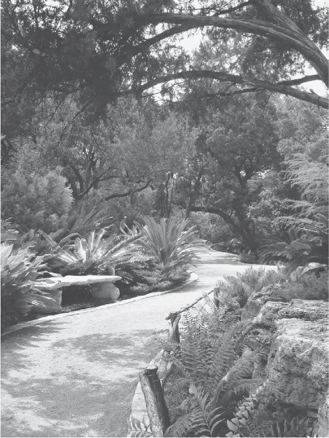
Xeriscaping promotes landscapes that need little supplemental water and the use of mulches to suppress weeds. The Hartman Prehistoric Garden in Zilker Park in Austin, Texas, is an example of xeriscaping
The 1977 drought in the western United States created a scare that led to the creation of a task force of water, horticultural, and landscaping experts from the Denver Water Department, Colorado State University, and the Associated Landscape Contractors of Colorado. The focus of the conference was water supply planning, which attempts to extend existing water supplies to meet future needs. One of the greatest challenges was to demonstrate that it was indeed possible have both beautiful gardens and use significantly less water. The term xeriscape was coined in 1981 by this task force. The term is trademarked by Denver Water and refers to water-efficient and bioregionally appropriate landscaping. The name is derived from the Greek xeros for “dry” and the English term landscape. In 1982, Denver Water donated land and 55 landscape businesses contributed money for a successful demonstration garden. There are seven principles that serve as the basis for the concept of xeriscaping:
- Planning and design
- Limiting turf areas
- Selecting and zoning plants appropriately
- Improving the soil
- Using mulches
- Irrigating efficiently
- Doing appropriate maintenance
The term xeriscape is flexible and allows for various levels of effort that can be tailored to meet specific local situations. Xeriscaping promotes landscapes that need little supplemental water. Acknowledging that droughts occur, it focuses on planting drought-tolerant landscapes, yet does not refer to a dry, barren landscape or a no-maintenance landscape. Instead it promotes the use of plants that are well adapted, in tandem with mulches that suppress weeds and conserve water. Xeriscaping does not imply a rock-strewn landscape devoid of vegetation and, in fact, can be lush, colorful, and easy to care for.
In addition, xeriscaping does not mean creating a landscape that requires no water. In fact, a xeriscaped lawn may require watering on a regular basis. However, it does encourage smart design that decreases the need for water. Efficient irrigation, such as watering at night instead of during the heat of the day and using properly designed hoses and sprinklers, is crucial to xeriscaping. Proper weeding, mowing, pruning, and fertilization can also help decrease water use. Zoning plants with similar needs in the same area can also greatly reduce the amount of water wasted. Ideally, the principles of xeriscaping benefit homeowners, businesses, and landscapers by encouraging them to plant and maintain shrubs, flowers, and lawns that are more suited to local soil and climate conditions.
...
- City Organizations, Movements, and Planning
- Agenda 21
- Brownfields
- Carrying Capacity
- Charrette
- City Politics
- Civic Space
- Ecoindustrial Parks
- Environmental Impact Assessment
- Environmental Planning
- Green Communities and Neighborhood Planning
- Green Design, Construction and Operations
- Greenfield Sites
- Infrastructure
- Intermodal Transportation
- Millennium Development Goals
- Mitigation
- NIMBY
- Personal Rapid Transit
- Resilience
- Sustainability Indicators
- Sustainable Development
- Transit-Oriented Development
- Transportation Demand Management
- City Profiles
- Austin, Texas
- Bahía de Caráquez, Ecuador
- Bangkok, Thailand
- Barcelona, Spain
- Beijing, China
- Bogotá, Colombia
- Chattanooga, Tennessee
- Chernobyl, Ukraine
- Chicago, Illinois
- Copenhagen, Denmark
- Curitiba, Brazil
- Dongtan, China
- Dzerzhinsk, Russia
- Hamburg, Germany
- Kabwe, Zambia
- Kampala, Uganda
- La Oroya, Peru
- Linfen, China
- London, England
- Los Angeles, California
- Malmö, Sweden
- Mexico City, Mexico
- New York City, New York
- Norilsk, Russia
- Portland, Oregon
- Reykjavik, Iceland
- Rio de Janeiro, Brazil
- San Francisco, California
- Seattle, Washington
- Stockholm, Sweden
- Sukinda, India
- Sumgayit, Azerbaijan
- Sydney, Australia
- Tianying, China
- Vancouver, Canada
- Vapi, India
- Green City Challenges
- Adaptation, Climate Change
- Adaptive Reuse
- Air Quality
- Biodiversity
- Carbon Footprints
- Coastal Zone Management
- Combined Sewer Overflow
- Commuting
- Construction and Demolition Waste
- Denitrification
- Density
- Ecological Footprint
- Ecosystem Restoration
- Embodied Energy
- Energy Efficiency
- Environmental Justice
- Environmental Risk
- Food Deserts
- Food Security
- Garbage
- Greywater
- Gridlock
- Heat Island Effect
- Indoor Air Quality
- Landfills
- Light Pollution
- Natural Capital
- Nonpoint Source Pollution
- Ports
- Power Grids
- Recycling in Cities
- Sea Level Rise
- Stormwater Management
- Transit
- Waste Disposal
- Water Conservation
- Water Pollution
- Water Treatment
- Water, Sources and Delivery
- Watershed Protection
- Wetlands
- Green City Solutions
- Bicycling
- Biophilia
- Bioregion
- Bluebelts
- Bus Rapid Transit
- Carbon Neutral
- Carbon Trading
- Carpooling
- Cities for Climate Protection
- Citizen Participation
- Combined Heat and Power (Cogeneration)
- Community Gardens
- Compact Development (New Urbanism)
- Composting
- Congestion Pricing
- Conservation Subdivision
- Daylighting
- Distributed Generation
- District Energy
- Ecovillages
- Green Belt
- Green Energy
- Green Fleets (Vehicles)
- Green Housing
- Green Infrastructure
- Green Jobs
- Green Landscaping
- Green Procurement and Purchasing
- Green Roofs
- Greening Suburbia
- Greyfield Development
- Habitat Conservation and Restoration
- Healthy Cities
- Historic Preservation
- Infill Development
- LEED (Leadership in Energy and Environmental Design)
- Location-Efficient Mortgage
- Masdar Ecocity
- Mayors Climate Protection Agreement
- Parks, Greenways, and Open Space
- Renewable Energy
- Smart Growth
- Traffic Calming
- Universal Design
- Urban Agriculture
- Urban Forests
- Walkability (Pedestrian-Friendly Streets)
- Xeriscaping
- Loading...
Get a 30 day FREE TRIAL
-
 Watch videos from a variety of sources bringing classroom topics to life
 -
Read modern, diverse business cases
-
Explore hundreds of books and reference titles

Read next

More like this
Sage Recommends
We found other relevant content for you on other Sage platforms.
Have you created a personal profile? Login or create a profile so that you can save clips, playlists and searches