
Entry
Reader's guide
Entries A-Z
Subject index
Wetlands
The term wetlands encompasses a wide variety of topographic conditions, including swamps, bogs, marshes, fens, pocosins, and vernal pools. The defining characteristics of all of these locations is frequent saturation (whether by saltwater or fresh), a high level of biodiversity and energy transfer, and extreme sensitivity to human interference. The Environmental Protection Act (40 CFR 230.3(t)) defines wetlands as “those areas that are inundated or saturated by surface or groundwater at a frequency and duration sufficient to support, and that under normal circumstances do support, a prevalence of vegetation typically adapted for life in saturated soil conditions.”
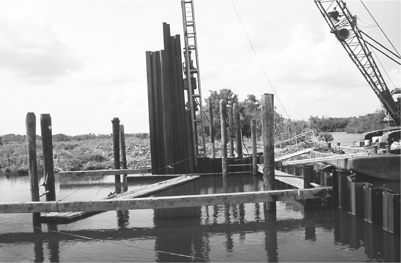
Some wetland plants adapt to specific salinity-tolerance ranges in estuarine locations where fresh water meets coastal marine systems. In a Louisiana bayou, a crane installs a self-regulating tide gate that will restrict the inflow and retention time of saline water
Wetlands are significant because of their contribution to the health and stability of both the terrestrial and the aquatic habitats that they straddle. Wetlands have been called ecotones—a term that describes a transitional ecosystem between two adjacent and distinct communities. It is this transitional position that gives wetlands both their fertility and their vulnerability. Shallower and occasionally saturated locations support species that cannot survive on uplands or in marine ecosystems. Solar energy is available at all depths in a wetland and cyclical saturation, whether tidal or seasonal, and promotes a resilient adaptation to changing conditions. Some wetland plants, for instance, adapt to very specific tolerance ranges of salinity in estuarine locations, where freshwater rivers and streams meet the tidal conditions of coastal marine systems. Disturbances that vary these salinity conditions, such as either excessive salt- or freshwater or alterations to the elevation of the shoreline, will allow other plant species to invade, crowding out the native wetland plants and interrupting the delicate food chain dynamics.
The variety of wetlands types and the fact that each of these may not in fact seem “wet” at any point in time has created ambiguity and confusion. Vegetation tolerant of saturated soil conditions has become the defining characteristic, as these plants cannot live anywhere but in a wetland. However, identifying such vegetation requires knowledge and experience, and therefore typically involves the services of an expert. In most cases it is the transitional nature of a wetland that makes it readily identifiable.
An estuary may provide one of the more dramatic examples of such a transitional wetland. Most estuaries occur where a river meets the sea, as in a bay, fjord, sound, and so on. The point of transition between the two water bodies is marked by tidal fluctuations, a mixture of fresh- and saltwater, and a high degree of biodiversity and ecological productivity. Because such areas provide abundant food sources and navigability, estuaries are favored locations for human settlements. In fact, of the 32 largest cities in the world, 22 are located on estuaries.
Marshes are characterized by the presence of grasses and reeds (cattails being emblematic), as well as occasional shrubs or woody plants. Marshes are often found in estuaries and constitute critical habitat for migrating birds, as well as productive generators of nutrients for marine food chains. A marsh that borders a body of saltwater is saline, referred to as a saltwater marsh. A marsh in an estuary where saltwater predominates over freshwater has specific characteristics and is known as a brackish marsh. There are also freshwater marshes that occur inland, near rivers or lakes. The largest freshwater marsh in the United States is the Everglades in southern Florida.
...
- City Organizations, Movements, and Planning
- Agenda 21
- Brownfields
- Carrying Capacity
- Charrette
- City Politics
- Civic Space
- Ecoindustrial Parks
- Environmental Impact Assessment
- Environmental Planning
- Green Communities and Neighborhood Planning
- Green Design, Construction and Operations
- Greenfield Sites
- Infrastructure
- Intermodal Transportation
- Millennium Development Goals
- Mitigation
- NIMBY
- Personal Rapid Transit
- Resilience
- Sustainability Indicators
- Sustainable Development
- Transit-Oriented Development
- Transportation Demand Management
- City Profiles
- Austin, Texas
- Bahía de Caráquez, Ecuador
- Bangkok, Thailand
- Barcelona, Spain
- Beijing, China
- Bogotá, Colombia
- Chattanooga, Tennessee
- Chernobyl, Ukraine
- Chicago, Illinois
- Copenhagen, Denmark
- Curitiba, Brazil
- Dongtan, China
- Dzerzhinsk, Russia
- Hamburg, Germany
- Kabwe, Zambia
- Kampala, Uganda
- La Oroya, Peru
- Linfen, China
- London, England
- Los Angeles, California
- Malmö, Sweden
- Mexico City, Mexico
- New York City, New York
- Norilsk, Russia
- Portland, Oregon
- Reykjavik, Iceland
- Rio de Janeiro, Brazil
- San Francisco, California
- Seattle, Washington
- Stockholm, Sweden
- Sukinda, India
- Sumgayit, Azerbaijan
- Sydney, Australia
- Tianying, China
- Vancouver, Canada
- Vapi, India
- Green City Challenges
- Adaptation, Climate Change
- Adaptive Reuse
- Air Quality
- Biodiversity
- Carbon Footprints
- Coastal Zone Management
- Combined Sewer Overflow
- Commuting
- Construction and Demolition Waste
- Denitrification
- Density
- Ecological Footprint
- Ecosystem Restoration
- Embodied Energy
- Energy Efficiency
- Environmental Justice
- Environmental Risk
- Food Deserts
- Food Security
- Garbage
- Greywater
- Gridlock
- Heat Island Effect
- Indoor Air Quality
- Landfills
- Light Pollution
- Natural Capital
- Nonpoint Source Pollution
- Ports
- Power Grids
- Recycling in Cities
- Sea Level Rise
- Stormwater Management
- Transit
- Waste Disposal
- Water Conservation
- Water Pollution
- Water Treatment
- Water, Sources and Delivery
- Watershed Protection
- Wetlands
- Green City Solutions
- Bicycling
- Biophilia
- Bioregion
- Bluebelts
- Bus Rapid Transit
- Carbon Neutral
- Carbon Trading
- Carpooling
- Cities for Climate Protection
- Citizen Participation
- Combined Heat and Power (Cogeneration)
- Community Gardens
- Compact Development (New Urbanism)
- Composting
- Congestion Pricing
- Conservation Subdivision
- Daylighting
- Distributed Generation
- District Energy
- Ecovillages
- Green Belt
- Green Energy
- Green Fleets (Vehicles)
- Green Housing
- Green Infrastructure
- Green Jobs
- Green Landscaping
- Green Procurement and Purchasing
- Green Roofs
- Greening Suburbia
- Greyfield Development
- Habitat Conservation and Restoration
- Healthy Cities
- Historic Preservation
- Infill Development
- LEED (Leadership in Energy and Environmental Design)
- Location-Efficient Mortgage
- Masdar Ecocity
- Mayors Climate Protection Agreement
- Parks, Greenways, and Open Space
- Renewable Energy
- Smart Growth
- Traffic Calming
- Universal Design
- Urban Agriculture
- Urban Forests
- Walkability (Pedestrian-Friendly Streets)
- Xeriscaping
- Loading...
Get a 30 day FREE TRIAL
-
 Watch videos from a variety of sources bringing classroom topics to life
 -
Read modern, diverse business cases
-
Explore hundreds of books and reference titles

Read next

More like this
Sage Recommends
We found other relevant content for you on other Sage platforms.
Have you created a personal profile? Login or create a profile so that you can save clips, playlists and searches