
Entry
Reader's guide
Entries A-Z
Subject index
Watershed Protection
Watersheds are topographically defined regions that are drained by a given stream or river system. They occur along a range of scale—anywhere from small headwater streams with small catchments to large rivers with watersheds that cover continental regions. The quality and quantity of water entering streams, rivers, lakes, and bays is often reflected in the land uses and land cover within the watershed. Watershed protection is considered any of the myriad of human measures (laws, policies, programs, and practices) intended to protect water quality and quantity in a watershed. These measures are numerous and often specific to land uses.
The 1972 Clean Water Act (CWA) and subsequent amendments represent the primary federal law intended to maintain and improve water quality in the United States. Although water pollution continues to be problem, substantial improvements have been achieved through the CWA. Some of the most important advances have resulted in better regulation of point source pollution (such as discharge from a factory pipe). However, to meet the goals of the CWA, it will be necessary to decrease pollution from nonpoint sources as well. These include the many diffuse sources that occur throughout the landscape.
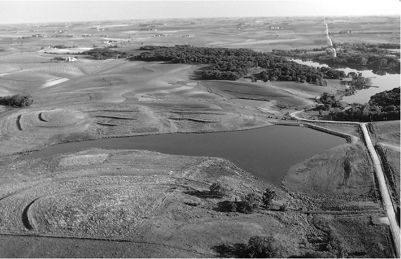
Watershed protection includes maintaining adequate flows in streams and rivers, like these terraces, buffer strips, and grass plantings at a lake in Iowa
To address nonpoint source pollution, the CWA includes provisions to maintain or improve water quality in watersheds. For instance, states are responsible for designating total maximum daily loads (TMDLs) to streams that are not meeting water quality standards. TMDLs are the maximum pollutant load that the stream can assimilate while still meeting water quality standards. Once a stream is designated, meeting the TMDL often is dependent on a variety of watershed partners (both public and private) to work collectively and meet water quality goals. Because stream water quality and quantity are a function of all the contributing land factors in a watershed, the challenge of managing watersheds is gaining the cooperation of multiple owners, users, and stakeholders. As a consequence, programs and measures intended to protect watersheds are often a combination of regulatory and incentive-based.
Incentive programs have been used extensively to implement watershed protection measures. According to the most recent National Water Quality Inventory by the Environmental Protection Agency, excess sediment from agricultural lands remains one of the main sources of pollution in streams and rivers of the United States. In response to this, the U.S. Department of Agriculture administers several incentive programs, including the Conservation Reserve Program. The Conservation Reserve Program was initiated in 1985 as a voluntary program for agricultural landowners. It uses rental payments and cost-shares to encourage farmers to stop production on lands that are susceptible to erosion or sensitive in other ways. Once land is enrolled, it is usually planted with a perennial grass and retired from production for 10 years. Often croplands on historical floodplains are enrolled because they flood regularly and are susceptible to soil loss. From the farmer's perspective, these fields may only be productive during drier years, and thus have only marginal value. In this case, there is usually an incentive for the farmer to enroll these lands as well, so they can receive a predictable payment for them.
...
- City Organizations, Movements, and Planning
- Agenda 21
- Brownfields
- Carrying Capacity
- Charrette
- City Politics
- Civic Space
- Ecoindustrial Parks
- Environmental Impact Assessment
- Environmental Planning
- Green Communities and Neighborhood Planning
- Green Design, Construction and Operations
- Greenfield Sites
- Infrastructure
- Intermodal Transportation
- Millennium Development Goals
- Mitigation
- NIMBY
- Personal Rapid Transit
- Resilience
- Sustainability Indicators
- Sustainable Development
- Transit-Oriented Development
- Transportation Demand Management
- City Profiles
- Austin, Texas
- Bahía de Caráquez, Ecuador
- Bangkok, Thailand
- Barcelona, Spain
- Beijing, China
- Bogotá, Colombia
- Chattanooga, Tennessee
- Chernobyl, Ukraine
- Chicago, Illinois
- Copenhagen, Denmark
- Curitiba, Brazil
- Dongtan, China
- Dzerzhinsk, Russia
- Hamburg, Germany
- Kabwe, Zambia
- Kampala, Uganda
- La Oroya, Peru
- Linfen, China
- London, England
- Los Angeles, California
- Malmö, Sweden
- Mexico City, Mexico
- New York City, New York
- Norilsk, Russia
- Portland, Oregon
- Reykjavik, Iceland
- Rio de Janeiro, Brazil
- San Francisco, California
- Seattle, Washington
- Stockholm, Sweden
- Sukinda, India
- Sumgayit, Azerbaijan
- Sydney, Australia
- Tianying, China
- Vancouver, Canada
- Vapi, India
- Green City Challenges
- Adaptation, Climate Change
- Adaptive Reuse
- Air Quality
- Biodiversity
- Carbon Footprints
- Coastal Zone Management
- Combined Sewer Overflow
- Commuting
- Construction and Demolition Waste
- Denitrification
- Density
- Ecological Footprint
- Ecosystem Restoration
- Embodied Energy
- Energy Efficiency
- Environmental Justice
- Environmental Risk
- Food Deserts
- Food Security
- Garbage
- Greywater
- Gridlock
- Heat Island Effect
- Indoor Air Quality
- Landfills
- Light Pollution
- Natural Capital
- Nonpoint Source Pollution
- Ports
- Power Grids
- Recycling in Cities
- Sea Level Rise
- Stormwater Management
- Transit
- Waste Disposal
- Water Conservation
- Water Pollution
- Water Treatment
- Water, Sources and Delivery
- Watershed Protection
- Wetlands
- Green City Solutions
- Bicycling
- Biophilia
- Bioregion
- Bluebelts
- Bus Rapid Transit
- Carbon Neutral
- Carbon Trading
- Carpooling
- Cities for Climate Protection
- Citizen Participation
- Combined Heat and Power (Cogeneration)
- Community Gardens
- Compact Development (New Urbanism)
- Composting
- Congestion Pricing
- Conservation Subdivision
- Daylighting
- Distributed Generation
- District Energy
- Ecovillages
- Green Belt
- Green Energy
- Green Fleets (Vehicles)
- Green Housing
- Green Infrastructure
- Green Jobs
- Green Landscaping
- Green Procurement and Purchasing
- Green Roofs
- Greening Suburbia
- Greyfield Development
- Habitat Conservation and Restoration
- Healthy Cities
- Historic Preservation
- Infill Development
- LEED (Leadership in Energy and Environmental Design)
- Location-Efficient Mortgage
- Masdar Ecocity
- Mayors Climate Protection Agreement
- Parks, Greenways, and Open Space
- Renewable Energy
- Smart Growth
- Traffic Calming
- Universal Design
- Urban Agriculture
- Urban Forests
- Walkability (Pedestrian-Friendly Streets)
- Xeriscaping
- Loading...
Get a 30 day FREE TRIAL
-
 Watch videos from a variety of sources bringing classroom topics to life
 -
Read modern, diverse business cases
-
Explore hundreds of books and reference titles

Read next

More like this
Sage Recommends
We found other relevant content for you on other Sage platforms.
Have you created a personal profile? Login or create a profile so that you can save clips, playlists and searches