
Entry
Reader's guide
Entries A-Z
Subject index
Water Conservation
Water conservation refers to a set of ideas and strategies orientated toward making less water do more. Thus, water conservation is about both increasing the efficiency of every unit of water used in all spheres—domestic, industrial, and agricultural—and also using less water overall. After decades of blind faith in “supply-side” solutions (ever-larger dams, etc.), policy makers now prefer to focus their energies on reducing demand across the entire range of users. The British government's strategy for water provision published in 2008, Future Water, talks about revising policies to encourage conservation behavior, including altering architectural and planning codes, changing the way water services are priced and regulated, and investing in consumer education. Water conservation policy in the United States is more complex, with some states (e.g., Arizona) working hard to promote conservation and others (e.g., Alaska, South Carolina) doing relatively little. Federal agencies such as the Natural Resources Conservation Service of the U.S. Department of Agriculture act more in an advisory than a regulatory capacity.
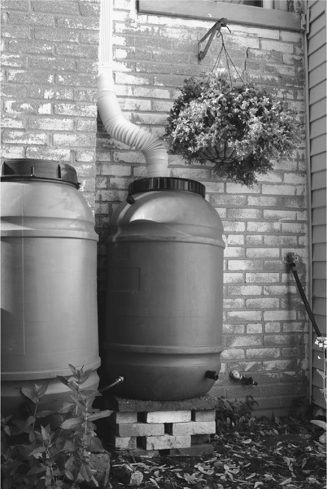
One traditional method of water conservation that is being revisited is a system of rain barrels that catch roof runoff through a downspout
The exact nature of conservation measures undertaken will, of course, also vary, with the structure of demand prevailing in any given country or region. In the United Kingdom, approximately two-thirds of water consumption is related to domestic use, so this is the relevant point of application. The Environment Agency for England and Wales estimates that the introduction of water metering, low-flow showers, low-flush toilets, and a variety of other water-saving technologies could save approximately 65 mega-liters per day in the southeast region and London. Parliament has established a cross-party “Water Saving Group,” and the private water companies have all written conservation and demand management into their 25-year “water resources plans” published in summer 2008. Across Europe the situation is broadly the same—though some governments are pursuing completion of national water grids long under development (e.g., Spain), most are now concentrating their energies on disciplining demand. In countries (such as France) in which agriculture consumes a greater share of available water resources, more effort has gone into promoting efficient irrigation through cooperative water management schemes and through the metered pricing of irrigation water. In the Midwest and Great Plains of the United States, water conservation in agriculture has become both pressing (because surface and groundwater resources are overdrafted) and intensely political (because the economies of entire counties and regions depend on continued overdraft).
Over the course of the 1990s, new development standards in Britain, such as “Eco Homes,” PPG 12, and the Water Supply Regulations (1999) provided various forms of regulatory encouragement in the United Kingdom. The 1999 Water Supply Regulations Act, for example, did make it mandatory for low-flush toilets to be fitted to all new developments, with the incentive of an enhanced capital allowance to encourage developers to take a more sustainable approach to water management in their developments. These gains, however, seem timid and a long time coming when compared with the more proactive and energetic approach taken by water managers in some U.S. states. For example, in the area served by Tucson Water in southeastern Arizona, water-intensive “xerophytic” landscaping has been strongly encouraged as water managers seek to push water conservation outside as well as inside the home. With respect to water fixtures inside the home, Tucson Water has instituted a rebate program that will pay up to half the cost of installing low-flush toilet fixtures and other water-saving devices. Tucson Water has also instituted tiered water-usage rates that encourage conservation by charging progressively more for higher water users. It is important to note that these sorts of strategies work in Tucson because they operate within the context of a complex network of local water-user organizations that give key stakeholders (homeowners associations, landscaping/gardening interests, etc.) “voice” within the water-regulatory apparatus.
...
- City Organizations, Movements, and Planning
- Agenda 21
- Brownfields
- Carrying Capacity
- Charrette
- City Politics
- Civic Space
- Ecoindustrial Parks
- Environmental Impact Assessment
- Environmental Planning
- Green Communities and Neighborhood Planning
- Green Design, Construction and Operations
- Greenfield Sites
- Infrastructure
- Intermodal Transportation
- Millennium Development Goals
- Mitigation
- NIMBY
- Personal Rapid Transit
- Resilience
- Sustainability Indicators
- Sustainable Development
- Transit-Oriented Development
- Transportation Demand Management
- City Profiles
- Austin, Texas
- Bahía de Caráquez, Ecuador
- Bangkok, Thailand
- Barcelona, Spain
- Beijing, China
- Bogotá, Colombia
- Chattanooga, Tennessee
- Chernobyl, Ukraine
- Chicago, Illinois
- Copenhagen, Denmark
- Curitiba, Brazil
- Dongtan, China
- Dzerzhinsk, Russia
- Hamburg, Germany
- Kabwe, Zambia
- Kampala, Uganda
- La Oroya, Peru
- Linfen, China
- London, England
- Los Angeles, California
- Malmö, Sweden
- Mexico City, Mexico
- New York City, New York
- Norilsk, Russia
- Portland, Oregon
- Reykjavik, Iceland
- Rio de Janeiro, Brazil
- San Francisco, California
- Seattle, Washington
- Stockholm, Sweden
- Sukinda, India
- Sumgayit, Azerbaijan
- Sydney, Australia
- Tianying, China
- Vancouver, Canada
- Vapi, India
- Green City Challenges
- Adaptation, Climate Change
- Adaptive Reuse
- Air Quality
- Biodiversity
- Carbon Footprints
- Coastal Zone Management
- Combined Sewer Overflow
- Commuting
- Construction and Demolition Waste
- Denitrification
- Density
- Ecological Footprint
- Ecosystem Restoration
- Embodied Energy
- Energy Efficiency
- Environmental Justice
- Environmental Risk
- Food Deserts
- Food Security
- Garbage
- Greywater
- Gridlock
- Heat Island Effect
- Indoor Air Quality
- Landfills
- Light Pollution
- Natural Capital
- Nonpoint Source Pollution
- Ports
- Power Grids
- Recycling in Cities
- Sea Level Rise
- Stormwater Management
- Transit
- Waste Disposal
- Water Conservation
- Water Pollution
- Water Treatment
- Water, Sources and Delivery
- Watershed Protection
- Wetlands
- Green City Solutions
- Bicycling
- Biophilia
- Bioregion
- Bluebelts
- Bus Rapid Transit
- Carbon Neutral
- Carbon Trading
- Carpooling
- Cities for Climate Protection
- Citizen Participation
- Combined Heat and Power (Cogeneration)
- Community Gardens
- Compact Development (New Urbanism)
- Composting
- Congestion Pricing
- Conservation Subdivision
- Daylighting
- Distributed Generation
- District Energy
- Ecovillages
- Green Belt
- Green Energy
- Green Fleets (Vehicles)
- Green Housing
- Green Infrastructure
- Green Jobs
- Green Landscaping
- Green Procurement and Purchasing
- Green Roofs
- Greening Suburbia
- Greyfield Development
- Habitat Conservation and Restoration
- Healthy Cities
- Historic Preservation
- Infill Development
- LEED (Leadership in Energy and Environmental Design)
- Location-Efficient Mortgage
- Masdar Ecocity
- Mayors Climate Protection Agreement
- Parks, Greenways, and Open Space
- Renewable Energy
- Smart Growth
- Traffic Calming
- Universal Design
- Urban Agriculture
- Urban Forests
- Walkability (Pedestrian-Friendly Streets)
- Xeriscaping
- Loading...
Get a 30 day FREE TRIAL
-
 Watch videos from a variety of sources bringing classroom topics to life
 -
Read modern, diverse business cases
-
Explore hundreds of books and reference titles

Read next

More like this
Sage Recommends
We found other relevant content for you on other Sage platforms.
Have you created a personal profile? Login or create a profile so that you can save clips, playlists and searches