
Entry
Reader's guide
Entries A-Z
Subject index
Urban Agriculture
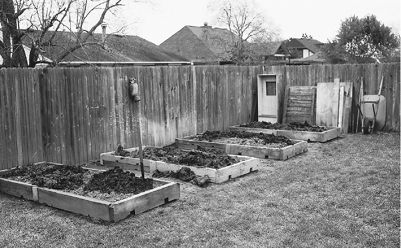
Urban agriculture may be found in backyards, like these raised garden beds in Houston, Texas, which also serve as rotating compost bins
Urban agriculture is any agricultural production—including the cultivation of crops and animal husbandry—both within and on the fringe (peri-urban) of a metropolitan area. Urban agriculture is distinguished from rural agriculture in that it is embedded in an urban political ecology and draws on resources from the city to produce resources for the city. The integration of agricultural production into urban life draws on urbanites for labor-power, provides direct food distribution to urban consumers, reduces urban ecological impacts, and uses urban resources such as organic waste, wastewater, and vacant land. Urban agriculture may be found in a variety of locations, including backyard, patio, and rooftop gardens; commercial operations of all sizes; vacant lot cultivation; institutional gardens (e.g., schools, hospitals, and prisons); and community gardens. Popular perceptions often view urban agriculture as a transitory redress for specific social, political, and economic problems, but advocates of urban agriculture insist on its permanence. Site-specific resources (e.g., land and water availability), combined with varying levels of formal support from urban policy makers, give urban agriculture its distinct character. Diverse agricultural practices and purposes are key features in the development, resiliency, and sustainability of urban agriculture. Urban agriculture helps to build food justice through subsistence production, provides income-generating opportunities for the urban poor, and fosters urban sustainability.
Characteristics of Urban Agriculture
Scholars debate the precise definition of urban and peri-urban, but the definitions are always relational, depending on such things as population density and infrastructure development (particularly transit). As a result, “urban agriculture” itself is loosely defined. Within dense city centers, urban agriculture is readily apparent. Urban agriculture is often defined as any agricultural production that occurs on land with other viable land use options, whereas rural agriculture occupies land that is not threatened by other land uses. Peri-urban agriculture takes advantage of land availability on the urban fringe, particularly on the edges of expanding cities, enjoying close proximity to both labor and markets. Urban agriculture also includes various processing, marketing, and service activities and may be conducted by individuals or by groups of people as a for-profit activity, by state officials, and increasingly, by not-for-profit and nongovernmental organizations.
An examination of the defining characteristics of urban agriculture facilitates an understanding of its place-specific formations within individual cities. Urban farms vary by the actors involved, the types of goods produced, the location of projects, the technological scale of the project, and the form of distribution and economic integration.
The urban poor are the primary actors in urban agricultural activities. Urban farmers are often rural immigrants, people of color, and/or women. In some cases, particularly in the global North, professionals from nongovernmental organizations, lower-level state officials, and schoolteachers are also involved. Throughout the world, women constitute an important segment of urban farmers, as women are most often responsible for household reproduction and combine food provisioning, farm work, and related activities (i.e., preparing, processing, and marketing) with other household labor. Urban agriculture does not readily combine with traditional wage labor, which requires long commutes and long hours, but as more people (particularly women) enter the wage relation, urban farmers are beginning to face this difficult reality.
...
- City Organizations, Movements, and Planning
- Agenda 21
- Brownfields
- Carrying Capacity
- Charrette
- City Politics
- Civic Space
- Ecoindustrial Parks
- Environmental Impact Assessment
- Environmental Planning
- Green Communities and Neighborhood Planning
- Green Design, Construction and Operations
- Greenfield Sites
- Infrastructure
- Intermodal Transportation
- Millennium Development Goals
- Mitigation
- NIMBY
- Personal Rapid Transit
- Resilience
- Sustainability Indicators
- Sustainable Development
- Transit-Oriented Development
- Transportation Demand Management
- City Profiles
- Austin, Texas
- Bahía de Caráquez, Ecuador
- Bangkok, Thailand
- Barcelona, Spain
- Beijing, China
- Bogotá, Colombia
- Chattanooga, Tennessee
- Chernobyl, Ukraine
- Chicago, Illinois
- Copenhagen, Denmark
- Curitiba, Brazil
- Dongtan, China
- Dzerzhinsk, Russia
- Hamburg, Germany
- Kabwe, Zambia
- Kampala, Uganda
- La Oroya, Peru
- Linfen, China
- London, England
- Los Angeles, California
- Malmö, Sweden
- Mexico City, Mexico
- New York City, New York
- Norilsk, Russia
- Portland, Oregon
- Reykjavik, Iceland
- Rio de Janeiro, Brazil
- San Francisco, California
- Seattle, Washington
- Stockholm, Sweden
- Sukinda, India
- Sumgayit, Azerbaijan
- Sydney, Australia
- Tianying, China
- Vancouver, Canada
- Vapi, India
- Green City Challenges
- Adaptation, Climate Change
- Adaptive Reuse
- Air Quality
- Biodiversity
- Carbon Footprints
- Coastal Zone Management
- Combined Sewer Overflow
- Commuting
- Construction and Demolition Waste
- Denitrification
- Density
- Ecological Footprint
- Ecosystem Restoration
- Embodied Energy
- Energy Efficiency
- Environmental Justice
- Environmental Risk
- Food Deserts
- Food Security
- Garbage
- Greywater
- Gridlock
- Heat Island Effect
- Indoor Air Quality
- Landfills
- Light Pollution
- Natural Capital
- Nonpoint Source Pollution
- Ports
- Power Grids
- Recycling in Cities
- Sea Level Rise
- Stormwater Management
- Transit
- Waste Disposal
- Water Conservation
- Water Pollution
- Water Treatment
- Water, Sources and Delivery
- Watershed Protection
- Wetlands
- Green City Solutions
- Bicycling
- Biophilia
- Bioregion
- Bluebelts
- Bus Rapid Transit
- Carbon Neutral
- Carbon Trading
- Carpooling
- Cities for Climate Protection
- Citizen Participation
- Combined Heat and Power (Cogeneration)
- Community Gardens
- Compact Development (New Urbanism)
- Composting
- Congestion Pricing
- Conservation Subdivision
- Daylighting
- Distributed Generation
- District Energy
- Ecovillages
- Green Belt
- Green Energy
- Green Fleets (Vehicles)
- Green Housing
- Green Infrastructure
- Green Jobs
- Green Landscaping
- Green Procurement and Purchasing
- Green Roofs
- Greening Suburbia
- Greyfield Development
- Habitat Conservation and Restoration
- Healthy Cities
- Historic Preservation
- Infill Development
- LEED (Leadership in Energy and Environmental Design)
- Location-Efficient Mortgage
- Masdar Ecocity
- Mayors Climate Protection Agreement
- Parks, Greenways, and Open Space
- Renewable Energy
- Smart Growth
- Traffic Calming
- Universal Design
- Urban Agriculture
- Urban Forests
- Walkability (Pedestrian-Friendly Streets)
- Xeriscaping
- Loading...
Get a 30 day FREE TRIAL
-
 Watch videos from a variety of sources bringing classroom topics to life
 -
Read modern, diverse business cases
-
Explore hundreds of books and reference titles

Read next

More like this
Sage Recommends
We found other relevant content for you on other Sage platforms.
Have you created a personal profile? Login or create a profile so that you can save clips, playlists and searches