
Entry
Reader's guide
Entries A-Z
Subject index
Traffic Calming
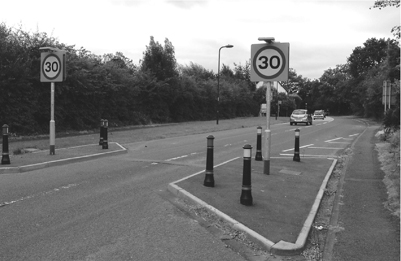
Traffic calming reduces the speed and volume of motorized traffic by means of physical alterations to the street layout, street closures, speed limits, and enforcement of traffic laws. Reductions in traffic speed and volume diminish the negative effects of motor vehicles on neighborhoods and the environment. This can improve neighborhood quality of life, promote neighborhood social activity, and enhance mobility options for vulnerable groups. Moreover, having slower and fewer motor vehicles increases traffic safety—especially for pedestrians and cyclists. In addition, less traffic accidents and more walking and cycling can increase public health. Some studies also show increases in the value of adjacent property and a reduction in the need for police enforcement. Common traffic calming measures are street closures or semiclosures, speed humps, speed tables, and raised crosswalks. Road narrowings, zig-zag road layouts, and bulb-outs—forcing motorists to turn at low speeds—are also common. Most traffic calming measures make car traffic slower and less attractive and, combined with the right policies, can increase the attractiveness of walking and cycling.
Traffic calming measures include street closures or partial-closures, speed bumps, raised crosswalks, zigzag road layouts, bulb-outs, and road narrowings, as seen here in Worcestershire, England
Traffic calming has its origins in the Netherlands. In the late 1960s and 1970s, residents of Dutch municipalities responded to increasing cut-through traffic in their neighborhoods. They used tables, benches, sand boxes, and physical streetscape alterations to create an obstacle course for automobiles and to claim the street as living space. This newly designed type of public space was called Woonerf—which literally translates into English as “residential”’ or “living yard”—today more commonly known as “home zone.” Indeed, home zones turn streets from traffic thoroughfares into outdoor living spaces for all. Physical alterations to the streetscape give priority to pedestrians, children at play, and bicyclists over car traffic. Moreover, maximum allowable automobile travel speeds are sharply reduced—often as low as walking speed, or roughly 4 mph. In the 1970s, the home zone concept spread throughout many Dutch municipalities, leading to official adoption by the Dutch national government in the mid-1970s.
In the late 1970s, the concept also spread to other European countries and to North America. In each country the concept was adapted differently. For example, German municipalities considered the extensive alterations to the street surface in home zones as too expensive to be applied to larger areas. Thus, traffic-calmed neighborhoods in Germany include only minor alterations of the streetscape, but restrict car travel speeds to 19 mph (so-called Zone 30 areas). Since the late 1970s, most German municipalities have traffic calmed nearly all of their neighborhood streets. In large cities, such as Berlin or Munich, between 70 and 80 percent of roads have been traffic calmed. Home zones also exist in Germany but are more limited in scope than Zone 30 traffic-calming schemes.
Today, traffic calming in Northern Europe is usually area-wide and not for isolated streets. This ensures that through traffic is displaced to arterial roads and not simply shifted from one residential street to another. Denmark, Norway, and Germany (among others) also successfully applied traffic calming to nonresidential arterials and other major roads. Related to traffic calming, almost every northern European city has created extensive car-free zones in their centers—the ultimate form of traffic calming.
...
- City Organizations, Movements, and Planning
- Agenda 21
- Brownfields
- Carrying Capacity
- Charrette
- City Politics
- Civic Space
- Ecoindustrial Parks
- Environmental Impact Assessment
- Environmental Planning
- Green Communities and Neighborhood Planning
- Green Design, Construction and Operations
- Greenfield Sites
- Infrastructure
- Intermodal Transportation
- Millennium Development Goals
- Mitigation
- NIMBY
- Personal Rapid Transit
- Resilience
- Sustainability Indicators
- Sustainable Development
- Transit-Oriented Development
- Transportation Demand Management
- City Profiles
- Austin, Texas
- Bahía de Caráquez, Ecuador
- Bangkok, Thailand
- Barcelona, Spain
- Beijing, China
- Bogotá, Colombia
- Chattanooga, Tennessee
- Chernobyl, Ukraine
- Chicago, Illinois
- Copenhagen, Denmark
- Curitiba, Brazil
- Dongtan, China
- Dzerzhinsk, Russia
- Hamburg, Germany
- Kabwe, Zambia
- Kampala, Uganda
- La Oroya, Peru
- Linfen, China
- London, England
- Los Angeles, California
- Malmö, Sweden
- Mexico City, Mexico
- New York City, New York
- Norilsk, Russia
- Portland, Oregon
- Reykjavik, Iceland
- Rio de Janeiro, Brazil
- San Francisco, California
- Seattle, Washington
- Stockholm, Sweden
- Sukinda, India
- Sumgayit, Azerbaijan
- Sydney, Australia
- Tianying, China
- Vancouver, Canada
- Vapi, India
- Green City Challenges
- Adaptation, Climate Change
- Adaptive Reuse
- Air Quality
- Biodiversity
- Carbon Footprints
- Coastal Zone Management
- Combined Sewer Overflow
- Commuting
- Construction and Demolition Waste
- Denitrification
- Density
- Ecological Footprint
- Ecosystem Restoration
- Embodied Energy
- Energy Efficiency
- Environmental Justice
- Environmental Risk
- Food Deserts
- Food Security
- Garbage
- Greywater
- Gridlock
- Heat Island Effect
- Indoor Air Quality
- Landfills
- Light Pollution
- Natural Capital
- Nonpoint Source Pollution
- Ports
- Power Grids
- Recycling in Cities
- Sea Level Rise
- Stormwater Management
- Transit
- Waste Disposal
- Water Conservation
- Water Pollution
- Water Treatment
- Water, Sources and Delivery
- Watershed Protection
- Wetlands
- Green City Solutions
- Bicycling
- Biophilia
- Bioregion
- Bluebelts
- Bus Rapid Transit
- Carbon Neutral
- Carbon Trading
- Carpooling
- Cities for Climate Protection
- Citizen Participation
- Combined Heat and Power (Cogeneration)
- Community Gardens
- Compact Development (New Urbanism)
- Composting
- Congestion Pricing
- Conservation Subdivision
- Daylighting
- Distributed Generation
- District Energy
- Ecovillages
- Green Belt
- Green Energy
- Green Fleets (Vehicles)
- Green Housing
- Green Infrastructure
- Green Jobs
- Green Landscaping
- Green Procurement and Purchasing
- Green Roofs
- Greening Suburbia
- Greyfield Development
- Habitat Conservation and Restoration
- Healthy Cities
- Historic Preservation
- Infill Development
- LEED (Leadership in Energy and Environmental Design)
- Location-Efficient Mortgage
- Masdar Ecocity
- Mayors Climate Protection Agreement
- Parks, Greenways, and Open Space
- Renewable Energy
- Smart Growth
- Traffic Calming
- Universal Design
- Urban Agriculture
- Urban Forests
- Walkability (Pedestrian-Friendly Streets)
- Xeriscaping
- Loading...
Get a 30 day FREE TRIAL
-
 Watch videos from a variety of sources bringing classroom topics to life
 -
Read modern, diverse business cases
-
Explore hundreds of books and reference titles

Read next

More like this
Sage Recommends
We found other relevant content for you on other Sage platforms.
Have you created a personal profile? Login or create a profile so that you can save clips, playlists and searches