
Entry
Reader's guide
Entries A-Z
Subject index
Reykjavik, Iceland
Located at the head of the Faxaflói Bay in southwestern Iceland, Reykjavik adopted its town charter in 1786 and became the capital of Iceland following the grant by Denmark of Home Rule in 1874. It was named Reykjavik, or Smoky Bay, soon after the first Norse settlers arrived in the late 9th century. The hot springs that give the city its name are heated by active volcanoes, and are in large part responsible for Reykjavik's acclaim in geothermal energy use and technologies. The city has been recognized as a Best Practice example for renewable energy by C40Cities, a network of cities that is affiliated with the Clinton Climate Initiative. Reykjavik has declared its intent to eliminate fossil fuel use within its jurisdiction altogether by 2040, and in January 2010 announced that it will seek the European Commission's European Green Capital designation for 2012 or 2013. The worldwide financial crisis of 2008 hit Iceland and Reykjavik with particular force, but the city's resolve to create a sustainable community is undiminished.
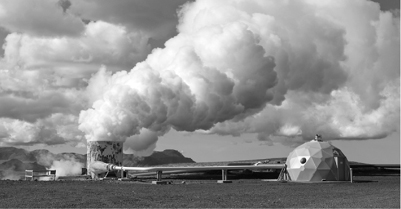
Most houses in Reykjavik are powered by the largest natural heating system in the world, with steam vents that tap deep into the Earth for geothermally heated water
Reykjavik formally committed to planning for sustainability when it signed the Aarlbourg Charter in 1997. With Aarlbourg, the city adopted its Master Plan 1997–2016 as its Local Agenda 21 (LA21), and subsequently updated it in 2001 under the urban policy program titled “The Future City.” That program included provisions for regular review, and by 2003 it had become clear that another revision was needed, because 90 percent of the projects listed in the 2001 LA21 had already been completed or were substantially underway. A new LA21 titled Shaping Reykjavik was adopted in 2006. It placed greater emphasis on urban form and transportation than the previous documents.
Energy management has played an enormous role in Reykjavik's progress toward becoming an exemplary green city. Long a leader in the development of geothermal energy technologies, Reykjavik has also stepped into the forefront of methane capture and conversion technology development. Geothermal resources comprised 53.2 percent of Reykjavik's energy profile in 2000. Oil accounted for the second highest proportion (27.3 percent), followed by hydropower (16.5 percent), and coal (2.9 percent).
Reykjavik's abundant geothermal resources have permitted the city an enormous head start in the race to become independent of fossil fuel. The city has been taking advantage and developing the potential of its underlying hot springs since the 1920s—though through the 1930s, coal furnaces remained the main source of heating. The geothermal system came on line in 1943, and use of geothermal heating became widespread in 1960. Over the next 40 years, the geothermal system expanded to serve 95 percent of the households in Reykjavik. Since 1944, the use of geothermal energy is estimated to have reduced total annual CO2 emissions by 37 percent compared to what would otherwise have been the case. Geothermal heating costs are one-third the cost of heating with oil—a significant financial benefit in this arctic country.
...
- City Organizations, Movements, and Planning
- Agenda 21
- Brownfields
- Carrying Capacity
- Charrette
- City Politics
- Civic Space
- Ecoindustrial Parks
- Environmental Impact Assessment
- Environmental Planning
- Green Communities and Neighborhood Planning
- Green Design, Construction and Operations
- Greenfield Sites
- Infrastructure
- Intermodal Transportation
- Millennium Development Goals
- Mitigation
- NIMBY
- Personal Rapid Transit
- Resilience
- Sustainability Indicators
- Sustainable Development
- Transit-Oriented Development
- Transportation Demand Management
- City Profiles
- Austin, Texas
- Bahía de Caráquez, Ecuador
- Bangkok, Thailand
- Barcelona, Spain
- Beijing, China
- Bogotá, Colombia
- Chattanooga, Tennessee
- Chernobyl, Ukraine
- Chicago, Illinois
- Copenhagen, Denmark
- Curitiba, Brazil
- Dongtan, China
- Dzerzhinsk, Russia
- Hamburg, Germany
- Kabwe, Zambia
- Kampala, Uganda
- La Oroya, Peru
- Linfen, China
- London, England
- Los Angeles, California
- Malmö, Sweden
- Mexico City, Mexico
- New York City, New York
- Norilsk, Russia
- Portland, Oregon
- Reykjavik, Iceland
- Rio de Janeiro, Brazil
- San Francisco, California
- Seattle, Washington
- Stockholm, Sweden
- Sukinda, India
- Sumgayit, Azerbaijan
- Sydney, Australia
- Tianying, China
- Vancouver, Canada
- Vapi, India
- Green City Challenges
- Adaptation, Climate Change
- Adaptive Reuse
- Air Quality
- Biodiversity
- Carbon Footprints
- Coastal Zone Management
- Combined Sewer Overflow
- Commuting
- Construction and Demolition Waste
- Denitrification
- Density
- Ecological Footprint
- Ecosystem Restoration
- Embodied Energy
- Energy Efficiency
- Environmental Justice
- Environmental Risk
- Food Deserts
- Food Security
- Garbage
- Greywater
- Gridlock
- Heat Island Effect
- Indoor Air Quality
- Landfills
- Light Pollution
- Natural Capital
- Nonpoint Source Pollution
- Ports
- Power Grids
- Recycling in Cities
- Sea Level Rise
- Stormwater Management
- Transit
- Waste Disposal
- Water Conservation
- Water Pollution
- Water Treatment
- Water, Sources and Delivery
- Watershed Protection
- Wetlands
- Green City Solutions
- Bicycling
- Biophilia
- Bioregion
- Bluebelts
- Bus Rapid Transit
- Carbon Neutral
- Carbon Trading
- Carpooling
- Cities for Climate Protection
- Citizen Participation
- Combined Heat and Power (Cogeneration)
- Community Gardens
- Compact Development (New Urbanism)
- Composting
- Congestion Pricing
- Conservation Subdivision
- Daylighting
- Distributed Generation
- District Energy
- Ecovillages
- Green Belt
- Green Energy
- Green Fleets (Vehicles)
- Green Housing
- Green Infrastructure
- Green Jobs
- Green Landscaping
- Green Procurement and Purchasing
- Green Roofs
- Greening Suburbia
- Greyfield Development
- Habitat Conservation and Restoration
- Healthy Cities
- Historic Preservation
- Infill Development
- LEED (Leadership in Energy and Environmental Design)
- Location-Efficient Mortgage
- Masdar Ecocity
- Mayors Climate Protection Agreement
- Parks, Greenways, and Open Space
- Renewable Energy
- Smart Growth
- Traffic Calming
- Universal Design
- Urban Agriculture
- Urban Forests
- Walkability (Pedestrian-Friendly Streets)
- Xeriscaping
- Loading...
Get a 30 day FREE TRIAL
-
 Watch videos from a variety of sources bringing classroom topics to life
 -
Read modern, diverse business cases
-
Explore hundreds of books and reference titles

Read next

More like this
Sage Recommends
We found other relevant content for you on other Sage platforms.
Have you created a personal profile? Login or create a profile so that you can save clips, playlists and searches