
Entry
Reader's guide
Entries A-Z
Subject index
Renewable Energy
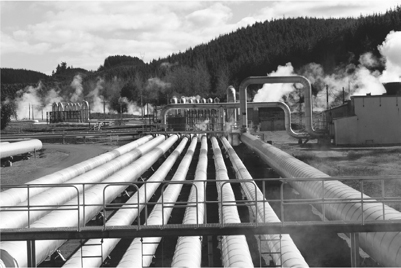
Geothermal plants usually drill deep into the Earth to reach the steam produced by the heat of the Earth. Here, steam pipes lead from a geothermal field toward a power-generation plant in New Zealand
Renewable energy is the energy produced by using natural resources that will regenerate in time. Primary sources of renewable energy are water, geothermal heat, wind, and sunlight. The energy produced by using different organic materials, such as wood, agricultural rejects, forestry residues, and urban solid waste (called biomass) is also regarded as “renewable.” According to authoritative international agencies like the United Nations Environment Programme and the Intergovernmental Panel on Climate Change, renewable energies represent the mo st realistic alternative to fossil fuels. At present, renewable sources are employed chiefly in the production of electricity, but also to produce biofuels and to provide heat for industrial and private users. Over the last 10 years, the development of renewable energies has been stimulated by concern over global warming. At this time, it is believed that renewable energy sources will play a key role in limiting greenhouse gases emissions.
Water
Hydroelectric energy has represented, and still represents today, the principal source of renewable energy: With reference to the global production of energy, hydroelectric represents 2.15 percent of the total. Concerning the construction of new large-scale hydroelectric plants today, development seems stalled because they require infrastructure (dams, reservoirs, catchment drains) that causes a considerable environmental impact. Although they produce no polluting emissions, they considerably alter the landscape, impair the balance of local ecosystems, and diminish the volume of water available for uses other than energy production. For these reasons, it seems more appropriate to develop hydroelectric plants with less than 10 megawatts (MW) of power production: These are small plants with a low environmental impact that produce energy by utilizing minor streams and river waterfalls. The realization of such small hydroelectric plants creates only modest environmental and technical problems, particularly where the construction of dams is unnecessary, and the cost of the electricity produced more or less equals that of larger plants.
Some countries today are experimenting with new technologies capable of producing power by using energy flows from seawater. Experiments are being conducted to try to exploit tidal power (in France), the energy potential of waves (in the United Kingdom, Norway, and Japan), and the temperature gradient—the difference in temperature that exists between deep and surface waters (in the United States).
Geothermal
Geothermic energy is generated by physical processes that occur in deepest layers of the Earth's crust (underground, the temperature rises by 30 degrees Celsius every 1,000 meters of depth). Geothermal heat rises to the Earth's surface, where it can generate a thermal current measuring about 0.065 watts per square meter. In general, geothermal plants use the following operational procedure: Through drilling, the steam produced by the heat of the Earth is brought to the surface and conveyed to pipes that carry it to a turbine, where, by means of a driving shaft, it is turned into mechanical energy, and into electrical power by an alternator. In cases where the geothermal fluid does not reach high temperatures, the required temperatures are reached by using hot water. The resulting heat is used, for example, in district heating plants or by agriculture for heating greenhouses.
...
- City Organizations, Movements, and Planning
- Agenda 21
- Brownfields
- Carrying Capacity
- Charrette
- City Politics
- Civic Space
- Ecoindustrial Parks
- Environmental Impact Assessment
- Environmental Planning
- Green Communities and Neighborhood Planning
- Green Design, Construction and Operations
- Greenfield Sites
- Infrastructure
- Intermodal Transportation
- Millennium Development Goals
- Mitigation
- NIMBY
- Personal Rapid Transit
- Resilience
- Sustainability Indicators
- Sustainable Development
- Transit-Oriented Development
- Transportation Demand Management
- City Profiles
- Austin, Texas
- Bahía de Caráquez, Ecuador
- Bangkok, Thailand
- Barcelona, Spain
- Beijing, China
- Bogotá, Colombia
- Chattanooga, Tennessee
- Chernobyl, Ukraine
- Chicago, Illinois
- Copenhagen, Denmark
- Curitiba, Brazil
- Dongtan, China
- Dzerzhinsk, Russia
- Hamburg, Germany
- Kabwe, Zambia
- Kampala, Uganda
- La Oroya, Peru
- Linfen, China
- London, England
- Los Angeles, California
- Malmö, Sweden
- Mexico City, Mexico
- New York City, New York
- Norilsk, Russia
- Portland, Oregon
- Reykjavik, Iceland
- Rio de Janeiro, Brazil
- San Francisco, California
- Seattle, Washington
- Stockholm, Sweden
- Sukinda, India
- Sumgayit, Azerbaijan
- Sydney, Australia
- Tianying, China
- Vancouver, Canada
- Vapi, India
- Green City Challenges
- Adaptation, Climate Change
- Adaptive Reuse
- Air Quality
- Biodiversity
- Carbon Footprints
- Coastal Zone Management
- Combined Sewer Overflow
- Commuting
- Construction and Demolition Waste
- Denitrification
- Density
- Ecological Footprint
- Ecosystem Restoration
- Embodied Energy
- Energy Efficiency
- Environmental Justice
- Environmental Risk
- Food Deserts
- Food Security
- Garbage
- Greywater
- Gridlock
- Heat Island Effect
- Indoor Air Quality
- Landfills
- Light Pollution
- Natural Capital
- Nonpoint Source Pollution
- Ports
- Power Grids
- Recycling in Cities
- Sea Level Rise
- Stormwater Management
- Transit
- Waste Disposal
- Water Conservation
- Water Pollution
- Water Treatment
- Water, Sources and Delivery
- Watershed Protection
- Wetlands
- Green City Solutions
- Bicycling
- Biophilia
- Bioregion
- Bluebelts
- Bus Rapid Transit
- Carbon Neutral
- Carbon Trading
- Carpooling
- Cities for Climate Protection
- Citizen Participation
- Combined Heat and Power (Cogeneration)
- Community Gardens
- Compact Development (New Urbanism)
- Composting
- Congestion Pricing
- Conservation Subdivision
- Daylighting
- Distributed Generation
- District Energy
- Ecovillages
- Green Belt
- Green Energy
- Green Fleets (Vehicles)
- Green Housing
- Green Infrastructure
- Green Jobs
- Green Landscaping
- Green Procurement and Purchasing
- Green Roofs
- Greening Suburbia
- Greyfield Development
- Habitat Conservation and Restoration
- Healthy Cities
- Historic Preservation
- Infill Development
- LEED (Leadership in Energy and Environmental Design)
- Location-Efficient Mortgage
- Masdar Ecocity
- Mayors Climate Protection Agreement
- Parks, Greenways, and Open Space
- Renewable Energy
- Smart Growth
- Traffic Calming
- Universal Design
- Urban Agriculture
- Urban Forests
- Walkability (Pedestrian-Friendly Streets)
- Xeriscaping
- Loading...
Get a 30 day FREE TRIAL
-
 Watch videos from a variety of sources bringing classroom topics to life
 -
Read modern, diverse business cases
-
Explore hundreds of books and reference titles

Read next

More like this
Sage Recommends
We found other relevant content for you on other Sage platforms.
Have you created a personal profile? Login or create a profile so that you can save clips, playlists and searches