
Entry
Reader's guide
Entries A-Z
Subject index
Recycling in Cities
The vast amount of waste created within city limits is a growing concern. Cities such as Naples, Italy, for example, have been facing serious concerns because of overfilling landfills. Recycling in cities is one answer to the problem of urban waste. Recycling is the recovery of discarded material for its reuse in new products. By reusing material destined for disposal, municipal recycling reduces an individual's ecological footprint by saving energy; avoiding the use of virgin resources, such as trees; and creating jobs.
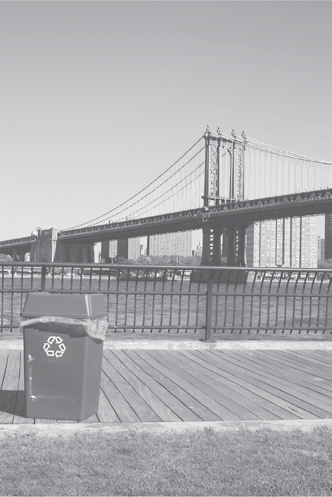
New York City offers recycling as a citywide service and provides recycling bins in public spaces, like this one along the East River
Curbside recycling is the most common recycling service provided in urban areas. There are a variety of ways to handle curbside pickup. Some municipal governments offer recycling as a citywide service. In these instances, the city either contracts with a for-profit or a nonprofit hauling company or provides recycling services itself. If the city does not offer recycling services, which is becoming increasingly uncommon, curbside pickup may be available via independent companies. Residents also have the option of dropping off their recycling at the processing center themselves. These latter two options require more awareness and initiative on the part of individual residents. Separate bins are often provided for trash and recycling, and if curbside pickup is offered, it generally occurs on the same day as trash pickup. Single-stream recycling offers an efficient means of collection. The term single stream means using one bin to collect all recycling, rather than the two or more bin system, usually mixed paper and commingled containers. This eliminates the need to run two or more recycling routes to collect the streams, provides an opportunity to standardize the collection vehicles, and thus decreases the energy, pollution, and economic costs associated with recycling pickup. In addition, the community participation rate often increases with the establishment of a single-stream recycling program. The downside to single-stream recycling is that there is a greater danger of contamination, the quality generally decreases, and there can be higher infrastructure costs up front. San Francisco, Toronto, Denver, Tucson, San Jose, Philadelphia, and Dallas are examples of cities that use single-stream recycling.
Both environmentalists and recyclers are concerned that the global economic downturn will spell disaster for municipal recycling programs. Where haulers were once paid by recycling centers, the bottom has dropped out of the market to such an extent that now haulers often have to pay the processing centers to accept their goods. As Western curbside recycling programs become less profitable, local governments will be forced to reevaluate the importance of recycling as they struggle with large deficits. The fear is that this may result in fewer municipally run recycling services.
There is no standard for what materials get recycled from city to city because different haulers pick up different items. They are limited by what their trucks are equipped to handle and what the processing facility they transport to has the capacity to process, as well as the market for the material. In addition, cities vary in their commitment to recycling, and therefore also vary in the stringency of their recycling standards. Although municipalities are generally responsible for the cost of waste disposal and recycling, throughout the European Union countries have adopted producer responsibility laws that require the producers of packaging material to either recover packaging material for recycling or pay into a system that ensures the packaging is collected and recycled.
...
- City Organizations, Movements, and Planning
- Agenda 21
- Brownfields
- Carrying Capacity
- Charrette
- City Politics
- Civic Space
- Ecoindustrial Parks
- Environmental Impact Assessment
- Environmental Planning
- Green Communities and Neighborhood Planning
- Green Design, Construction and Operations
- Greenfield Sites
- Infrastructure
- Intermodal Transportation
- Millennium Development Goals
- Mitigation
- NIMBY
- Personal Rapid Transit
- Resilience
- Sustainability Indicators
- Sustainable Development
- Transit-Oriented Development
- Transportation Demand Management
- City Profiles
- Austin, Texas
- Bahía de Caráquez, Ecuador
- Bangkok, Thailand
- Barcelona, Spain
- Beijing, China
- Bogotá, Colombia
- Chattanooga, Tennessee
- Chernobyl, Ukraine
- Chicago, Illinois
- Copenhagen, Denmark
- Curitiba, Brazil
- Dongtan, China
- Dzerzhinsk, Russia
- Hamburg, Germany
- Kabwe, Zambia
- Kampala, Uganda
- La Oroya, Peru
- Linfen, China
- London, England
- Los Angeles, California
- Malmö, Sweden
- Mexico City, Mexico
- New York City, New York
- Norilsk, Russia
- Portland, Oregon
- Reykjavik, Iceland
- Rio de Janeiro, Brazil
- San Francisco, California
- Seattle, Washington
- Stockholm, Sweden
- Sukinda, India
- Sumgayit, Azerbaijan
- Sydney, Australia
- Tianying, China
- Vancouver, Canada
- Vapi, India
- Green City Challenges
- Adaptation, Climate Change
- Adaptive Reuse
- Air Quality
- Biodiversity
- Carbon Footprints
- Coastal Zone Management
- Combined Sewer Overflow
- Commuting
- Construction and Demolition Waste
- Denitrification
- Density
- Ecological Footprint
- Ecosystem Restoration
- Embodied Energy
- Energy Efficiency
- Environmental Justice
- Environmental Risk
- Food Deserts
- Food Security
- Garbage
- Greywater
- Gridlock
- Heat Island Effect
- Indoor Air Quality
- Landfills
- Light Pollution
- Natural Capital
- Nonpoint Source Pollution
- Ports
- Power Grids
- Recycling in Cities
- Sea Level Rise
- Stormwater Management
- Transit
- Waste Disposal
- Water Conservation
- Water Pollution
- Water Treatment
- Water, Sources and Delivery
- Watershed Protection
- Wetlands
- Green City Solutions
- Bicycling
- Biophilia
- Bioregion
- Bluebelts
- Bus Rapid Transit
- Carbon Neutral
- Carbon Trading
- Carpooling
- Cities for Climate Protection
- Citizen Participation
- Combined Heat and Power (Cogeneration)
- Community Gardens
- Compact Development (New Urbanism)
- Composting
- Congestion Pricing
- Conservation Subdivision
- Daylighting
- Distributed Generation
- District Energy
- Ecovillages
- Green Belt
- Green Energy
- Green Fleets (Vehicles)
- Green Housing
- Green Infrastructure
- Green Jobs
- Green Landscaping
- Green Procurement and Purchasing
- Green Roofs
- Greening Suburbia
- Greyfield Development
- Habitat Conservation and Restoration
- Healthy Cities
- Historic Preservation
- Infill Development
- LEED (Leadership in Energy and Environmental Design)
- Location-Efficient Mortgage
- Masdar Ecocity
- Mayors Climate Protection Agreement
- Parks, Greenways, and Open Space
- Renewable Energy
- Smart Growth
- Traffic Calming
- Universal Design
- Urban Agriculture
- Urban Forests
- Walkability (Pedestrian-Friendly Streets)
- Xeriscaping
- Loading...
Get a 30 day FREE TRIAL
-
 Watch videos from a variety of sources bringing classroom topics to life
 -
Read modern, diverse business cases
-
Explore hundreds of books and reference titles

Read next

More like this
Sage Recommends
We found other relevant content for you on other Sage platforms.
Have you created a personal profile? Login or create a profile so that you can save clips, playlists and searches