
Entry
Reader's guide
Entries A-Z
Subject index
Parks, Greenways, and Open Space
Parks, greenways, and open space make up the most prominent features of urban greenspace. Although the creation, conservation, and protection of urban greenspace has a long history in urban development, parks, greenways, and open space are becoming an increasingly important aspect of building sustainable cities. If used individually, parks, greenways, and open space would have an important effect on greening the urban landscape, but when these elements are effectively integrated, they can have great effects on a city's environmental integrity and economic stability, as well as have great benefits for nonhuman systems.
Broadly defined, open space is any undeveloped land that remains in either a natural state, such as a wetland or forested hillside, or is in agricultural land use. Because it is one of any city's scarcest, and therefore most precious, assets, preserving open space is often one of the core goals of any urban greening strategy. Throughout the 19th and 20th centuries, urban open space has been thought to have beneficial social effects. More recently, open space is being seen by many planners as a socially necessary and valuable addition to cities because it can protect urban watersheds, preserve wildlife habitat, maintain agricultural land, provide scenic amenities, and provide outdoor recreation opportunities for residents. Since the onset of rapid urban sprawl in the mid-20th century, open space conservation has been a central goal of many urban environmental movements.
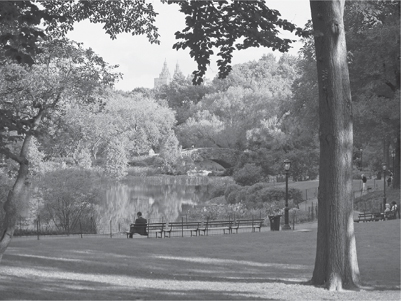
Parks have long served city residents as places of leisure, recreation, and respite from the density of the city. Here, early risers in New York relax near the lake in Central Park
The public desire to preserve open space continues to be one of the most powerful barriers to contemporary urban encroachment into previously undeveloped greenfields. Urban growth boundaries and green belts, or legally protected undeveloped land surrounding a city, are important tools that many cities have used to preserve open space for use by their residents and the preservation of the environment.
Urban parks are the most well-known forms of urban greenspace. Parks have long served city residents as places of leisure, recreation, beauty, and respite from the density of the city. Historically, parks were public spaces designed to respond to the perceived social needs of a community. Urban park researcher Galen Cranz identifies a useful set of characteristics of the historical uses of these important community spaces. Many of the most famous large urban park systems such as Central Park in New York City were designed as pleasure grounds for upper-middle-class city residents (1850–1900). Frederick Law Olmsted, the much-acclaimed father of landscape architecture, designed Central Park and other parks as pastoral settings that were designed to operate as the “lungs of the city.” Later, other parks were designed as places of social reform for children and immigrants (1900–1930) or as places of recreation for suburban families (1930–1965). Still other parks were designed as a way to incorporate open space into the city to facilitate the mental and social health of city residents (since 1965). Although many of these historical parks were designed to respond to perceived social problems, rarely did they attempt to address environmental concerns. It has been only been recently, as city residents and officials have begun to recognize important connections between urban social and environmental problems, that parks have become critical assets to creating sustainable cities. Many new parks are situated on redeveloped industrial brownfield sites or on top of sealed landfills. In this way, the city is rid of a potentially toxic site and in its place has instead a vibrant urban environmental amenity. In addition, park planners are beginning to use parks to create more environmentally sensitive cities by using more native plant species in the design, educating park users in environmental stewardship, and linking parks through greenways that provide corridors for wildlife and human movement.
...
- City Organizations, Movements, and Planning
- Agenda 21
- Brownfields
- Carrying Capacity
- Charrette
- City Politics
- Civic Space
- Ecoindustrial Parks
- Environmental Impact Assessment
- Environmental Planning
- Green Communities and Neighborhood Planning
- Green Design, Construction and Operations
- Greenfield Sites
- Infrastructure
- Intermodal Transportation
- Millennium Development Goals
- Mitigation
- NIMBY
- Personal Rapid Transit
- Resilience
- Sustainability Indicators
- Sustainable Development
- Transit-Oriented Development
- Transportation Demand Management
- City Profiles
- Austin, Texas
- Bahía de Caráquez, Ecuador
- Bangkok, Thailand
- Barcelona, Spain
- Beijing, China
- Bogotá, Colombia
- Chattanooga, Tennessee
- Chernobyl, Ukraine
- Chicago, Illinois
- Copenhagen, Denmark
- Curitiba, Brazil
- Dongtan, China
- Dzerzhinsk, Russia
- Hamburg, Germany
- Kabwe, Zambia
- Kampala, Uganda
- La Oroya, Peru
- Linfen, China
- London, England
- Los Angeles, California
- Malmö, Sweden
- Mexico City, Mexico
- New York City, New York
- Norilsk, Russia
- Portland, Oregon
- Reykjavik, Iceland
- Rio de Janeiro, Brazil
- San Francisco, California
- Seattle, Washington
- Stockholm, Sweden
- Sukinda, India
- Sumgayit, Azerbaijan
- Sydney, Australia
- Tianying, China
- Vancouver, Canada
- Vapi, India
- Green City Challenges
- Adaptation, Climate Change
- Adaptive Reuse
- Air Quality
- Biodiversity
- Carbon Footprints
- Coastal Zone Management
- Combined Sewer Overflow
- Commuting
- Construction and Demolition Waste
- Denitrification
- Density
- Ecological Footprint
- Ecosystem Restoration
- Embodied Energy
- Energy Efficiency
- Environmental Justice
- Environmental Risk
- Food Deserts
- Food Security
- Garbage
- Greywater
- Gridlock
- Heat Island Effect
- Indoor Air Quality
- Landfills
- Light Pollution
- Natural Capital
- Nonpoint Source Pollution
- Ports
- Power Grids
- Recycling in Cities
- Sea Level Rise
- Stormwater Management
- Transit
- Waste Disposal
- Water Conservation
- Water Pollution
- Water Treatment
- Water, Sources and Delivery
- Watershed Protection
- Wetlands
- Green City Solutions
- Bicycling
- Biophilia
- Bioregion
- Bluebelts
- Bus Rapid Transit
- Carbon Neutral
- Carbon Trading
- Carpooling
- Cities for Climate Protection
- Citizen Participation
- Combined Heat and Power (Cogeneration)
- Community Gardens
- Compact Development (New Urbanism)
- Composting
- Congestion Pricing
- Conservation Subdivision
- Daylighting
- Distributed Generation
- District Energy
- Ecovillages
- Green Belt
- Green Energy
- Green Fleets (Vehicles)
- Green Housing
- Green Infrastructure
- Green Jobs
- Green Landscaping
- Green Procurement and Purchasing
- Green Roofs
- Greening Suburbia
- Greyfield Development
- Habitat Conservation and Restoration
- Healthy Cities
- Historic Preservation
- Infill Development
- LEED (Leadership in Energy and Environmental Design)
- Location-Efficient Mortgage
- Masdar Ecocity
- Mayors Climate Protection Agreement
- Parks, Greenways, and Open Space
- Renewable Energy
- Smart Growth
- Traffic Calming
- Universal Design
- Urban Agriculture
- Urban Forests
- Walkability (Pedestrian-Friendly Streets)
- Xeriscaping
- Loading...
Get a 30 day FREE TRIAL
-
 Watch videos from a variety of sources bringing classroom topics to life
 -
Read modern, diverse business cases
-
Explore hundreds of books and reference titles

Read next

More like this
Sage Recommends
We found other relevant content for you on other Sage platforms.
Have you created a personal profile? Login or create a profile so that you can save clips, playlists and searches