
Entry
Reader's guide
Entries A-Z
Subject index
London, England
London is a world city that faces many challenges in the context of climate change and a growing urban population. Although there is evidence that London's environmental quality is increasing, a growing urban population is putting pressure on land and resources. The mayor of London has a statutory duty to develop a strategic vision of how to address issues such as energy, water, and waste, and London's general approach to facing its challenges has been to involve key stakeholders from the business and community sectors in the environmental management of the city. A major focus of (re)development over the coming decades is East London, especially the Olympic Park and Thames Gateway developments.
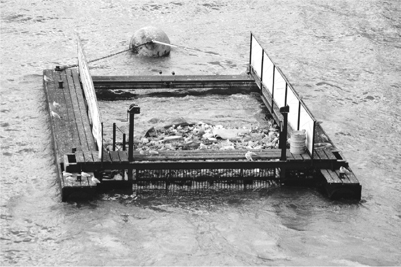
Thanks in part to these floating, garbage-catching devices, the Thames is one of the cleanest metropolitan rivers in the world. London's growth, however, burdens a sewer system that dumps 52 million cubic meters of untreated sewage and rainwater each year into the Thames and Lee rivers
London's Profile
London is the largest city in Europe, with approximately 7.5 million inhabitants, contributing around 20 percent to the United Kingdom's total gross domestic product. The administration is made up of a two-tier structure, in which the Greater London Authority (GLA), the citywide government, is in charge of strategic planning, economic development, transport, and police and fire services, and 33 local councils are in charge of local services such as schools, social services, local planning issues, and waste. The spatial development strategy set out by the mayor of London seeks to accommodate London's growth without intruding on the city's open spaces by increasing the city's currently relatively low density (4,730 inhabitants per square kilometer).
Climate Change and Energy
Climate change has become a top priority on the city's policy agenda since 2000, when the GLA (and the role of mayor of London) was established. In 2006, London's carbon dioxide emissions amounted to 44 million tons, comparable to that of countries such as Greece and Portugal and 8 percent of total U.K. emissions. A part of London's emissions are from landfill and waste incineration, but energy is the largest source of emissions, with the domestic sector accounting for 38 percent, followed by the commercial sector (33 percent), ground-based transport (22 percent), and industry (7 percent). Although emissions in the period 1990–2006 actually decreased by 1.5 percent, this is attributed to a decline in industrial activities in London and a more general shift in the United Kingdom's electricity generation mix from coal toward natural gas (and does not constitute a long-term trend).
The mayor set an ambitious target for London of a 60 percent reduction in carbon dioxide emissions below 1990 levels by 2025. As the bulk (75 percent) of emissions are caused by London's electricity and gas consumption, climate change and energy policy have become closely interlinked in London. The almost simultaneous publication of Energy Strategy and the London Plan in 2004 set up an unprecedented framework for tackling climate change in London (followed in 2007 by the Climate Change Action Plan). Policies have focused on three key areas: first, the planning system (by introducing a mandatory requirement of 10 percent on-site generation of renewable energy in new developments over a certain size); second, energy efficiency in the built environment by changing practices (schemes such as the Green Housing Programme and the Green Concierge Services for domestic users and Better Buildings Partnership, Green 500, and the Buildings Retrofit Programme for the commercial and public sectors); third, reducing London's carbon intensity by moving a quarter of London's energy supply to decentralized energy sources (mainly combined heat and power). To deliver these and involve key stakeholders from the business and third sectors, the mayor set up several strategic partnerships (such as the London Energy Partnership, London Hydrogen Partnership, and London Climate Change Agency). As a result there has been a steady increase in the installation of biomass boilers, heat pumps, solar thermal, and photovoltaic cells. London has also been a vocal player on the international climate policy stage, engaged in initiatives such as the C40 and the Clinton Climate Initiative. Every year the GLA releases the London Energy and Greenhouse Gas Emissions Inventory to monitor the capital's progress.
...
- City Organizations, Movements, and Planning
- Agenda 21
- Brownfields
- Carrying Capacity
- Charrette
- City Politics
- Civic Space
- Ecoindustrial Parks
- Environmental Impact Assessment
- Environmental Planning
- Green Communities and Neighborhood Planning
- Green Design, Construction and Operations
- Greenfield Sites
- Infrastructure
- Intermodal Transportation
- Millennium Development Goals
- Mitigation
- NIMBY
- Personal Rapid Transit
- Resilience
- Sustainability Indicators
- Sustainable Development
- Transit-Oriented Development
- Transportation Demand Management
- City Profiles
- Austin, Texas
- Bahía de Caráquez, Ecuador
- Bangkok, Thailand
- Barcelona, Spain
- Beijing, China
- Bogotá, Colombia
- Chattanooga, Tennessee
- Chernobyl, Ukraine
- Chicago, Illinois
- Copenhagen, Denmark
- Curitiba, Brazil
- Dongtan, China
- Dzerzhinsk, Russia
- Hamburg, Germany
- Kabwe, Zambia
- Kampala, Uganda
- La Oroya, Peru
- Linfen, China
- London, England
- Los Angeles, California
- Malmö, Sweden
- Mexico City, Mexico
- New York City, New York
- Norilsk, Russia
- Portland, Oregon
- Reykjavik, Iceland
- Rio de Janeiro, Brazil
- San Francisco, California
- Seattle, Washington
- Stockholm, Sweden
- Sukinda, India
- Sumgayit, Azerbaijan
- Sydney, Australia
- Tianying, China
- Vancouver, Canada
- Vapi, India
- Green City Challenges
- Adaptation, Climate Change
- Adaptive Reuse
- Air Quality
- Biodiversity
- Carbon Footprints
- Coastal Zone Management
- Combined Sewer Overflow
- Commuting
- Construction and Demolition Waste
- Denitrification
- Density
- Ecological Footprint
- Ecosystem Restoration
- Embodied Energy
- Energy Efficiency
- Environmental Justice
- Environmental Risk
- Food Deserts
- Food Security
- Garbage
- Greywater
- Gridlock
- Heat Island Effect
- Indoor Air Quality
- Landfills
- Light Pollution
- Natural Capital
- Nonpoint Source Pollution
- Ports
- Power Grids
- Recycling in Cities
- Sea Level Rise
- Stormwater Management
- Transit
- Waste Disposal
- Water Conservation
- Water Pollution
- Water Treatment
- Water, Sources and Delivery
- Watershed Protection
- Wetlands
- Green City Solutions
- Bicycling
- Biophilia
- Bioregion
- Bluebelts
- Bus Rapid Transit
- Carbon Neutral
- Carbon Trading
- Carpooling
- Cities for Climate Protection
- Citizen Participation
- Combined Heat and Power (Cogeneration)
- Community Gardens
- Compact Development (New Urbanism)
- Composting
- Congestion Pricing
- Conservation Subdivision
- Daylighting
- Distributed Generation
- District Energy
- Ecovillages
- Green Belt
- Green Energy
- Green Fleets (Vehicles)
- Green Housing
- Green Infrastructure
- Green Jobs
- Green Landscaping
- Green Procurement and Purchasing
- Green Roofs
- Greening Suburbia
- Greyfield Development
- Habitat Conservation and Restoration
- Healthy Cities
- Historic Preservation
- Infill Development
- LEED (Leadership in Energy and Environmental Design)
- Location-Efficient Mortgage
- Masdar Ecocity
- Mayors Climate Protection Agreement
- Parks, Greenways, and Open Space
- Renewable Energy
- Smart Growth
- Traffic Calming
- Universal Design
- Urban Agriculture
- Urban Forests
- Walkability (Pedestrian-Friendly Streets)
- Xeriscaping
- Loading...
Get a 30 day FREE TRIAL
-
 Watch videos from a variety of sources bringing classroom topics to life
 -
Read modern, diverse business cases
-
Explore hundreds of books and reference titles

Read next

More like this
Sage Recommends
We found other relevant content for you on other Sage platforms.
Have you created a personal profile? Login or create a profile so that you can save clips, playlists and searches