
Entry
Reader's guide
Entries A-Z
Subject index
Light Pollution
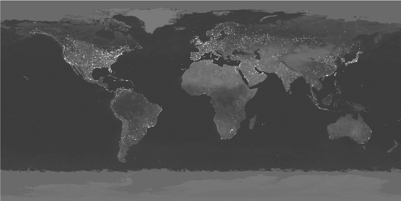
One-fifth of the world's population cannot see the Milky Way at night because of so-called sky glow. This NASA composite image of Earth at night shows particularly impacted areas like Europe, Japan, and North America
Light pollution generally refers to human-designed, artificial lighting that illuminates areas other than those the light was designed to illuminate. A classic example of light pollution would be a streetlight that is constructed to illuminate a sidewalk or street to allow walkers and motorists to travel with greater ease and safety at night. Depending on the design and construction of the light fixture, the light can either be directed directly to the ground beneath it or, alternatively, can release light in every direction. The light that escapes above the light fixture and is not helpful in illuminating the ground below contributes to what is called light pollution.
What is Light Pollution?
Although light pollution may intuitively seem to be in a different category from other forms of pollution such as air or water pollution, it is rightly considered a form of pollution, if pollution is understood to mean the presence of something in the environment that is either harmful and/or toxic. Light pollution affects our environments aesthetically, and it also has been demonstrated to have harmful effects on the health of human and nonhuman species and to alter human and nonhuman animal behavior.
What Light Pollution Does
Light pollution has various effects. The most visible effect of light pollution is the reduction of star visibility. This is the result of what has been termed sky glow. Sky glow is what hangs over cities and urban centers. It is said to be the result of artificial light interacting with clouds and other elements in the atmosphere that causes the bright glow common to urban areas that presents a dome-like barrier between the inhabitants of urban areas and the larger cosmos beyond the glow. There are far fewer stars visible to residents of urban, light-polluted areas than to inhabitants of rural, less light-polluted areas. Most of the world's population currently lives under sky glow of greater or lesser severity. Sky glow prevents one-fifth of the world's population from seeing the Milky Way at night; this number is much higher in the most affected areas, such as Europe, Japan, and North America, where the number is set as high as two-thirds.
Light pollution can have severe cultural and physical effects. In terms of health and behavioral effects of light pollution, many species, including our own, are sensitive in our daily routines to the presence and absence of light. Our species is fundamentally diurnal (active by day) as opposed to nocturnal (active by night). To facilitate our activity by night, we need to light up our way. Unfortunately, excess artificial light can severely and detrimentally affect the health and behavior of other species. Light pollution has been cited as disrupting feeding patterns, migration patterns, mating, and so on. There are reported cases of birds being attracted by artificial light from buildings only to collide with them, or to circle the light source until dying of exhaustion. A famous example used in discussions of light pollution is that of the sea turtles that lay eggs on dark beaches; when the hatchlings emerge they gravitate toward the brightness of the sea. With beachfront development and its attendant light pollution, however, the light from the sea is often eclipsed by the light from the beach, thus disorienting the hatchlings, leaving many of them vulnerable and unlikely to ever reach the sea. Another example of the effect of light pollution on animals is the opportunity it provides for creatures to forage for food longer; however, this simultaneously leaves them more vulnerable to predation. The general point is that many species’ health and behavior are closely connected to the cycles of light and day, and as we engineer the darkness into light and obstruct these rhythms, animals and ecosystems are being affected in ways we do not yet fully understand.
...
- City Organizations, Movements, and Planning
- Agenda 21
- Brownfields
- Carrying Capacity
- Charrette
- City Politics
- Civic Space
- Ecoindustrial Parks
- Environmental Impact Assessment
- Environmental Planning
- Green Communities and Neighborhood Planning
- Green Design, Construction and Operations
- Greenfield Sites
- Infrastructure
- Intermodal Transportation
- Millennium Development Goals
- Mitigation
- NIMBY
- Personal Rapid Transit
- Resilience
- Sustainability Indicators
- Sustainable Development
- Transit-Oriented Development
- Transportation Demand Management
- City Profiles
- Austin, Texas
- Bahía de Caráquez, Ecuador
- Bangkok, Thailand
- Barcelona, Spain
- Beijing, China
- Bogotá, Colombia
- Chattanooga, Tennessee
- Chernobyl, Ukraine
- Chicago, Illinois
- Copenhagen, Denmark
- Curitiba, Brazil
- Dongtan, China
- Dzerzhinsk, Russia
- Hamburg, Germany
- Kabwe, Zambia
- Kampala, Uganda
- La Oroya, Peru
- Linfen, China
- London, England
- Los Angeles, California
- Malmö, Sweden
- Mexico City, Mexico
- New York City, New York
- Norilsk, Russia
- Portland, Oregon
- Reykjavik, Iceland
- Rio de Janeiro, Brazil
- San Francisco, California
- Seattle, Washington
- Stockholm, Sweden
- Sukinda, India
- Sumgayit, Azerbaijan
- Sydney, Australia
- Tianying, China
- Vancouver, Canada
- Vapi, India
- Green City Challenges
- Adaptation, Climate Change
- Adaptive Reuse
- Air Quality
- Biodiversity
- Carbon Footprints
- Coastal Zone Management
- Combined Sewer Overflow
- Commuting
- Construction and Demolition Waste
- Denitrification
- Density
- Ecological Footprint
- Ecosystem Restoration
- Embodied Energy
- Energy Efficiency
- Environmental Justice
- Environmental Risk
- Food Deserts
- Food Security
- Garbage
- Greywater
- Gridlock
- Heat Island Effect
- Indoor Air Quality
- Landfills
- Light Pollution
- Natural Capital
- Nonpoint Source Pollution
- Ports
- Power Grids
- Recycling in Cities
- Sea Level Rise
- Stormwater Management
- Transit
- Waste Disposal
- Water Conservation
- Water Pollution
- Water Treatment
- Water, Sources and Delivery
- Watershed Protection
- Wetlands
- Green City Solutions
- Bicycling
- Biophilia
- Bioregion
- Bluebelts
- Bus Rapid Transit
- Carbon Neutral
- Carbon Trading
- Carpooling
- Cities for Climate Protection
- Citizen Participation
- Combined Heat and Power (Cogeneration)
- Community Gardens
- Compact Development (New Urbanism)
- Composting
- Congestion Pricing
- Conservation Subdivision
- Daylighting
- Distributed Generation
- District Energy
- Ecovillages
- Green Belt
- Green Energy
- Green Fleets (Vehicles)
- Green Housing
- Green Infrastructure
- Green Jobs
- Green Landscaping
- Green Procurement and Purchasing
- Green Roofs
- Greening Suburbia
- Greyfield Development
- Habitat Conservation and Restoration
- Healthy Cities
- Historic Preservation
- Infill Development
- LEED (Leadership in Energy and Environmental Design)
- Location-Efficient Mortgage
- Masdar Ecocity
- Mayors Climate Protection Agreement
- Parks, Greenways, and Open Space
- Renewable Energy
- Smart Growth
- Traffic Calming
- Universal Design
- Urban Agriculture
- Urban Forests
- Walkability (Pedestrian-Friendly Streets)
- Xeriscaping
- Loading...
Get a 30 day FREE TRIAL
-
 Watch videos from a variety of sources bringing classroom topics to life
 -
Read modern, diverse business cases
-
Explore hundreds of books and reference titles

Read next

More like this
Sage Recommends
We found other relevant content for you on other Sage platforms.
Have you created a personal profile? Login or create a profile so that you can save clips, playlists and searches