
Entry
Reader's guide
Entries A-Z
Subject index
Landfills
In the United States, 228 million metric tons per year of trash/solid waste materials are generated at an astonishing rate of 4.6 pounds (2.1 kilograms) per day per person. It is twice the amount generated by other major developed countries in the world. According to the U.S. Environmental Protection Agency, about 32.5 percent of solid waste is recycled, 12.5 percent is burned, and the rest—55 percent—is buried in landfills.
Compaction of waste at landfills like this one in Perth, Western Australia, is organized by cells. Once one cell is covered with compacted solid waste and topped with soil or other materials, another cell is dug close to it
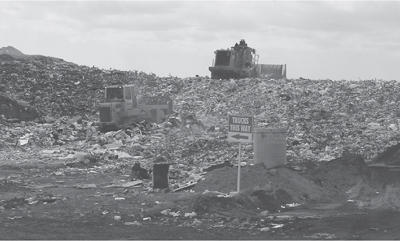
Landfills used by a single producer to bury their own waste at the place of production are known as internal waste disposal landfills. Landfills in urban settings are used by many producers and are known as municipal solid waste landfills (MSWLFs). They receive solid wastes from households or commercial operations and nonhazardous sludge, industrial solid waste, and construction and demolition debris. MSWLFs are carefully designed structures built into or on top of the ground for solid waste disposal, so that the wastes can be isolated from the surrounding environment including groundwater, air, rain, scavenging animals, and so on. This isolation is accomplished by the provision of an impervious bottom liner and daily layering of soil on top of the wastes.
Landfill Construction Criteria
The MSWLFs are built in compliance with federal regulations because landfills are ticking environmental hazards. In the United States, taking care of trash and building landfills are local government responsibilities. An environmental impact assessment is conducted on the proposed site by the agency responsible for the landfill to make it commercially and environmentally viable. The important requirements for building a landfill include location, capacity, and stability: composition of the underlying soil and bedrock at the proposed location, surface water flow at the proposed site, the effect of the proposed landfill on the local environment and wildlife, the historical or archaeological value of the proposed site, and most important, cost.
Location is one of the major criteria for siting a landfill. It must be constructed far from densely populated area and should have easy transportation access for trash producers, as well as for transporting compost from the site. Several studies have shown that in the United States, landfills are being constructed close to poor neighborhoods or settlements of socially weaker or underprivileged populations. The capacity of the landfill must be determined on the basis of the density of the wastes, the number of people to be served by it, and the construction of lining, drainage layers, and daily and intermediate covering availability. Underlying geology, nearby earthquake fault lines, groundwater table, and location of nearby flood plains and water bodies such as rivers, streams, and lakes also help determine the construction of landfills. Landfills can easily pollute groundwater; therefore, special care should be taken to confirm the stability of a landfill. Surface water should not flow from a landfill to nearby properties, and landfills should not be constructed in locations where there are possibilities of interference with local or migrating birds, wildlife, and fisheries. Landfills should not be built on locations that contain historical and archeological artifacts. The final consideration for building a landfill is its cost. In the United States, the cost of landfills is mostly borne by the local public. A feasibility study must be conducted to determine the cost of building a landfill.
...
- City Organizations, Movements, and Planning
- Agenda 21
- Brownfields
- Carrying Capacity
- Charrette
- City Politics
- Civic Space
- Ecoindustrial Parks
- Environmental Impact Assessment
- Environmental Planning
- Green Communities and Neighborhood Planning
- Green Design, Construction and Operations
- Greenfield Sites
- Infrastructure
- Intermodal Transportation
- Millennium Development Goals
- Mitigation
- NIMBY
- Personal Rapid Transit
- Resilience
- Sustainability Indicators
- Sustainable Development
- Transit-Oriented Development
- Transportation Demand Management
- City Profiles
- Austin, Texas
- Bahía de Caráquez, Ecuador
- Bangkok, Thailand
- Barcelona, Spain
- Beijing, China
- Bogotá, Colombia
- Chattanooga, Tennessee
- Chernobyl, Ukraine
- Chicago, Illinois
- Copenhagen, Denmark
- Curitiba, Brazil
- Dongtan, China
- Dzerzhinsk, Russia
- Hamburg, Germany
- Kabwe, Zambia
- Kampala, Uganda
- La Oroya, Peru
- Linfen, China
- London, England
- Los Angeles, California
- Malmö, Sweden
- Mexico City, Mexico
- New York City, New York
- Norilsk, Russia
- Portland, Oregon
- Reykjavik, Iceland
- Rio de Janeiro, Brazil
- San Francisco, California
- Seattle, Washington
- Stockholm, Sweden
- Sukinda, India
- Sumgayit, Azerbaijan
- Sydney, Australia
- Tianying, China
- Vancouver, Canada
- Vapi, India
- Green City Challenges
- Adaptation, Climate Change
- Adaptive Reuse
- Air Quality
- Biodiversity
- Carbon Footprints
- Coastal Zone Management
- Combined Sewer Overflow
- Commuting
- Construction and Demolition Waste
- Denitrification
- Density
- Ecological Footprint
- Ecosystem Restoration
- Embodied Energy
- Energy Efficiency
- Environmental Justice
- Environmental Risk
- Food Deserts
- Food Security
- Garbage
- Greywater
- Gridlock
- Heat Island Effect
- Indoor Air Quality
- Landfills
- Light Pollution
- Natural Capital
- Nonpoint Source Pollution
- Ports
- Power Grids
- Recycling in Cities
- Sea Level Rise
- Stormwater Management
- Transit
- Waste Disposal
- Water Conservation
- Water Pollution
- Water Treatment
- Water, Sources and Delivery
- Watershed Protection
- Wetlands
- Green City Solutions
- Bicycling
- Biophilia
- Bioregion
- Bluebelts
- Bus Rapid Transit
- Carbon Neutral
- Carbon Trading
- Carpooling
- Cities for Climate Protection
- Citizen Participation
- Combined Heat and Power (Cogeneration)
- Community Gardens
- Compact Development (New Urbanism)
- Composting
- Congestion Pricing
- Conservation Subdivision
- Daylighting
- Distributed Generation
- District Energy
- Ecovillages
- Green Belt
- Green Energy
- Green Fleets (Vehicles)
- Green Housing
- Green Infrastructure
- Green Jobs
- Green Landscaping
- Green Procurement and Purchasing
- Green Roofs
- Greening Suburbia
- Greyfield Development
- Habitat Conservation and Restoration
- Healthy Cities
- Historic Preservation
- Infill Development
- LEED (Leadership in Energy and Environmental Design)
- Location-Efficient Mortgage
- Masdar Ecocity
- Mayors Climate Protection Agreement
- Parks, Greenways, and Open Space
- Renewable Energy
- Smart Growth
- Traffic Calming
- Universal Design
- Urban Agriculture
- Urban Forests
- Walkability (Pedestrian-Friendly Streets)
- Xeriscaping
- Loading...
Get a 30 day FREE TRIAL
-
 Watch videos from a variety of sources bringing classroom topics to life
 -
Read modern, diverse business cases
-
Explore hundreds of books and reference titles

Read next

More like this
Sage Recommends
We found other relevant content for you on other Sage platforms.
Have you created a personal profile? Login or create a profile so that you can save clips, playlists and searches