
Entry
Reader's guide
Entries A-Z
Subject index
Indoor Air Quality
Though often taken for granted, indoor air quality is an important concern. Most people spend more time indoors than out, consequently the health risks posed by pollutants trapped within buildings can be significantly greater than those associated with outdoor air pollution. The main causes of poor indoor air quality fall into two broad categories: (1) emissions from building materials and furnishings, dirt and molds, chemical cleaning supplies, heating and air conditioning system fuels and filters, and site characteristics; and (2) poor ventilation that concentrates interior pollutants by preventing exchange with the outside air.
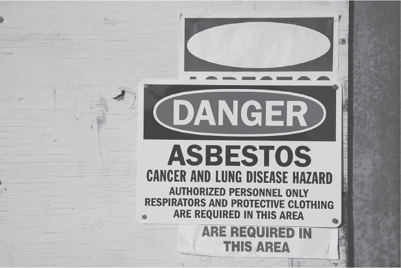
The heavy use of asbestos as a building material has resulted in major health problems, leading to extensive litigation against manufacturers over its use
Emissions from building materials and furnishings emerged as a problem with the increased use of processed wood products, foams and plastics. Virtually every modern building contains some of these products, for example, particleboard, plywood, fiberboard, and paneling. The primary pollutant associated with this group is formaldehyde, a component of many adhesives. Problems with formaldehyde rose to prominence during the 1970s when urea-formaldehyde foam insulation was installed in many U.S. homes as an energy conservation measure. Soon after installation, occupants of these structures began to suffer from eye, nose, and throat irritations and upper-respiratory difficulties. The cause was traced to high interior concentrations of formaldehyde.
A similar situation occurred when manufactured homes containing formaldehyde-based components were provided to families displaced by the flooding in and around New Orleans as a result of Hurricane Katrina in 2005. Since 1985, the Department of Housing and Urban Development and many U.S. states have established specific emissions limits for building products containing formaldehyde, and limits on volatile organic compound (VOC) emissions from paint have been set by many air pollution control districts.
Radon is an example of natural pollutant characteristic of a building's location. An odorless, tasteless gas, radon emanates from the natural radioactive decay of uranium in the soil. Radon ions have a static charge that binds them to minute dust particles, which can easily be inhaled, a trait that links radon to lung cancer. Four conditions must exist for radon to pose a problem in a building. Two are geological: There has to be a source of uranium in the soil, and the soil must be permeable enough to allow radon to move through it. The two other requisites relate to building construction: There must be a pathway into the structure—a hole, crack, or gap, and a negative air pressure differential must exist between the building's interior and surrounding soils. Radon can be found throughout the United States, and since the 1980s, homeowners have been advised to test for its presence in their homes.
Before emissions from building materials and furnishings were identified as health threats, buildings were designed to be as air tight as possible in order to conserve energy and reduce heating and cooling costs. Consequently, indoor pollutants were trapped and concentrations tended to increase over time. Today, green construction techniques allow buildings to breathe, striking a more healthful balance between energy conservation and indoor air quality. Indoor air quality is enhanced by the use of nontoxic materials, those emitting few or no VOCs, and those resistant to mold and mildew problems. However, much of the current U.S. housing stock predates these design and product improvements, and poor indoor air quality still places an estimated 40 percent of the U.S. population at risk for allergies, respiratory disease, cancer, and developmental problems.
...
- City Organizations, Movements, and Planning
- Agenda 21
- Brownfields
- Carrying Capacity
- Charrette
- City Politics
- Civic Space
- Ecoindustrial Parks
- Environmental Impact Assessment
- Environmental Planning
- Green Communities and Neighborhood Planning
- Green Design, Construction and Operations
- Greenfield Sites
- Infrastructure
- Intermodal Transportation
- Millennium Development Goals
- Mitigation
- NIMBY
- Personal Rapid Transit
- Resilience
- Sustainability Indicators
- Sustainable Development
- Transit-Oriented Development
- Transportation Demand Management
- City Profiles
- Austin, Texas
- Bahía de Caráquez, Ecuador
- Bangkok, Thailand
- Barcelona, Spain
- Beijing, China
- Bogotá, Colombia
- Chattanooga, Tennessee
- Chernobyl, Ukraine
- Chicago, Illinois
- Copenhagen, Denmark
- Curitiba, Brazil
- Dongtan, China
- Dzerzhinsk, Russia
- Hamburg, Germany
- Kabwe, Zambia
- Kampala, Uganda
- La Oroya, Peru
- Linfen, China
- London, England
- Los Angeles, California
- Malmö, Sweden
- Mexico City, Mexico
- New York City, New York
- Norilsk, Russia
- Portland, Oregon
- Reykjavik, Iceland
- Rio de Janeiro, Brazil
- San Francisco, California
- Seattle, Washington
- Stockholm, Sweden
- Sukinda, India
- Sumgayit, Azerbaijan
- Sydney, Australia
- Tianying, China
- Vancouver, Canada
- Vapi, India
- Green City Challenges
- Adaptation, Climate Change
- Adaptive Reuse
- Air Quality
- Biodiversity
- Carbon Footprints
- Coastal Zone Management
- Combined Sewer Overflow
- Commuting
- Construction and Demolition Waste
- Denitrification
- Density
- Ecological Footprint
- Ecosystem Restoration
- Embodied Energy
- Energy Efficiency
- Environmental Justice
- Environmental Risk
- Food Deserts
- Food Security
- Garbage
- Greywater
- Gridlock
- Heat Island Effect
- Indoor Air Quality
- Landfills
- Light Pollution
- Natural Capital
- Nonpoint Source Pollution
- Ports
- Power Grids
- Recycling in Cities
- Sea Level Rise
- Stormwater Management
- Transit
- Waste Disposal
- Water Conservation
- Water Pollution
- Water Treatment
- Water, Sources and Delivery
- Watershed Protection
- Wetlands
- Green City Solutions
- Bicycling
- Biophilia
- Bioregion
- Bluebelts
- Bus Rapid Transit
- Carbon Neutral
- Carbon Trading
- Carpooling
- Cities for Climate Protection
- Citizen Participation
- Combined Heat and Power (Cogeneration)
- Community Gardens
- Compact Development (New Urbanism)
- Composting
- Congestion Pricing
- Conservation Subdivision
- Daylighting
- Distributed Generation
- District Energy
- Ecovillages
- Green Belt
- Green Energy
- Green Fleets (Vehicles)
- Green Housing
- Green Infrastructure
- Green Jobs
- Green Landscaping
- Green Procurement and Purchasing
- Green Roofs
- Greening Suburbia
- Greyfield Development
- Habitat Conservation and Restoration
- Healthy Cities
- Historic Preservation
- Infill Development
- LEED (Leadership in Energy and Environmental Design)
- Location-Efficient Mortgage
- Masdar Ecocity
- Mayors Climate Protection Agreement
- Parks, Greenways, and Open Space
- Renewable Energy
- Smart Growth
- Traffic Calming
- Universal Design
- Urban Agriculture
- Urban Forests
- Walkability (Pedestrian-Friendly Streets)
- Xeriscaping
- Loading...
Get a 30 day FREE TRIAL
-
 Watch videos from a variety of sources bringing classroom topics to life
 -
Read modern, diverse business cases
-
Explore hundreds of books and reference titles

Read next

More like this
Sage Recommends
We found other relevant content for you on other Sage platforms.
Have you created a personal profile? Login or create a profile so that you can save clips, playlists and searches