
Entry
Reader's guide
Entries A-Z
Subject index
Greenfield Sites
Greenfield sites are created when land presently used for agricultural, recreational, or amenity purposes is developed for urban uses. These sites are usually adjacent to existing urban areas, and as such, the development of greenfield sites leads to sprawl. For many centuries the development of greenfield sites was regarded as a normal development pattern that was a sign of civic progress. However, the realization of the financial and environmental costs of this style of development in the late 20th and early 21st centuries led to an effort to reduce the reliance on greenfield sites through the greater use of former industrial sites (brownfields) and urban infill sites for development.
Greenfield development and associated urban sprawl became a political issue in Britain and Europe in the 1990s because of its close association with the “crisis” in housing provision. This led to a series of policy initiatives such as the British Urban Renaissance Programme that tried to redirect development from greenfields to existing developed urban areas. The conversion of greenfield land into urban development is largely irreversible and has a number of environmental and social impacts. If the land concerned, such as a wetland, has environmental values or provides landscape values, then the environmental costs of development can be substantial. Equally, if the land is being used productively for agriculture, then the development of greenfield sites will result in the loss of that productive capacity. This serves to push agricultural production of everyday food supplies such as market garden crops and milk supplies farther from the users of those products. This has consequences for retail prices and the energy and environmental costs associated with feeding city dwellers. It also reduces the amount of land available for agricultural production and makes the remaining agricultural land difficult to use.
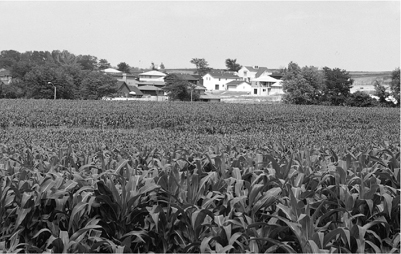
Greenfield sites are created when land presently used for agriculture, like these cornfields on the edge of Des Moines, Iowa, are developed for urban uses
The planning response to urban growth was often to establish a greenbelt around cites in an attempt to delineate the extent of urban growth. More recent planning approaches such as smart growth policies retained the concept of a city or metropolitan limit, which defined the boundaries for growth of that city but included at least a modest area for greenfield site development. The idea is that some greenfield development should be provided to allow for some choice within the housing market. Depending largely on the speed of growth, these greenfield areas may remain undeveloped for some years and face a number of challenges. The continuation of their present use for purposes such as farming may be impossible because of a number of factors. Urban neighbors may be unwilling to accept the noise, smells, and environmental issues associated with farming, and the farmers are faced with meeting the costs of city services that they may or may not have access to. Alternatively, the land is used for recreation or amenity purposes, which is usually more acceptable but that can produce community outrage when the land identified as having community values is revealed as land awaiting development. The land may also become derelict in a rural version of urban blight.
...
- City Organizations, Movements, and Planning
- Agenda 21
- Brownfields
- Carrying Capacity
- Charrette
- City Politics
- Civic Space
- Ecoindustrial Parks
- Environmental Impact Assessment
- Environmental Planning
- Green Communities and Neighborhood Planning
- Green Design, Construction and Operations
- Greenfield Sites
- Infrastructure
- Intermodal Transportation
- Millennium Development Goals
- Mitigation
- NIMBY
- Personal Rapid Transit
- Resilience
- Sustainability Indicators
- Sustainable Development
- Transit-Oriented Development
- Transportation Demand Management
- City Profiles
- Austin, Texas
- Bahía de Caráquez, Ecuador
- Bangkok, Thailand
- Barcelona, Spain
- Beijing, China
- Bogotá, Colombia
- Chattanooga, Tennessee
- Chernobyl, Ukraine
- Chicago, Illinois
- Copenhagen, Denmark
- Curitiba, Brazil
- Dongtan, China
- Dzerzhinsk, Russia
- Hamburg, Germany
- Kabwe, Zambia
- Kampala, Uganda
- La Oroya, Peru
- Linfen, China
- London, England
- Los Angeles, California
- Malmö, Sweden
- Mexico City, Mexico
- New York City, New York
- Norilsk, Russia
- Portland, Oregon
- Reykjavik, Iceland
- Rio de Janeiro, Brazil
- San Francisco, California
- Seattle, Washington
- Stockholm, Sweden
- Sukinda, India
- Sumgayit, Azerbaijan
- Sydney, Australia
- Tianying, China
- Vancouver, Canada
- Vapi, India
- Green City Challenges
- Adaptation, Climate Change
- Adaptive Reuse
- Air Quality
- Biodiversity
- Carbon Footprints
- Coastal Zone Management
- Combined Sewer Overflow
- Commuting
- Construction and Demolition Waste
- Denitrification
- Density
- Ecological Footprint
- Ecosystem Restoration
- Embodied Energy
- Energy Efficiency
- Environmental Justice
- Environmental Risk
- Food Deserts
- Food Security
- Garbage
- Greywater
- Gridlock
- Heat Island Effect
- Indoor Air Quality
- Landfills
- Light Pollution
- Natural Capital
- Nonpoint Source Pollution
- Ports
- Power Grids
- Recycling in Cities
- Sea Level Rise
- Stormwater Management
- Transit
- Waste Disposal
- Water Conservation
- Water Pollution
- Water Treatment
- Water, Sources and Delivery
- Watershed Protection
- Wetlands
- Green City Solutions
- Bicycling
- Biophilia
- Bioregion
- Bluebelts
- Bus Rapid Transit
- Carbon Neutral
- Carbon Trading
- Carpooling
- Cities for Climate Protection
- Citizen Participation
- Combined Heat and Power (Cogeneration)
- Community Gardens
- Compact Development (New Urbanism)
- Composting
- Congestion Pricing
- Conservation Subdivision
- Daylighting
- Distributed Generation
- District Energy
- Ecovillages
- Green Belt
- Green Energy
- Green Fleets (Vehicles)
- Green Housing
- Green Infrastructure
- Green Jobs
- Green Landscaping
- Green Procurement and Purchasing
- Green Roofs
- Greening Suburbia
- Greyfield Development
- Habitat Conservation and Restoration
- Healthy Cities
- Historic Preservation
- Infill Development
- LEED (Leadership in Energy and Environmental Design)
- Location-Efficient Mortgage
- Masdar Ecocity
- Mayors Climate Protection Agreement
- Parks, Greenways, and Open Space
- Renewable Energy
- Smart Growth
- Traffic Calming
- Universal Design
- Urban Agriculture
- Urban Forests
- Walkability (Pedestrian-Friendly Streets)
- Xeriscaping
- Loading...
Get a 30 day FREE TRIAL
-
 Watch videos from a variety of sources bringing classroom topics to life
 -
Read modern, diverse business cases
-
Explore hundreds of books and reference titles

Read next

More like this
Sage Recommends
We found other relevant content for you on other Sage platforms.
Have you created a personal profile? Login or create a profile so that you can save clips, playlists and searches