
Entry
Reader's guide
Entries A-Z
Subject index
Green Roofs
A green roof is the roof of a building that is covered with vegetation and soil or another growing medium. Other layers such as a waterproofing membrane, a root barrier, or drainage and irrigation systems are often included as well. Sometimes referred to as rooftop gardens, ecoroofs, or vegetated roofs, green roofs are becoming increasingly popular for their environmental, economic, and aesthetic benefits.
The green roof of Chicago's city hall was planted in 2000 to test the effects of such roofs on air quality and temperature. It contains over 100 species of shrubs and vines, mostly prairie plants native to the Chicago region
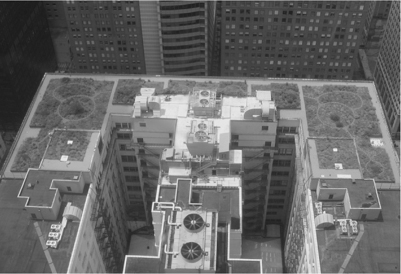
The benefits attributed to green roofs are numerous. The first is energy efficiency. By providing a layer of insulation and absorbing the heat of the summer sun, green roofs have been found to lower energy requirements for cooling and heating buildings significantly. Green roofs can reduce the urban heat island effect and can reduce air pollution, as the vegetation filters both particulate matter and carbon dioxide. Another benefit of green roofs is that they reduce a city's impervious surface area. By absorbing rainfall, green roofs can help control storm water runoff, which in combined sewer systems is typically discharged with untreated wastewater into receiving water bodies. A green roof can also protect the manufactured roof of a building from the damaging effects of sun and harsh weather, increasing its life span significantly. Aesthetically, green roofs increase green amenity space in urban areas and beautify city buildings. Finally, green roofs can provide habitat for urban wildlife, thereby maintaining and improving biodiversity within cities.
Types of Green Roofs
There are two main kinds of green roofs: intensive and extensive. The difference depends largely on the amount of maintenance they need and the depth of the planting medium used. Intensive green roofs tend to have deeper planting media as well as contain complex irrigation systems. Intensive green roofs generally include a broad range of ornamental plant species and large plants such as trees and shrubs, and they may have ponds and other decorative features. Intensive roofs are the most expensive kind of green roof. The roofs they are built on must be engineered to accept the weight of deep soil and large plants. Their need for ongoing maintenance also adds significantly to the long-term labor costs of the roof. Intensive green roofs have a greater emphasis on aesthetics than extensive roofs and are usually designed for public access and recreational use.
Extensive green roofs, which have lower construction and maintenance costs than intensive roofs, are the more common kind of green roof. They generally have a thin, lightweight growing medium, which lowers the weight load that the building must handle, allowing this type of green roof to be built on a larger variety of structures. The lightweight planting media, along with a lack of irrigation other than rainfall, requires that the plants on these roofs be chosen for their hardiness and drought-resistant properties, such as sedum. These features, along with ease of maintenance, are generally considered more important than the plants’ aesthetic appeal. Extensive green roofs are designed to be virtually self-sustaining and to require only a minimum of maintenance. They are generally accessed only for maintenance and not for recreational purposes.
...
- City Organizations, Movements, and Planning
- Agenda 21
- Brownfields
- Carrying Capacity
- Charrette
- City Politics
- Civic Space
- Ecoindustrial Parks
- Environmental Impact Assessment
- Environmental Planning
- Green Communities and Neighborhood Planning
- Green Design, Construction and Operations
- Greenfield Sites
- Infrastructure
- Intermodal Transportation
- Millennium Development Goals
- Mitigation
- NIMBY
- Personal Rapid Transit
- Resilience
- Sustainability Indicators
- Sustainable Development
- Transit-Oriented Development
- Transportation Demand Management
- City Profiles
- Austin, Texas
- Bahía de Caráquez, Ecuador
- Bangkok, Thailand
- Barcelona, Spain
- Beijing, China
- Bogotá, Colombia
- Chattanooga, Tennessee
- Chernobyl, Ukraine
- Chicago, Illinois
- Copenhagen, Denmark
- Curitiba, Brazil
- Dongtan, China
- Dzerzhinsk, Russia
- Hamburg, Germany
- Kabwe, Zambia
- Kampala, Uganda
- La Oroya, Peru
- Linfen, China
- London, England
- Los Angeles, California
- Malmö, Sweden
- Mexico City, Mexico
- New York City, New York
- Norilsk, Russia
- Portland, Oregon
- Reykjavik, Iceland
- Rio de Janeiro, Brazil
- San Francisco, California
- Seattle, Washington
- Stockholm, Sweden
- Sukinda, India
- Sumgayit, Azerbaijan
- Sydney, Australia
- Tianying, China
- Vancouver, Canada
- Vapi, India
- Green City Challenges
- Adaptation, Climate Change
- Adaptive Reuse
- Air Quality
- Biodiversity
- Carbon Footprints
- Coastal Zone Management
- Combined Sewer Overflow
- Commuting
- Construction and Demolition Waste
- Denitrification
- Density
- Ecological Footprint
- Ecosystem Restoration
- Embodied Energy
- Energy Efficiency
- Environmental Justice
- Environmental Risk
- Food Deserts
- Food Security
- Garbage
- Greywater
- Gridlock
- Heat Island Effect
- Indoor Air Quality
- Landfills
- Light Pollution
- Natural Capital
- Nonpoint Source Pollution
- Ports
- Power Grids
- Recycling in Cities
- Sea Level Rise
- Stormwater Management
- Transit
- Waste Disposal
- Water Conservation
- Water Pollution
- Water Treatment
- Water, Sources and Delivery
- Watershed Protection
- Wetlands
- Green City Solutions
- Bicycling
- Biophilia
- Bioregion
- Bluebelts
- Bus Rapid Transit
- Carbon Neutral
- Carbon Trading
- Carpooling
- Cities for Climate Protection
- Citizen Participation
- Combined Heat and Power (Cogeneration)
- Community Gardens
- Compact Development (New Urbanism)
- Composting
- Congestion Pricing
- Conservation Subdivision
- Daylighting
- Distributed Generation
- District Energy
- Ecovillages
- Green Belt
- Green Energy
- Green Fleets (Vehicles)
- Green Housing
- Green Infrastructure
- Green Jobs
- Green Landscaping
- Green Procurement and Purchasing
- Green Roofs
- Greening Suburbia
- Greyfield Development
- Habitat Conservation and Restoration
- Healthy Cities
- Historic Preservation
- Infill Development
- LEED (Leadership in Energy and Environmental Design)
- Location-Efficient Mortgage
- Masdar Ecocity
- Mayors Climate Protection Agreement
- Parks, Greenways, and Open Space
- Renewable Energy
- Smart Growth
- Traffic Calming
- Universal Design
- Urban Agriculture
- Urban Forests
- Walkability (Pedestrian-Friendly Streets)
- Xeriscaping
- Loading...
Get a 30 day FREE TRIAL
-
 Watch videos from a variety of sources bringing classroom topics to life
 -
Read modern, diverse business cases
-
Explore hundreds of books and reference titles

Read next

More like this
Sage Recommends
We found other relevant content for you on other Sage platforms.
Have you created a personal profile? Login or create a profile so that you can save clips, playlists and searches