
Entry
Reader's guide
Entries A-Z
Subject index
Green Jobs
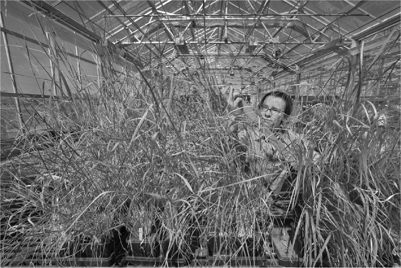
A bio-energy scientist conducts crop research on switchgrass at this U.S. government laboratory
In recent decades, global economic growth has been fueled largely by manufacturing industries. Technology advancement in manufacturing has improved production capacity in terms of output and connected the world through efficient supply chain processes. The benefits of global economic growth through an industrial economy are indeed far reaching, providing opportunities for increased quality of life for millions, particularly in developing nations.
The boom of an industrial economy does come at a price. Most manufacturing requires extensive use of fossil fuels to operate efficiently. Research strongly suggests that the use of fossil fuels produces excessive carbon emissions, resulting in significant environmental degradation including climate change. Beyond the effect of growing carbon emissions on the environment, the industrial economy produces excess waste that threatens the Earth's ecosystems. The increased energy usage and excessive waste discharge from the industrial economy has created an urgent need for change across the globe to protect the Earth's natural resources for future generations.
In recent years there has been a movement to create so-called green jobs to address the issues attendant to an industrial economy. The broadest view of green jobs includes those that facilitate any process important to the future of our environment, such as those that conserve energy, reduce natural resource usage, and manage or avoid the generation of waste and pollution. Governmental sources present a similar view, categorizing green jobs as those that provide products and services that use renewable energy resources, reduce pollution, conserve energy and natural resources, and reconstitute waste. Many believe that any job supporting a process focused on sustainability of our natural resources should be considered green.
Despite the various interpretations, there is general agreement that green jobs are those that improve environmental quality and build sustainable enterprises that do not harm the Earth's ecosystems. To date, reference to green jobs includes multiple industries, from manufacturing to agriculture, and includes any focus on improving the environment. Many in government and in the private sector believe these green jobs will launch the next revolution in the global economy.
It is important to note, however, that an inclusive notion of green employment makes measuring the specific impact on the environment a challenge. For example, most would agree that a firm dedicated to installing solar panels is considered to have green jobs. However, some might question the jobs at the solar panel manufacturing plant if the plant itself releases carbon emissions from the use of fossil fuels.
As concern for the environment has grown, so has the interest in measuring the specific impact certain jobs have on the Earth's natural resources. Early environmentalists thought of “end of the pipe” jobs as green, which included only those that focused on cleaning pollution after it had been produced. More recent interpretations view production, distribution, sale, and disposal as a holistic process, attempting to track the full effect on the environment from a systems perspective.
Defining what constitutes a green job, then measuring the impact on the environment of such jobs, continues to be a challenge. Most agree that new industries exclusively dedicated to improving the environment are relatively easy to identify and measure. However, the impact from existing industries that integrate new technologies to reduce their energy consumption or recycle waste output is difficult to quantify. In those instances, “green” is relative to a previously employed process versus a well-defined standard. One approach to defining green jobs is to measure the impact of the industry in terms of its overall impact on the environment.
...
- City Organizations, Movements, and Planning
- Agenda 21
- Brownfields
- Carrying Capacity
- Charrette
- City Politics
- Civic Space
- Ecoindustrial Parks
- Environmental Impact Assessment
- Environmental Planning
- Green Communities and Neighborhood Planning
- Green Design, Construction and Operations
- Greenfield Sites
- Infrastructure
- Intermodal Transportation
- Millennium Development Goals
- Mitigation
- NIMBY
- Personal Rapid Transit
- Resilience
- Sustainability Indicators
- Sustainable Development
- Transit-Oriented Development
- Transportation Demand Management
- City Profiles
- Austin, Texas
- Bahía de Caráquez, Ecuador
- Bangkok, Thailand
- Barcelona, Spain
- Beijing, China
- Bogotá, Colombia
- Chattanooga, Tennessee
- Chernobyl, Ukraine
- Chicago, Illinois
- Copenhagen, Denmark
- Curitiba, Brazil
- Dongtan, China
- Dzerzhinsk, Russia
- Hamburg, Germany
- Kabwe, Zambia
- Kampala, Uganda
- La Oroya, Peru
- Linfen, China
- London, England
- Los Angeles, California
- Malmö, Sweden
- Mexico City, Mexico
- New York City, New York
- Norilsk, Russia
- Portland, Oregon
- Reykjavik, Iceland
- Rio de Janeiro, Brazil
- San Francisco, California
- Seattle, Washington
- Stockholm, Sweden
- Sukinda, India
- Sumgayit, Azerbaijan
- Sydney, Australia
- Tianying, China
- Vancouver, Canada
- Vapi, India
- Green City Challenges
- Adaptation, Climate Change
- Adaptive Reuse
- Air Quality
- Biodiversity
- Carbon Footprints
- Coastal Zone Management
- Combined Sewer Overflow
- Commuting
- Construction and Demolition Waste
- Denitrification
- Density
- Ecological Footprint
- Ecosystem Restoration
- Embodied Energy
- Energy Efficiency
- Environmental Justice
- Environmental Risk
- Food Deserts
- Food Security
- Garbage
- Greywater
- Gridlock
- Heat Island Effect
- Indoor Air Quality
- Landfills
- Light Pollution
- Natural Capital
- Nonpoint Source Pollution
- Ports
- Power Grids
- Recycling in Cities
- Sea Level Rise
- Stormwater Management
- Transit
- Waste Disposal
- Water Conservation
- Water Pollution
- Water Treatment
- Water, Sources and Delivery
- Watershed Protection
- Wetlands
- Green City Solutions
- Bicycling
- Biophilia
- Bioregion
- Bluebelts
- Bus Rapid Transit
- Carbon Neutral
- Carbon Trading
- Carpooling
- Cities for Climate Protection
- Citizen Participation
- Combined Heat and Power (Cogeneration)
- Community Gardens
- Compact Development (New Urbanism)
- Composting
- Congestion Pricing
- Conservation Subdivision
- Daylighting
- Distributed Generation
- District Energy
- Ecovillages
- Green Belt
- Green Energy
- Green Fleets (Vehicles)
- Green Housing
- Green Infrastructure
- Green Jobs
- Green Landscaping
- Green Procurement and Purchasing
- Green Roofs
- Greening Suburbia
- Greyfield Development
- Habitat Conservation and Restoration
- Healthy Cities
- Historic Preservation
- Infill Development
- LEED (Leadership in Energy and Environmental Design)
- Location-Efficient Mortgage
- Masdar Ecocity
- Mayors Climate Protection Agreement
- Parks, Greenways, and Open Space
- Renewable Energy
- Smart Growth
- Traffic Calming
- Universal Design
- Urban Agriculture
- Urban Forests
- Walkability (Pedestrian-Friendly Streets)
- Xeriscaping
- Loading...
Get a 30 day FREE TRIAL
-
 Watch videos from a variety of sources bringing classroom topics to life
 -
Read modern, diverse business cases
-
Explore hundreds of books and reference titles

Read next

More like this
Sage Recommends
We found other relevant content for you on other Sage platforms.
Have you created a personal profile? Login or create a profile so that you can save clips, playlists and searches