
Entry
Reader's guide
Entries A-Z
Subject index
Construction and Demolition Waste
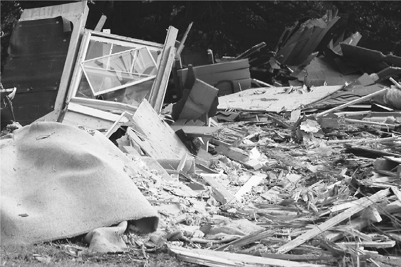
Construction and demolition (C&D) is one of the many types of waste streams that include municipal waste (household wastes), shipping and boating waste, and commercial/industrial waste. C&D waste is the waste produced during new construction, renovation, and demolition of buildings and structures. This includes building materials such as bricks, plastics and vinyl, carpet, brick and rubble, glass, metal, asphalt roofing, concrete, damaged wood, scraps of insulation, nails, electrical wiring, and rebar, as well as waste originating from site preparation such as dredging materials, and tree stumps. C&D waste may contain lead, asbestos, or other hazardous substances. For example, C&D wastes such as plasterboard are hazardous once broken down in landfill as they release hydrogen sulfide, a toxic gas.
Waste created during new building construction, renovation, or demolition can include bricks, plastics and vinyl, carpet, glass, metal, asphalt roofing, concrete, damaged wood, insulation, nails, electrical wiring, and rebar
It has been estimated that C&D waste accounts for from 10 percent to as much as 30 percent of the total municipal waste stream. More specific research has also attempted to estimate the amount of construction and demolition waste in various countries. C&D waste is most often disposed of in landfills, where it takes up much of the space. For example about 65 percent of Hong Kong's landfill space at its peak in 1994–1995 was C&D waste. About one-third of the volume of materials in landfills in the United States is C&D waste. Data available for some European countries also indicate that the amount of C&D waste varies from country to country, depending on how it is defined. In 1996, the amounts of C&D waste in Austria, Denmark, Germany, and the Netherlands were about 300, over 500, about 2,600, and about 900 kg/cap, respectively.
Although C&D waste is a complex waste stream, made up of a wide variety of materials, recent recognition of its increasing volumes and shortage of landfill has led to more attention being paid in most countries to the diversion of waste components from landfills through waste reduction, recovery, reuse, and recycling. Reduction, reuse, and recovery (the three Rs principle) of waste, otherwise known as the waste management hierarchy, has been very widely adopted and has been officially recognized in most countries as one of the principles of sustainable waste management and development. In Denmark, the percentage of recycling is more than 80 percent. Germany, the Netherlands, Finland, Ireland, and Italy each recycle 30–50 percent, whereas the recycling percentage in Luxembourg is 10 percent. Even building rubble (including concrete, brick, tile, and asphalt), can be recycled. In Australia in 2002–2003, approximately 50 percent of all recycled waste was C&D waste, and building rubble was by far the most recycled material.
Recycling, one strategy of waste minimization, offers some benefits: reduction of demand for new resources, reduction of transport and production energy costs, and reduction of space required for landfill. Furthermore, the social effects of solid waste management systems are reflected in the employment, health, and quality of life of residents in the region. Recycling, reusing, and salvaging construction waste can save money and also create employment related to salvaging and recycling of construction waste. In addition, the health and quality of life of residents are improved because less pollution is generated by reducing manufacturing and transportation energy-related emissions when salvaging and recycling are practiced.
...
- City Organizations, Movements, and Planning
- Agenda 21
- Brownfields
- Carrying Capacity
- Charrette
- City Politics
- Civic Space
- Ecoindustrial Parks
- Environmental Impact Assessment
- Environmental Planning
- Green Communities and Neighborhood Planning
- Green Design, Construction and Operations
- Greenfield Sites
- Infrastructure
- Intermodal Transportation
- Millennium Development Goals
- Mitigation
- NIMBY
- Personal Rapid Transit
- Resilience
- Sustainability Indicators
- Sustainable Development
- Transit-Oriented Development
- Transportation Demand Management
- City Profiles
- Austin, Texas
- Bahía de Caráquez, Ecuador
- Bangkok, Thailand
- Barcelona, Spain
- Beijing, China
- Bogotá, Colombia
- Chattanooga, Tennessee
- Chernobyl, Ukraine
- Chicago, Illinois
- Copenhagen, Denmark
- Curitiba, Brazil
- Dongtan, China
- Dzerzhinsk, Russia
- Hamburg, Germany
- Kabwe, Zambia
- Kampala, Uganda
- La Oroya, Peru
- Linfen, China
- London, England
- Los Angeles, California
- Malmö, Sweden
- Mexico City, Mexico
- New York City, New York
- Norilsk, Russia
- Portland, Oregon
- Reykjavik, Iceland
- Rio de Janeiro, Brazil
- San Francisco, California
- Seattle, Washington
- Stockholm, Sweden
- Sukinda, India
- Sumgayit, Azerbaijan
- Sydney, Australia
- Tianying, China
- Vancouver, Canada
- Vapi, India
- Green City Challenges
- Adaptation, Climate Change
- Adaptive Reuse
- Air Quality
- Biodiversity
- Carbon Footprints
- Coastal Zone Management
- Combined Sewer Overflow
- Commuting
- Construction and Demolition Waste
- Denitrification
- Density
- Ecological Footprint
- Ecosystem Restoration
- Embodied Energy
- Energy Efficiency
- Environmental Justice
- Environmental Risk
- Food Deserts
- Food Security
- Garbage
- Greywater
- Gridlock
- Heat Island Effect
- Indoor Air Quality
- Landfills
- Light Pollution
- Natural Capital
- Nonpoint Source Pollution
- Ports
- Power Grids
- Recycling in Cities
- Sea Level Rise
- Stormwater Management
- Transit
- Waste Disposal
- Water Conservation
- Water Pollution
- Water Treatment
- Water, Sources and Delivery
- Watershed Protection
- Wetlands
- Green City Solutions
- Bicycling
- Biophilia
- Bioregion
- Bluebelts
- Bus Rapid Transit
- Carbon Neutral
- Carbon Trading
- Carpooling
- Cities for Climate Protection
- Citizen Participation
- Combined Heat and Power (Cogeneration)
- Community Gardens
- Compact Development (New Urbanism)
- Composting
- Congestion Pricing
- Conservation Subdivision
- Daylighting
- Distributed Generation
- District Energy
- Ecovillages
- Green Belt
- Green Energy
- Green Fleets (Vehicles)
- Green Housing
- Green Infrastructure
- Green Jobs
- Green Landscaping
- Green Procurement and Purchasing
- Green Roofs
- Greening Suburbia
- Greyfield Development
- Habitat Conservation and Restoration
- Healthy Cities
- Historic Preservation
- Infill Development
- LEED (Leadership in Energy and Environmental Design)
- Location-Efficient Mortgage
- Masdar Ecocity
- Mayors Climate Protection Agreement
- Parks, Greenways, and Open Space
- Renewable Energy
- Smart Growth
- Traffic Calming
- Universal Design
- Urban Agriculture
- Urban Forests
- Walkability (Pedestrian-Friendly Streets)
- Xeriscaping
- Loading...
Get a 30 day FREE TRIAL
-
 Watch videos from a variety of sources bringing classroom topics to life
 -
Read modern, diverse business cases
-
Explore hundreds of books and reference titles

Read next

More like this
Sage Recommends
We found other relevant content for you on other Sage platforms.
Have you created a personal profile? Login or create a profile so that you can save clips, playlists and searches