
Entry
Reader's guide
Entries A-Z
Subject index
Congestion Pricing
Congestion pricing is a market-based policy instrument that, at its most basic, requires road users to pay for using a stretch or road or for passing through a designated charging zone. Congestion pricing may also be referred to as road pricing or congestion charging. The terminology may differ according to the country using the term and may also be influenced by factors such as public acceptability and the aims of the pricing scheme in question.
There are a number of reasons why congestion pricing might be introduced: first, for environmental reasons—to reduce the emissions of greenhouse gases, or local air pollution; second, to ease the traffic flow, especially in cases where congestion is considered to be having an adverse effect on the local economy; third, to pay for improvements to the transport infrastructure; and fourth, to raise revenue for other purposes. Most commonly, congestion pricing is introduced for environmental or traffic flow reasons or a combination of the two. Where the aim of a pricing scheme is to reduce traffic levels, the charge is often higher than if it were simply aimed at raising revenue. This is to provide a disincentive to car users, working on an “unwillingness to pay” principle.
Traffic in central London, where congestion pricing has been in effect for a number of years, fell by 21 percent 2002–2006, and an estimated 70,000 fewer vehicles are on the streets each day
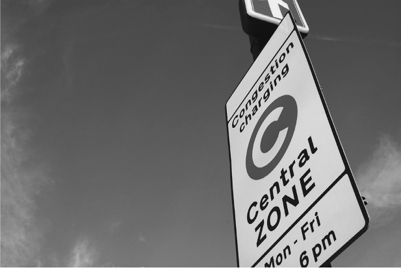
There are several high-profile examples of congestion pricing within cities, most notably Singapore, with the Electronic Road Pricing; Stockholm, with the Stockholm Congestion Tax; and London, with the Congestion Charge. There are a number of ways in which charges can be applied. In all three examples, road users pay as they enter the designated charging zone. In the cases of Singapore and Stockholm, a charge is made every time the road user crosses the zone boundary, whereas in the case of London, a flat daily rate is charged.
Criticisms of Congestion Pricing
Congestion pricing is criticized for its unequal effects on different sections of society, especially where there is a distinction between willingness and ability to pay. The extent of this depends on the setting and level of the charge and on the nature of the pricing zone. Arguably, where an entire area carries a charge, those living or working within it or on the boundaries of it are likely to fare worse compared with those who do not. In contrast, when a charge is made for a particular road, but there are alternative routes, this may be less problematic in this respect, although traffic levels may increase in areas that do not carry a charge, resulting in social and environmental consequences. Peter Jones identifies two significant issues related to congestion pricing—spatial inequality and social equity.
Spatial Inequality
The geographical location of a congestion pricing area may particularly affect living or working in an area. For example, the boundaries of a charge may mean that some individuals and organizations will end up paying charges more often than others, especially if they have to pay every time they cross into a charging area. Some argue that businesses located within charging areas may suffer, as customers avoid entering charging zones. Businesses reliant on regular travel by car, van, or motorbike (e.g., couriers, taxi firms, or those in the building trade) may also suffer if they are required to pay to enter or travel within a congestion zone. Equally, there are arguments that suggest that residential areas on the edges of congestion pricing zones may suffer from increased levels of traffic as motorists attempt to avoid charges. Affects on those living in these areas may include increased levels of pollution, increases in health problems associated with pollution (such as respiratory diseases), increased damage to physical infrastructure, and increases in road traffic, accident-related deaths, and injuries.
...
- City Organizations, Movements, and Planning
- Agenda 21
- Brownfields
- Carrying Capacity
- Charrette
- City Politics
- Civic Space
- Ecoindustrial Parks
- Environmental Impact Assessment
- Environmental Planning
- Green Communities and Neighborhood Planning
- Green Design, Construction and Operations
- Greenfield Sites
- Infrastructure
- Intermodal Transportation
- Millennium Development Goals
- Mitigation
- NIMBY
- Personal Rapid Transit
- Resilience
- Sustainability Indicators
- Sustainable Development
- Transit-Oriented Development
- Transportation Demand Management
- City Profiles
- Austin, Texas
- Bahía de Caráquez, Ecuador
- Bangkok, Thailand
- Barcelona, Spain
- Beijing, China
- Bogotá, Colombia
- Chattanooga, Tennessee
- Chernobyl, Ukraine
- Chicago, Illinois
- Copenhagen, Denmark
- Curitiba, Brazil
- Dongtan, China
- Dzerzhinsk, Russia
- Hamburg, Germany
- Kabwe, Zambia
- Kampala, Uganda
- La Oroya, Peru
- Linfen, China
- London, England
- Los Angeles, California
- Malmö, Sweden
- Mexico City, Mexico
- New York City, New York
- Norilsk, Russia
- Portland, Oregon
- Reykjavik, Iceland
- Rio de Janeiro, Brazil
- San Francisco, California
- Seattle, Washington
- Stockholm, Sweden
- Sukinda, India
- Sumgayit, Azerbaijan
- Sydney, Australia
- Tianying, China
- Vancouver, Canada
- Vapi, India
- Green City Challenges
- Adaptation, Climate Change
- Adaptive Reuse
- Air Quality
- Biodiversity
- Carbon Footprints
- Coastal Zone Management
- Combined Sewer Overflow
- Commuting
- Construction and Demolition Waste
- Denitrification
- Density
- Ecological Footprint
- Ecosystem Restoration
- Embodied Energy
- Energy Efficiency
- Environmental Justice
- Environmental Risk
- Food Deserts
- Food Security
- Garbage
- Greywater
- Gridlock
- Heat Island Effect
- Indoor Air Quality
- Landfills
- Light Pollution
- Natural Capital
- Nonpoint Source Pollution
- Ports
- Power Grids
- Recycling in Cities
- Sea Level Rise
- Stormwater Management
- Transit
- Waste Disposal
- Water Conservation
- Water Pollution
- Water Treatment
- Water, Sources and Delivery
- Watershed Protection
- Wetlands
- Green City Solutions
- Bicycling
- Biophilia
- Bioregion
- Bluebelts
- Bus Rapid Transit
- Carbon Neutral
- Carbon Trading
- Carpooling
- Cities for Climate Protection
- Citizen Participation
- Combined Heat and Power (Cogeneration)
- Community Gardens
- Compact Development (New Urbanism)
- Composting
- Congestion Pricing
- Conservation Subdivision
- Daylighting
- Distributed Generation
- District Energy
- Ecovillages
- Green Belt
- Green Energy
- Green Fleets (Vehicles)
- Green Housing
- Green Infrastructure
- Green Jobs
- Green Landscaping
- Green Procurement and Purchasing
- Green Roofs
- Greening Suburbia
- Greyfield Development
- Habitat Conservation and Restoration
- Healthy Cities
- Historic Preservation
- Infill Development
- LEED (Leadership in Energy and Environmental Design)
- Location-Efficient Mortgage
- Masdar Ecocity
- Mayors Climate Protection Agreement
- Parks, Greenways, and Open Space
- Renewable Energy
- Smart Growth
- Traffic Calming
- Universal Design
- Urban Agriculture
- Urban Forests
- Walkability (Pedestrian-Friendly Streets)
- Xeriscaping
- Loading...
Get a 30 day FREE TRIAL
-
 Watch videos from a variety of sources bringing classroom topics to life
 -
Read modern, diverse business cases
-
Explore hundreds of books and reference titles

Read next

More like this
Sage Recommends
We found other relevant content for you on other Sage platforms.
Have you created a personal profile? Login or create a profile so that you can save clips, playlists and searches