
Entry
Reader's guide
Entries A-Z
Subject index
Chernobyl, Ukraine
Chernobyl is a city in northern Ukraine, close to the border with Belarus. It lends its name to the nearby power plant, whose number four reactor was the subject of the worst disaster in civil nuclear history and one of the worst industrial disasters the world has ever seen. It was the only occurrence of a level 7 disaster on the International Nuclear Event Scale. At the time of the incident, the area was part of the Ukrainian Soviet Socialist Republic, which was part of the former Soviet Union.
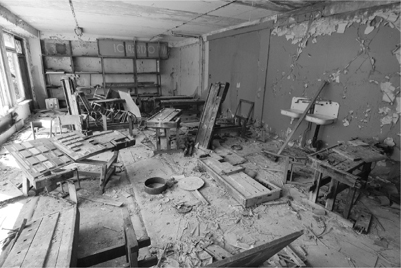
The Chernobyl nuclear disaster claimed two immediate victims and resulted in the evacuation of 135,000 people, including 50,000 from the nearby town of Pripyat. This abandoned classroom is in Pripyat
The reactor was of a design type called RBMK-1000 (Reaktor Bolshoy Moshchnosti Kanalniy; Russian:  ), which uses graphite as a moderator and water as a coolant. The water boils in the core at 290 degrees Celsius/ 554 degrees Fahrenheit. The design of the reactor leads it to be unstable at low power levels because of the design of its control rods and because the design has a positive void coefficient. The incident released 100 times the amount of radiation that was released from the atomic bombs that devastated Hiroshima and Nagasaki in 1945.
Cause of the Disaster
On the night that the accident occurred, the operating crew was ordered to perform tests to ascertain whether, in the event of a loss of external power, the spinning turbines could produce sufficient power to keep the coolant pumps running until the emergency diesel generator started up.
The safety systems of the reactor were switched off deliberately to prevent any interruption to the tests. The reactors’ design was such that in the event of a power failure, the reactor would SCRAM (control rods would be inserted into the reactor, which in turn would shut down). However, even when the control rods were fully inserted, the reactor still required cooling, as the fission products from reaction would continue to produce heat as they decayed—and this heat could in turn lead to damage of the reactor's core.
Aside from “human error” and “defective technology,” another area where the RBMK reactor came under heavy criticism is in the design of the interface between “people” and “machines.”
The design of the RBMK reactor has also come under heavy criticism. One notable feature of the reactor is that it has an unusually large “void reactivity coefficient;” this is a parameter that defines how the reactor will respond to the formation of steam bubbles in the water coolant. In many designs, as steam bubbles form, the reactor will produce less energy—this is because water is used to slow down fast neutrons, which are less likely to split atoms of uranium than slower neutrons. As water turns to steam, fewer neutrons are slowed, splitting fewer uranium atoms and releasing less energy. In the RBMK reactor design, graphite was used as a moderator to slow down neutrons, and light water, which absorbs neutrons, to cool the core. The bubbles of steam will not absorb neutrons as readily as water; therefore, as bubbles of steam form, the energy production and reactor temperature increases.
...
- City Organizations, Movements, and Planning
- Agenda 21
- Brownfields
- Carrying Capacity
- Charrette
- City Politics
- Civic Space
- Ecoindustrial Parks
- Environmental Impact Assessment
- Environmental Planning
- Green Communities and Neighborhood Planning
- Green Design, Construction and Operations
- Greenfield Sites
- Infrastructure
- Intermodal Transportation
- Millennium Development Goals
- Mitigation
- NIMBY
- Personal Rapid Transit
- Resilience
- Sustainability Indicators
- Sustainable Development
- Transit-Oriented Development
- Transportation Demand Management
- City Profiles
- Austin, Texas
- Bahía de Caráquez, Ecuador
- Bangkok, Thailand
- Barcelona, Spain
- Beijing, China
- Bogotá, Colombia
- Chattanooga, Tennessee
- Chernobyl, Ukraine
- Chicago, Illinois
- Copenhagen, Denmark
- Curitiba, Brazil
- Dongtan, China
- Dzerzhinsk, Russia
- Hamburg, Germany
- Kabwe, Zambia
- Kampala, Uganda
- La Oroya, Peru
- Linfen, China
- London, England
- Los Angeles, California
- Malmö, Sweden
- Mexico City, Mexico
- New York City, New York
- Norilsk, Russia
- Portland, Oregon
- Reykjavik, Iceland
- Rio de Janeiro, Brazil
- San Francisco, California
- Seattle, Washington
- Stockholm, Sweden
- Sukinda, India
- Sumgayit, Azerbaijan
- Sydney, Australia
- Tianying, China
- Vancouver, Canada
- Vapi, India
- Green City Challenges
- Adaptation, Climate Change
- Adaptive Reuse
- Air Quality
- Biodiversity
- Carbon Footprints
- Coastal Zone Management
- Combined Sewer Overflow
- Commuting
- Construction and Demolition Waste
- Denitrification
- Density
- Ecological Footprint
- Ecosystem Restoration
- Embodied Energy
- Energy Efficiency
- Environmental Justice
- Environmental Risk
- Food Deserts
- Food Security
- Garbage
- Greywater
- Gridlock
- Heat Island Effect
- Indoor Air Quality
- Landfills
- Light Pollution
- Natural Capital
- Nonpoint Source Pollution
- Ports
- Power Grids
- Recycling in Cities
- Sea Level Rise
- Stormwater Management
- Transit
- Waste Disposal
- Water Conservation
- Water Pollution
- Water Treatment
- Water, Sources and Delivery
- Watershed Protection
- Wetlands
- Green City Solutions
- Bicycling
- Biophilia
- Bioregion
- Bluebelts
- Bus Rapid Transit
- Carbon Neutral
- Carbon Trading
- Carpooling
- Cities for Climate Protection
- Citizen Participation
- Combined Heat and Power (Cogeneration)
- Community Gardens
- Compact Development (New Urbanism)
- Composting
- Congestion Pricing
- Conservation Subdivision
- Daylighting
- Distributed Generation
- District Energy
- Ecovillages
- Green Belt
- Green Energy
- Green Fleets (Vehicles)
- Green Housing
- Green Infrastructure
- Green Jobs
- Green Landscaping
- Green Procurement and Purchasing
- Green Roofs
- Greening Suburbia
- Greyfield Development
- Habitat Conservation and Restoration
- Healthy Cities
- Historic Preservation
- Infill Development
- LEED (Leadership in Energy and Environmental Design)
- Location-Efficient Mortgage
- Masdar Ecocity
- Mayors Climate Protection Agreement
- Parks, Greenways, and Open Space
- Renewable Energy
- Smart Growth
- Traffic Calming
- Universal Design
- Urban Agriculture
- Urban Forests
- Walkability (Pedestrian-Friendly Streets)
- Xeriscaping
- Loading...
Get a 30 day FREE TRIAL
-
 Watch videos from a variety of sources bringing classroom topics to life
 -
Read modern, diverse business cases
-
Explore hundreds of books and reference titles

Read next

More like this
Sage Recommends
We found other relevant content for you on other Sage platforms.
Have you created a personal profile? Login or create a profile so that you can save clips, playlists and searches