
Entry
Reader's guide
Entries A-Z
Subject index
Carpooling
Carpooling is the process of sharing private automobile trips, usually to and from work, and usually with fellow commuters. The term is also used to refer to parents’ sharing obligations for ferrying their own and other people's children to and from school and other activities. Adult carpool members may live in the same neighborhood or town, or may work for the same employer or employers in proximate locations, or both. The pool may alternate all members as drivers, or one or more drivers in the pool may be the only drivers, with the general understanding that drivers are to be compensated for their effort through reduction in the carpool fee arrangements. Carpools are flexible as to how costs are allocated, again based on prearranged agreements. Members may be picked up and dropped off at their homes or at specified collection points. Carpooling may be distinguished from vanpooling in that carpools use one or more private automobiles of the participants, whereas vanpools rely on a van made available strictly for that purpose by an employer or nonprofit transit agency.
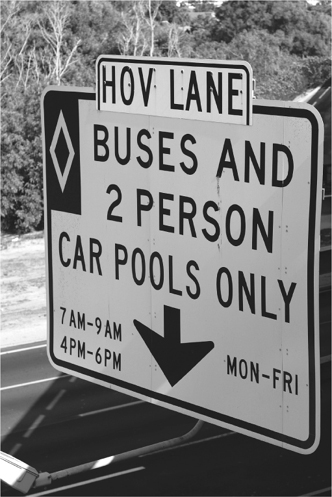
To attract carpoolers, some states dedicate a high-occupancy vehicle (HOV) lane on busy highways
Carpooling Benefits and Incentives
The benefits of carpooling are that it saves fuel (one vehicle with multiple occupants rather than multiple single-occupant vehicles) and reduces traffic congestion, thereby reducing commuter costs, reducing greenhouse gas emissions, and improving highway air quality. It also reduces stress and improves personal time management for members, as they can attend to other tasks (reading, napping, listening to music, chatting, or doing paperwork) during the ride. It reduces wear and tear on the member automobiles that are not being used for that day's commute, and may allow members an automobile insurance premium reduction congruent with the reduction in miles driven on their own automobiles.
Effective carpooling depends on a set of common expectations shared by the members of the pool. When guidelines for wait times, notifications for an absence from the commute, and even personal comfort factors (like the interior temperature of the vehicle, the types of music or radio stations preferred, and whether food and beverages may be brought into the vehicle) are discussed and agreed to in advance, the probability of an arrangement that is successful in the long-term is increased.
Carpools may be formed on an ad hoc basis when neighbors or coworkers decide to share rides on a regular basis. However, given the benefits noted above, others, including employers, state transportation agencies, and metropolitan governments, have also taken an interest in promoting and supporting carpooling through various means, both structural and operational. Structural means include construction of high-occupancy vehicle (HOV) lanes. Operational means include designation of existing lanes as HOV lanes restricted to carpools, vanpools, and buses; reductions in tolls or other forms of congestion pricing relief for carpools; technical assistance and financial support for organizing carpools; purchase of fleets of vans for vanpools; and public awareness campaigns to encourage shared commuting.
A common strategy to incentivize carpooling is the establishment of HOV lanes, and many metropolitan areas have such facilities. HOV facilities are restricted to vehicles carrying a minimum number of travelers, usually two, although the original restriction was often for a minimum of three travelers. A 2008 inventory by the Federal Highway Administration lists 345 HOV facilities in the United States, with the largest concentrations around the Twin Cities, San Francisco, Seattle–Tacoma, Los Angeles, and Houston. (It should be noted that each HOV segment is counted as a separate facility; a center city with highway approaches from the four cardinal directions might thus be counted as having four HOV facilities.) A variety of complicated pricing structures, dependent on time of day and number of occupants, are used in many regions to balance traffic flows between the HOV lanes and the main line.
...
- City Organizations, Movements, and Planning
- Agenda 21
- Brownfields
- Carrying Capacity
- Charrette
- City Politics
- Civic Space
- Ecoindustrial Parks
- Environmental Impact Assessment
- Environmental Planning
- Green Communities and Neighborhood Planning
- Green Design, Construction and Operations
- Greenfield Sites
- Infrastructure
- Intermodal Transportation
- Millennium Development Goals
- Mitigation
- NIMBY
- Personal Rapid Transit
- Resilience
- Sustainability Indicators
- Sustainable Development
- Transit-Oriented Development
- Transportation Demand Management
- City Profiles
- Austin, Texas
- Bahía de Caráquez, Ecuador
- Bangkok, Thailand
- Barcelona, Spain
- Beijing, China
- Bogotá, Colombia
- Chattanooga, Tennessee
- Chernobyl, Ukraine
- Chicago, Illinois
- Copenhagen, Denmark
- Curitiba, Brazil
- Dongtan, China
- Dzerzhinsk, Russia
- Hamburg, Germany
- Kabwe, Zambia
- Kampala, Uganda
- La Oroya, Peru
- Linfen, China
- London, England
- Los Angeles, California
- Malmö, Sweden
- Mexico City, Mexico
- New York City, New York
- Norilsk, Russia
- Portland, Oregon
- Reykjavik, Iceland
- Rio de Janeiro, Brazil
- San Francisco, California
- Seattle, Washington
- Stockholm, Sweden
- Sukinda, India
- Sumgayit, Azerbaijan
- Sydney, Australia
- Tianying, China
- Vancouver, Canada
- Vapi, India
- Green City Challenges
- Adaptation, Climate Change
- Adaptive Reuse
- Air Quality
- Biodiversity
- Carbon Footprints
- Coastal Zone Management
- Combined Sewer Overflow
- Commuting
- Construction and Demolition Waste
- Denitrification
- Density
- Ecological Footprint
- Ecosystem Restoration
- Embodied Energy
- Energy Efficiency
- Environmental Justice
- Environmental Risk
- Food Deserts
- Food Security
- Garbage
- Greywater
- Gridlock
- Heat Island Effect
- Indoor Air Quality
- Landfills
- Light Pollution
- Natural Capital
- Nonpoint Source Pollution
- Ports
- Power Grids
- Recycling in Cities
- Sea Level Rise
- Stormwater Management
- Transit
- Waste Disposal
- Water Conservation
- Water Pollution
- Water Treatment
- Water, Sources and Delivery
- Watershed Protection
- Wetlands
- Green City Solutions
- Bicycling
- Biophilia
- Bioregion
- Bluebelts
- Bus Rapid Transit
- Carbon Neutral
- Carbon Trading
- Carpooling
- Cities for Climate Protection
- Citizen Participation
- Combined Heat and Power (Cogeneration)
- Community Gardens
- Compact Development (New Urbanism)
- Composting
- Congestion Pricing
- Conservation Subdivision
- Daylighting
- Distributed Generation
- District Energy
- Ecovillages
- Green Belt
- Green Energy
- Green Fleets (Vehicles)
- Green Housing
- Green Infrastructure
- Green Jobs
- Green Landscaping
- Green Procurement and Purchasing
- Green Roofs
- Greening Suburbia
- Greyfield Development
- Habitat Conservation and Restoration
- Healthy Cities
- Historic Preservation
- Infill Development
- LEED (Leadership in Energy and Environmental Design)
- Location-Efficient Mortgage
- Masdar Ecocity
- Mayors Climate Protection Agreement
- Parks, Greenways, and Open Space
- Renewable Energy
- Smart Growth
- Traffic Calming
- Universal Design
- Urban Agriculture
- Urban Forests
- Walkability (Pedestrian-Friendly Streets)
- Xeriscaping
- Loading...
Get a 30 day FREE TRIAL
-
 Watch videos from a variety of sources bringing classroom topics to life
 -
Read modern, diverse business cases
-
Explore hundreds of books and reference titles

Read next

More like this
Sage Recommends
We found other relevant content for you on other Sage platforms.
Have you created a personal profile? Login or create a profile so that you can save clips, playlists and searches