
Entry
Reader's guide
Entries A-Z
Subject index
Bus Rapid Transit
Bus Rapid Transit (BRT) refers to the adaptation of rubber-tired road buses to serve rapid transit purposes within metropolitan areas. In many ways, the kind of transportation service offered by BRT systems is analogous to traditional rail rapid transit systems, such as metros (subways) or light rail, because they are designed to operate at higher frequencies and generally serve fewer stops, spaced farther apart from one another, than bus stops in a regular city bus service. The first comprehensive BRT system was implemented in Curitiba, Brazil, for its cost advantages and the operational flexibility it offered over rail systems. As a result of the success of the system in Curitiba, BRT has been growing in popularity around the globe, in both the developing and developed worlds, where cities are increasingly faced with limited resources for providing transportation services.
BRT systems, like this one in Eindhoven, the Netherlands, are designed to operate at higher frequencies, and generally have fewer stops spaced farther apart, compared to regular city bus service
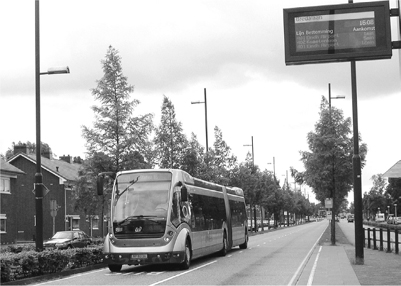
Similar to rail rapid transit systems, BRT is designed to transport larger numbers of riders over longer distances than traditional bus systems operating in mixed traffic. BRT systems incorporate design features meant to distinguish them from regular bus service, including some, if not all, of the following elements: the construction of permanent stations and stops that are an improvement over conventional bus stops, enhanced efficiency of passenger boarding and fare collection to speed up service, the use of traffic signal priority and intelligent transportation system technologies, and service that is branded separately from conventional bus service, often using distinctive bus designs and special labeling as a rapid transit service on transit maps. Often, but not always, BRT buses travel in a dedicated right of way that is separated from the city's public road network. This is done either by marking off a separate lane or, in more advanced circumstances, by constructing a unique roadway—often referred to colloquially as a “busway”—that is physically separated from city streets.
The Birth of BRT
BRT was pioneered in Curitiba, Brazil, in 1974. Similar to a metro system, passengers entered buses not at stops but from specially designed stations where fares were paid before entry. Buses traveled on an exclusive right of way in the median of the road and were specially designed to handle larger loads, with multiple wide doors and a floor that was the same height as that of the station. The design considerations of the buses and stations permitted riders to enter and exit buses much more quickly, and the dedicated right of way and later traffic signal prioritization allowed buses to travel considerably faster than they would on a conventional street. Although notable BRT systems such as Ottawa's Transitway, Los Angeles's Orange Line, Las Vegas's Max, Boston's Silver Line, Cleveland's Euclid Corridor, and Eugene's EmX Green Line have opened recently in North America, choosing a bus over a rail-based strategy for urban rapid transit has been especially popular in the developing world, particularly in Latin America, where BRT planning began. The TransMilenio network in Bogotá, Colombia, is widely cited as the most advanced example of successful BRT planning.
...
- City Organizations, Movements, and Planning
- Agenda 21
- Brownfields
- Carrying Capacity
- Charrette
- City Politics
- Civic Space
- Ecoindustrial Parks
- Environmental Impact Assessment
- Environmental Planning
- Green Communities and Neighborhood Planning
- Green Design, Construction and Operations
- Greenfield Sites
- Infrastructure
- Intermodal Transportation
- Millennium Development Goals
- Mitigation
- NIMBY
- Personal Rapid Transit
- Resilience
- Sustainability Indicators
- Sustainable Development
- Transit-Oriented Development
- Transportation Demand Management
- City Profiles
- Austin, Texas
- Bahía de Caráquez, Ecuador
- Bangkok, Thailand
- Barcelona, Spain
- Beijing, China
- Bogotá, Colombia
- Chattanooga, Tennessee
- Chernobyl, Ukraine
- Chicago, Illinois
- Copenhagen, Denmark
- Curitiba, Brazil
- Dongtan, China
- Dzerzhinsk, Russia
- Hamburg, Germany
- Kabwe, Zambia
- Kampala, Uganda
- La Oroya, Peru
- Linfen, China
- London, England
- Los Angeles, California
- Malmö, Sweden
- Mexico City, Mexico
- New York City, New York
- Norilsk, Russia
- Portland, Oregon
- Reykjavik, Iceland
- Rio de Janeiro, Brazil
- San Francisco, California
- Seattle, Washington
- Stockholm, Sweden
- Sukinda, India
- Sumgayit, Azerbaijan
- Sydney, Australia
- Tianying, China
- Vancouver, Canada
- Vapi, India
- Green City Challenges
- Adaptation, Climate Change
- Adaptive Reuse
- Air Quality
- Biodiversity
- Carbon Footprints
- Coastal Zone Management
- Combined Sewer Overflow
- Commuting
- Construction and Demolition Waste
- Denitrification
- Density
- Ecological Footprint
- Ecosystem Restoration
- Embodied Energy
- Energy Efficiency
- Environmental Justice
- Environmental Risk
- Food Deserts
- Food Security
- Garbage
- Greywater
- Gridlock
- Heat Island Effect
- Indoor Air Quality
- Landfills
- Light Pollution
- Natural Capital
- Nonpoint Source Pollution
- Ports
- Power Grids
- Recycling in Cities
- Sea Level Rise
- Stormwater Management
- Transit
- Waste Disposal
- Water Conservation
- Water Pollution
- Water Treatment
- Water, Sources and Delivery
- Watershed Protection
- Wetlands
- Green City Solutions
- Bicycling
- Biophilia
- Bioregion
- Bluebelts
- Bus Rapid Transit
- Carbon Neutral
- Carbon Trading
- Carpooling
- Cities for Climate Protection
- Citizen Participation
- Combined Heat and Power (Cogeneration)
- Community Gardens
- Compact Development (New Urbanism)
- Composting
- Congestion Pricing
- Conservation Subdivision
- Daylighting
- Distributed Generation
- District Energy
- Ecovillages
- Green Belt
- Green Energy
- Green Fleets (Vehicles)
- Green Housing
- Green Infrastructure
- Green Jobs
- Green Landscaping
- Green Procurement and Purchasing
- Green Roofs
- Greening Suburbia
- Greyfield Development
- Habitat Conservation and Restoration
- Healthy Cities
- Historic Preservation
- Infill Development
- LEED (Leadership in Energy and Environmental Design)
- Location-Efficient Mortgage
- Masdar Ecocity
- Mayors Climate Protection Agreement
- Parks, Greenways, and Open Space
- Renewable Energy
- Smart Growth
- Traffic Calming
- Universal Design
- Urban Agriculture
- Urban Forests
- Walkability (Pedestrian-Friendly Streets)
- Xeriscaping
- Loading...
Get a 30 day FREE TRIAL
-
 Watch videos from a variety of sources bringing classroom topics to life
 -
Read modern, diverse business cases
-
Explore hundreds of books and reference titles

Read next

More like this
Sage Recommends
We found other relevant content for you on other Sage platforms.
Have you created a personal profile? Login or create a profile so that you can save clips, playlists and searches