
Entry
Reader's guide
Entries A-Z
Subject index
Austin, Texas
Austin, the capital of Texas, is a city of almost 800,000 people, located in the central hill country of the state and home to a diverse group of citizens. It has the reputation of being a major American center of progressive culture and politics. Many of the unique attributes of Austin contribute to its reputation as a “green city” as well.
For example, Austin is home to the University of Texas, which alone adds a school-year population of over 50,000 students to the city. Austin also has a large and influential music scene, which causes a mass migration of hopeful rock stars. The combination of young high-tech workers, university students and professors, and a large artistic community makes Austin the most liberally minded city in the largely conservative state of Texas. Thus, it is no surprise that Austin would be a national vanguard of green living.
Austinites are known for their desire to “Keep Austin Weird.” This is a slogan that is plastered on bumper stickers and billboards throughout the city. It refers to the Austinites’ desire to promote small business and maintain the local charm of the “little blue island” in the middle of the politically conservative red Texas sea. This commitment to the city manifests itself in the high level of community involvement with environmental issues. Beginning in the 1970s, citizens became concerned with the state of their environment. During the 1970s and 1980s, many city ordinances were passed to protect Austin's rivers and lakes. One particular focus that continues to this day is the preservation and maintenance of Barton Springs, a green and blue oasis almost adjacent to downtown Austin.
Austin, the capital of Texas, is a major center of progressive culture and politics. Austin's citizens have been involved in environmental movements since the 1970s
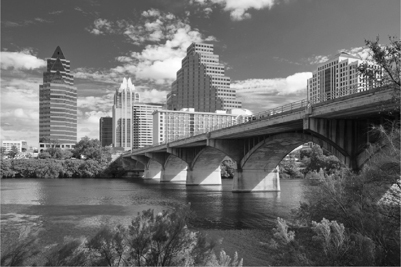
The government of the City of Austin has been integral in pursuing a sustainable, green city. Because of the liberal tendencies of many Austin citizens, the municipal government is expected to be active in promoting, and even mandating, green living. The city supports green living by promoting the use of renewable energy, enforcing green building codes, supporting efficient public and private transportation, advocating for watersheds, having a proactive stance toward climate change, and emphasizing green gardening. Over the 2009–2012 time span, the City of Austin has planned to complete the transition to renewable-energy power for all municipal facilities. Austin produces more wind power and biodiesel fuel than any city in the United States.
The city has mandated that by 2015, every new home in Austin have an optional solar power system in the building plans, which would result in rendering the house energy neutral. The city is already participating in sustainable building, having recently rebuilt the Austin City Hall with mostly recycled materials.
Austin also is widely known for its cost-effective metro bus system. Many university students use public transportation, rather than drive to school. The city planned to unveil its downtown rail system in mid-2009. Many areas of Austin are carefully designed for pedestrian traffic, and the city is renowned for being bicycle friendly. Bikes can be rented from any public library or from one of the many bike rental shops in the city. The Lance Armstrong Bicycle Highway is under construction, intended to add a number of bicycling paths throughout much of the greater Austin area.
...
- City Organizations, Movements, and Planning
- Agenda 21
- Brownfields
- Carrying Capacity
- Charrette
- City Politics
- Civic Space
- Ecoindustrial Parks
- Environmental Impact Assessment
- Environmental Planning
- Green Communities and Neighborhood Planning
- Green Design, Construction and Operations
- Greenfield Sites
- Infrastructure
- Intermodal Transportation
- Millennium Development Goals
- Mitigation
- NIMBY
- Personal Rapid Transit
- Resilience
- Sustainability Indicators
- Sustainable Development
- Transit-Oriented Development
- Transportation Demand Management
- City Profiles
- Austin, Texas
- Bahía de Caráquez, Ecuador
- Bangkok, Thailand
- Barcelona, Spain
- Beijing, China
- Bogotá, Colombia
- Chattanooga, Tennessee
- Chernobyl, Ukraine
- Chicago, Illinois
- Copenhagen, Denmark
- Curitiba, Brazil
- Dongtan, China
- Dzerzhinsk, Russia
- Hamburg, Germany
- Kabwe, Zambia
- Kampala, Uganda
- La Oroya, Peru
- Linfen, China
- London, England
- Los Angeles, California
- Malmö, Sweden
- Mexico City, Mexico
- New York City, New York
- Norilsk, Russia
- Portland, Oregon
- Reykjavik, Iceland
- Rio de Janeiro, Brazil
- San Francisco, California
- Seattle, Washington
- Stockholm, Sweden
- Sukinda, India
- Sumgayit, Azerbaijan
- Sydney, Australia
- Tianying, China
- Vancouver, Canada
- Vapi, India
- Green City Challenges
- Adaptation, Climate Change
- Adaptive Reuse
- Air Quality
- Biodiversity
- Carbon Footprints
- Coastal Zone Management
- Combined Sewer Overflow
- Commuting
- Construction and Demolition Waste
- Denitrification
- Density
- Ecological Footprint
- Ecosystem Restoration
- Embodied Energy
- Energy Efficiency
- Environmental Justice
- Environmental Risk
- Food Deserts
- Food Security
- Garbage
- Greywater
- Gridlock
- Heat Island Effect
- Indoor Air Quality
- Landfills
- Light Pollution
- Natural Capital
- Nonpoint Source Pollution
- Ports
- Power Grids
- Recycling in Cities
- Sea Level Rise
- Stormwater Management
- Transit
- Waste Disposal
- Water Conservation
- Water Pollution
- Water Treatment
- Water, Sources and Delivery
- Watershed Protection
- Wetlands
- Green City Solutions
- Bicycling
- Biophilia
- Bioregion
- Bluebelts
- Bus Rapid Transit
- Carbon Neutral
- Carbon Trading
- Carpooling
- Cities for Climate Protection
- Citizen Participation
- Combined Heat and Power (Cogeneration)
- Community Gardens
- Compact Development (New Urbanism)
- Composting
- Congestion Pricing
- Conservation Subdivision
- Daylighting
- Distributed Generation
- District Energy
- Ecovillages
- Green Belt
- Green Energy
- Green Fleets (Vehicles)
- Green Housing
- Green Infrastructure
- Green Jobs
- Green Landscaping
- Green Procurement and Purchasing
- Green Roofs
- Greening Suburbia
- Greyfield Development
- Habitat Conservation and Restoration
- Healthy Cities
- Historic Preservation
- Infill Development
- LEED (Leadership in Energy and Environmental Design)
- Location-Efficient Mortgage
- Masdar Ecocity
- Mayors Climate Protection Agreement
- Parks, Greenways, and Open Space
- Renewable Energy
- Smart Growth
- Traffic Calming
- Universal Design
- Urban Agriculture
- Urban Forests
- Walkability (Pedestrian-Friendly Streets)
- Xeriscaping
- Loading...
Get a 30 day FREE TRIAL
-
 Watch videos from a variety of sources bringing classroom topics to life
 -
Read modern, diverse business cases
-
Explore hundreds of books and reference titles

Read next

More like this
Sage Recommends
We found other relevant content for you on other Sage platforms.
Have you created a personal profile? Login or create a profile so that you can save clips, playlists and searches