
Entry
Reader's guide
Entries A-Z
Subject index
Air Quality
The standard composition of a well-mixed atmosphere is approximately 78 percent nitrogen, 21 percent oxygen, 0.93 percent argon, and 0.038 percent carbon dioxide, plus water vapor (spatially and temporally variable) and numerous trace constituents. Because of the negative impacts of poor air quality, such as acid precipitation or compromised human health, an understanding of both normal and disturbed atmospheric conditions is necessary. Air quality is an assessment of the state of the atmosphere that uses a combination of various characteristics describing the ambient atmosphere, including concentration of pollutants, visibility, turbidity, and thermal pollution. Air quality problems are often common to urbanized regions, where people engage in industrial activities, vehicular traffic is concentrated, and other conditions that deteriorate the ambient atmosphere exist. Efforts to mitigate compromised air quality range from international treaties and protocols to local regulations and ordinances.
Photochemical smog, most commonly associated with Los Angeles, is caused by the interaction of solar radiation with pollutants like nitrogen oxides, peroxyacytyl nitrate, and volatile organic compounds
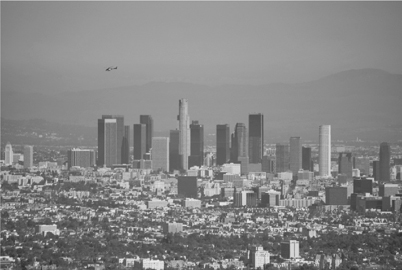
Pollutants that compromise the “clean” characteristics of the air may come from nonhuman or human (anthropogenic) sources. Nonhuman sources of pollutants include volcanic eruptions, which send ash and sulfurous gases into the atmosphere, diminishing local visibility and possibly contributing to cooling on a global scale. Lightning-caused forest fires create airborne particulates, or soot, and anaerobic decomposition in wetlands is a source of methane. Because there is little that can be done with respect to natural sources of air pollutants, efforts to restore and maintain air quality usually focus on reducing anthropogenic sources of pollution. Anthropogenic sources of air pollutants include particulate matter caused by combustion engines, chemicals released by industrial and agricultural processes, and the use of consumer products.
Components of Air Quality
Increasing the concentrations of pollutants compromises the integrity of the ambient air and causes human health problems. Sulfur dioxide, for example, affects the respiratory and circulatory systems of humans, with particularly sensitive populations (e.g., the elderly, asthmatics, children) suffering the most. Carbon monoxide can impair the transport of oxygen to the brain and other organs. Toxic chemicals in the air can cause a range of adverse health problems.
Another component of air quality is visibility, or the ability to view objects at a distance. Visibility is described as the farthest horizontal distance at which the unaided eye can view an object. Atmospheric substances can impair visibility, reducing the visual quality of the air. Particulates may reflect or scatter solar radiation, which decreases viewing ability. Smog, largely produced by coal combustion, as well as by industrial and vehicular emissions that interact with incoming sunlight, reduces visibility. Haze, another cause for diminished visibility, is also caused by air pollution.
Turbidity refers to a reduction in the cloud-free part of the atmosphere's ability to transmit light. It is a function of both atmospheric depth (measured in the vertical) and the components in the air. In the troposphere, turbidity is typically caused by anthropogenic activities and can be described by Beer's Law. Turbidity is both spatially and temporally variable. An urban megalopolis, for example, typically exhibits greater turbidity than a proximate rural locale, owing to the greater presence of aerosols, tropospheric ozone, and other factors. Turbidity is not to be confused with global dimming—a phenomenon describing the overall reduced amount of solar radiation striking the Earth's surface.
...
- City Organizations, Movements, and Planning
- Agenda 21
- Brownfields
- Carrying Capacity
- Charrette
- City Politics
- Civic Space
- Ecoindustrial Parks
- Environmental Impact Assessment
- Environmental Planning
- Green Communities and Neighborhood Planning
- Green Design, Construction and Operations
- Greenfield Sites
- Infrastructure
- Intermodal Transportation
- Millennium Development Goals
- Mitigation
- NIMBY
- Personal Rapid Transit
- Resilience
- Sustainability Indicators
- Sustainable Development
- Transit-Oriented Development
- Transportation Demand Management
- City Profiles
- Austin, Texas
- Bahía de Caráquez, Ecuador
- Bangkok, Thailand
- Barcelona, Spain
- Beijing, China
- Bogotá, Colombia
- Chattanooga, Tennessee
- Chernobyl, Ukraine
- Chicago, Illinois
- Copenhagen, Denmark
- Curitiba, Brazil
- Dongtan, China
- Dzerzhinsk, Russia
- Hamburg, Germany
- Kabwe, Zambia
- Kampala, Uganda
- La Oroya, Peru
- Linfen, China
- London, England
- Los Angeles, California
- Malmö, Sweden
- Mexico City, Mexico
- New York City, New York
- Norilsk, Russia
- Portland, Oregon
- Reykjavik, Iceland
- Rio de Janeiro, Brazil
- San Francisco, California
- Seattle, Washington
- Stockholm, Sweden
- Sukinda, India
- Sumgayit, Azerbaijan
- Sydney, Australia
- Tianying, China
- Vancouver, Canada
- Vapi, India
- Green City Challenges
- Adaptation, Climate Change
- Adaptive Reuse
- Air Quality
- Biodiversity
- Carbon Footprints
- Coastal Zone Management
- Combined Sewer Overflow
- Commuting
- Construction and Demolition Waste
- Denitrification
- Density
- Ecological Footprint
- Ecosystem Restoration
- Embodied Energy
- Energy Efficiency
- Environmental Justice
- Environmental Risk
- Food Deserts
- Food Security
- Garbage
- Greywater
- Gridlock
- Heat Island Effect
- Indoor Air Quality
- Landfills
- Light Pollution
- Natural Capital
- Nonpoint Source Pollution
- Ports
- Power Grids
- Recycling in Cities
- Sea Level Rise
- Stormwater Management
- Transit
- Waste Disposal
- Water Conservation
- Water Pollution
- Water Treatment
- Water, Sources and Delivery
- Watershed Protection
- Wetlands
- Green City Solutions
- Bicycling
- Biophilia
- Bioregion
- Bluebelts
- Bus Rapid Transit
- Carbon Neutral
- Carbon Trading
- Carpooling
- Cities for Climate Protection
- Citizen Participation
- Combined Heat and Power (Cogeneration)
- Community Gardens
- Compact Development (New Urbanism)
- Composting
- Congestion Pricing
- Conservation Subdivision
- Daylighting
- Distributed Generation
- District Energy
- Ecovillages
- Green Belt
- Green Energy
- Green Fleets (Vehicles)
- Green Housing
- Green Infrastructure
- Green Jobs
- Green Landscaping
- Green Procurement and Purchasing
- Green Roofs
- Greening Suburbia
- Greyfield Development
- Habitat Conservation and Restoration
- Healthy Cities
- Historic Preservation
- Infill Development
- LEED (Leadership in Energy and Environmental Design)
- Location-Efficient Mortgage
- Masdar Ecocity
- Mayors Climate Protection Agreement
- Parks, Greenways, and Open Space
- Renewable Energy
- Smart Growth
- Traffic Calming
- Universal Design
- Urban Agriculture
- Urban Forests
- Walkability (Pedestrian-Friendly Streets)
- Xeriscaping
- Loading...
Get a 30 day FREE TRIAL
-
 Watch videos from a variety of sources bringing classroom topics to life
 -
Read modern, diverse business cases
-
Explore hundreds of books and reference titles

Read next

More like this
Sage Recommends
We found other relevant content for you on other Sage platforms.
Have you created a personal profile? Login or create a profile so that you can save clips, playlists and searches