
Entry
Reader's guide
Entries A-Z
Subject index
Upcycle
In modern industrial economies, the materials that go into the production, transportation, and consumption of goods are commonly either put into landfills, burned, or recycled. In each case, the material—often based on nonrenewable resources—is either wasted, or its use is downgraded (as in document paper recycled as toilet paper or tires used as playground swings, also referred to as downcycling). Upcycling denotes the concept of converting used materials at the end of their original life cycle and turning them into new materials or products of either equal or higher quality (such as creating automobile dashboards from recycled plastic bottles, furniture from discarded wood, or wallets from old tires).
The term upcycling was popularized in the United States by William McDonough and Michael Braungart in their book Cradle to Cradle: Remaking the Way We Make Things. In addition to making better use of resources and materials, the book shows that upcycling could also significantly reduce the consumption of nonrenewable raw materials, and, in the production process, result in a reduction of energy use, pollution, and greenhouse gas emissions. As such, upcycling is generally a reinvestment in the environment. “Upcycling is the practice of taking something that is disposable or downcycled and transforming it into something of greater use and value.” By contrast, downcycling is the recycling of a material into a material of lesser quality or reuse of a product with crippled functionality for alternative purposes.
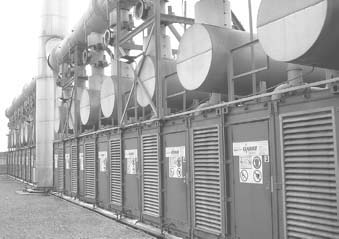
This GE Jenbacher landfill gas engine runs on the offgas produced by landfills, such as methane, carbon dioxide, and nitrogen. Upcycling takes something disposable (material from a landfill) and transforms it into something of greater value (energy)
Using historical sketches on the roots of the industrial revolution and commentary on science, nature, and society, McDonough and Braungart assert that an industrial system can become a creator of goods and services that generate ecological, social, and economic value. Their vision is based on a system of “life cycle development” initiated by Braungart. The idea is that there is nothing inherently wrong with being “wasteful,” as long as the products are completely returned to nature, or are completely reborn as new products. For example, each year a cherry tree dumps a great pile of fruit and leaves on the ground to rot. All of this waste goes back into nature to be reborn as new trees, bacteria, birds, and other parts of the natural ecosystem. According to the authors, humans should try to emulate this natural system instead of trying to do more with less.
The concepts proposed by Braungart and McDonough led to the cradle-to-cradle (C2C) model, where all materials used in industrial or commercial processes—such as metals, fibers, dyes—are seen to fall into one of two categories: “technical” or “biological” nutrients. Technical nutrients are strictly limited to nontoxic, nonharmful synthetic materials that have no negative effects on the natural environment; they can be used in continuous cycles as the same product without losing their integrity or quality. In this manner these materials can be used over and over again instead of being “downcycled” into lesser products, ultimately becoming waste. Biological nutrients are organic materials that, once used, can be disposed of in any natural environment and decompose into the soil, providing food for small life forms without affecting the natural environment.
...
- Business Organizations, Movements, and Planning
- Balanced Scorecard
- Best Available Control Technology
- Best Management Practices
- Ceres Principles
- Certification
- Closed-Loop Supply Chain
- Compliance
- Core Competencies
- Corporate Social Responsibility
- Cost-Benefit Analysis
- Demand-Side Management
- Discounting
- Dow Jones Sustainability Index
- Ecoeffectiveness
- Ecoefficiency
- Ecoindustrial Park
- Ecological Economics
- Economic Value Added
- Emissions Trading
- Energy Performance Contracting
- Energy Service Company
- Environmental Accounting
- Environmental Assessment
- Environmental Audit
- Environmental Economics
- Environmental Impact Statement
- Environmental Indicators
- Environmental Management System
- Environmental Marketing
- Environmental Risk Assessment
- Environmental Services
- Environmentally Preferable Purchasing
- Equator Principles
- Extended Producer Responsibility
- Extended Product Responsibility
- Externalities
- Factor Four and Factor Ten
- Fair Trade
- Genuine Progress Indicator
- Global Reporting Initiative
- Global Sullivan Principles
- Industrial Ecology
- Industrial Metabolism
- Industrial Nutrients
- Informational Regulation
- Integrated Bottom Line
- International Organization for Standardization
- ISO 14000
- ISO 19011
- Leadership in Green Business
- Life Cycle Analysis
- Material Input per Service Unit (MIPS)
- Maximum Achievable Control Technology
- National Priorities List
- Natural Capital
- New Source Review
- Quantitative Risk Assessment
- Recycling, Business of
- Reverse Logistics
- Service Design
- Social Return on Investment
- Steady State Economy
- Stewardship
- Supply Chain Management
- Value Chain
- Business Profiles
- Green Business Challenges
- Green Business Solutions
- Abatement
- Appropriate Technology
- Bio-Based Material
- Biofuels
- Biological Resource Management
- Biomimicry
- Bioremediation
- Biotechnology
- Blended Value
- Brownfield Redevelopment
- Carbon Neutral
- Carbon Sequestration
- Carbon Trading
- Cause-Related Marketing
- Clean Fuels
- Clean Production
- Clean Technology
- Cogeneration
- Conservation
- Coopetition
- Cradle-to-Cradle
- Deposit Systems
- Distributed Energy
- Ecolabels
- Ecosystem Services
- Ecotourism
- Environmental Justice
- Green Building
- Green Chemistry
- Green Design
- Green Retailing
- Green Technology
- Green-Collar Jobs
- Gross National Happiness
- Integrated Pest Management
- Organic
- Pollution Offsets
- Pollution Prevention
- Precautionary Principle
- Remanufacturing
- Resource Management
- Responsible Sourcing
- Restoration
- Right to Know
- Seventh Generation
- Six Sigma
- Smart Energy
- Social Entrepreneurship
- Social Marketing
- Socially Responsible Investing
- Superfund
- Sustainability
- Sustainable Design
- Sustainable Development
- Systems Thinking
- Take Back
- Upcycle
- Voluntary Standards
- Waste Reduction
- Loading...
Get a 30 day FREE TRIAL
-
 Watch videos from a variety of sources bringing classroom topics to life
 -
Read modern, diverse business cases
-
Explore hundreds of books and reference titles

Read next

More like this
Sage Recommends
We found other relevant content for you on other Sage platforms.
Have you created a personal profile? Login or create a profile so that you can save clips, playlists and searches