
Entry
Reader's guide
Entries A-Z
Subject index
Superfund
Superfund is the popular name for the Comprehensive Environmental Response, Compensation, and Liability Act (CERCLA). CERCLA, passed by Congress in 1980, was aimed at cleaning up the nation's hazardous waste sites. The timing of the legislation was largely in response to media coverage about the troubles of citizens of New York dealing with hazardous waste cleanup at a site known as the Love Canal. As part of CERCLA, Congress created a special fund to cover the cost of hazardous waste cleanup known as the Superfund.
In 1978, residents of the United States became aware of the struggle of residents in the area of Niagara, New York, living close to and on top of a hazardous waste dumpsite. Residents maintained that they were being exposed to dangerous chemicals that caused cancer, miscarriages, and birth defects. The New York Health Commissioner ordered a cleanup of the area. The commissioner did not want to declare the area as uninhabitable, which angered citizens, as they demanded to be relocated. Part of the dispute had to do with who should pay to relocate families and to clean up the area. Although the city owned much of the land, it had previously been owned by a private chemical company. Moreover, city, state, and local governments could not agree on who should be responsible for the cleanup costs. The New York Times eventually picked up the story, which gave it national attention. Eventually, all of the residents were relocated, and the state government borrowed the money from the federal government for relocation and cleanup.
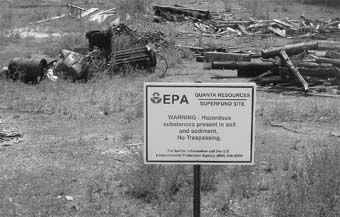
This Quanta Resources superfund site is located in Edgewater, New Jersey
The Love Canal case brought the issue of toxic waste sites to the foreground of the U.S. policy-making agenda. The site in New York was only one of thousands of potential hazardous waste sites across the nation. Congress quickly realized that, due to the high cost of cleanup, many citizens could be exposed to hazardous wastes. Congress passed CERCLA to address the cost of cleanup. Superfund was financed by a tax charged to chemical and petroleum companies. CERCLA also increased federal government authority to respond directly to the need for cleanup of hazardous waste sites that endangered public health or the environment. Over the first five years, $1.6 billion was collected and put into the Superfund for cleaning up abandoned hazardous waste sites.
The money allocated to the Superfund was only to be drawn on in cases in which the polluter could not be directly indentified. A provision of CERCLA encompassed the “polluters pay” principle, which required companies responsible for hazardous waste pollution to pay for its cleanup. One of the most controversial aspects of the CERCLA was that polluters were responsible to pay for cleanup even if they no longer owned the site. CERCLA also created rules and requirements for closed or abandoned hazardous waste sites.
In order for a site to become eligible for Superfund money, it was required to go through a verification process called the Hazardous Ranking System (HRS). The HRS is a method to score individual sites based on their danger to the surrounding community. It uses a method of assigning numerical values to various factors that are related to specific conditions at a given site. The factors are grouped into categories including the likelihood that a site had released hazardous waste or toxins into the environment, the specific characteristics of the waste, and the proximity of people or easily upset ecosystems. There are four different paths for this waste to be scored in relation to how the toxins may be spread and these include groundwater, surface water, and air migrations, as well as exposure to soil.
...
- Business Organizations, Movements, and Planning
- Balanced Scorecard
- Best Available Control Technology
- Best Management Practices
- Ceres Principles
- Certification
- Closed-Loop Supply Chain
- Compliance
- Core Competencies
- Corporate Social Responsibility
- Cost-Benefit Analysis
- Demand-Side Management
- Discounting
- Dow Jones Sustainability Index
- Ecoeffectiveness
- Ecoefficiency
- Ecoindustrial Park
- Ecological Economics
- Economic Value Added
- Emissions Trading
- Energy Performance Contracting
- Energy Service Company
- Environmental Accounting
- Environmental Assessment
- Environmental Audit
- Environmental Economics
- Environmental Impact Statement
- Environmental Indicators
- Environmental Management System
- Environmental Marketing
- Environmental Risk Assessment
- Environmental Services
- Environmentally Preferable Purchasing
- Equator Principles
- Extended Producer Responsibility
- Extended Product Responsibility
- Externalities
- Factor Four and Factor Ten
- Fair Trade
- Genuine Progress Indicator
- Global Reporting Initiative
- Global Sullivan Principles
- Industrial Ecology
- Industrial Metabolism
- Industrial Nutrients
- Informational Regulation
- Integrated Bottom Line
- International Organization for Standardization
- ISO 14000
- ISO 19011
- Leadership in Green Business
- Life Cycle Analysis
- Material Input per Service Unit (MIPS)
- Maximum Achievable Control Technology
- National Priorities List
- Natural Capital
- New Source Review
- Quantitative Risk Assessment
- Recycling, Business of
- Reverse Logistics
- Service Design
- Social Return on Investment
- Steady State Economy
- Stewardship
- Supply Chain Management
- Value Chain
- Business Profiles
- Green Business Challenges
- Green Business Solutions
- Abatement
- Appropriate Technology
- Bio-Based Material
- Biofuels
- Biological Resource Management
- Biomimicry
- Bioremediation
- Biotechnology
- Blended Value
- Brownfield Redevelopment
- Carbon Neutral
- Carbon Sequestration
- Carbon Trading
- Cause-Related Marketing
- Clean Fuels
- Clean Production
- Clean Technology
- Cogeneration
- Conservation
- Coopetition
- Cradle-to-Cradle
- Deposit Systems
- Distributed Energy
- Ecolabels
- Ecosystem Services
- Ecotourism
- Environmental Justice
- Green Building
- Green Chemistry
- Green Design
- Green Retailing
- Green Technology
- Green-Collar Jobs
- Gross National Happiness
- Integrated Pest Management
- Organic
- Pollution Offsets
- Pollution Prevention
- Precautionary Principle
- Remanufacturing
- Resource Management
- Responsible Sourcing
- Restoration
- Right to Know
- Seventh Generation
- Six Sigma
- Smart Energy
- Social Entrepreneurship
- Social Marketing
- Socially Responsible Investing
- Superfund
- Sustainability
- Sustainable Design
- Sustainable Development
- Systems Thinking
- Take Back
- Upcycle
- Voluntary Standards
- Waste Reduction
- Loading...
Get a 30 day FREE TRIAL
-
 Watch videos from a variety of sources bringing classroom topics to life
 -
Read modern, diverse business cases
-
Explore hundreds of books and reference titles

Read next

More like this
Sage Recommends
We found other relevant content for you on other Sage platforms.
Have you created a personal profile? Login or create a profile so that you can save clips, playlists and searches